The Entombment of Christ (1817)
Original title: The Entombment of Christ
kurzbeschreibung
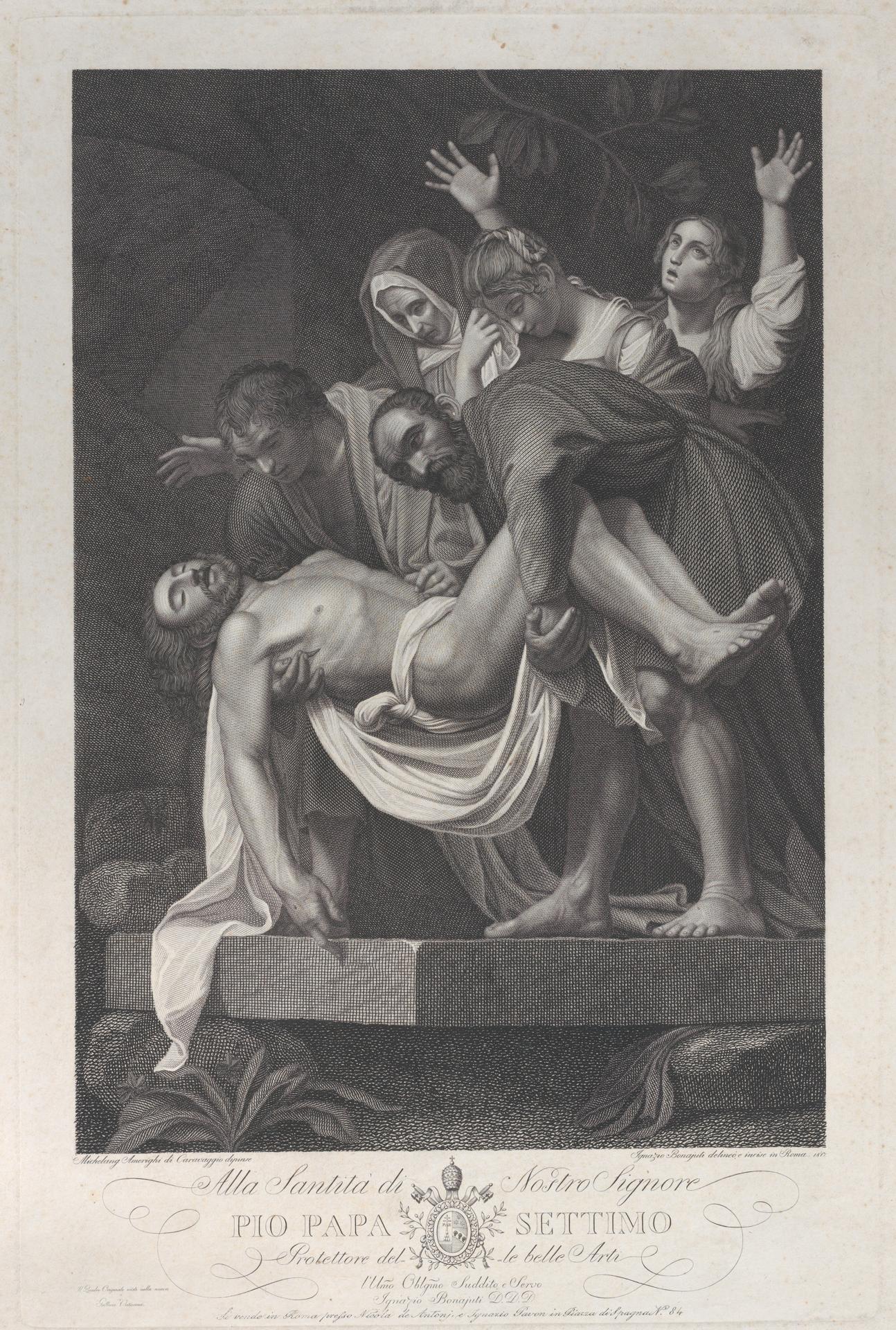
Ignazio Bonajuti produced this engraving in 1817, taking the Entombment of Christ as its subject. Before us lies the biblical lamentation over the body taken down from the cross, with a crowd of mourners gathered around it. The sheet is executed as a carefully shaded copper engraving with fine line work.
Description
The layout is symmetrical: at the center the dead Christ rests on a platform, his arms stretched upward. One figure holds or supports the body, while further figures to the left and right express grief and despair. Dark gray tones, almost Gothic in feel, dominate the sheet; subdued light heightens the seriousness of the event. Clear contours and precisely placed shadows define the classicist bearing of the figures.
Context
This print was made around 1817, when classicism was the leading style in Italy. Bonajuti, an Italian engraver, frequently took up religious subjects and reproduced them as prints. The Entombment is among the most frequently treated scenes in Christian iconography. The work survives as a single sheet, now held by the Metropolitan Museum of Art.
Impact
Solemn and almost devotional in effect, the print draws on its somber mood and symmetrical arrangement. The restrained lighting and expressive gestures of those present make deep grief palpable and draw the viewer into the event. The style is strictly classicist, yet the emotional force of the scene is not lost.
Technique
As a copper engraving, the image relies on a technique in which lines are incised into a copper plate and then printed. Finely graded shading yields a high level of detail with soft tonal transitions. Varying densities of hatched lines produce the different gray values.
AI-generated description text
Source: Metropolitan Museum of Art · Public Domain (CC0 1.0)