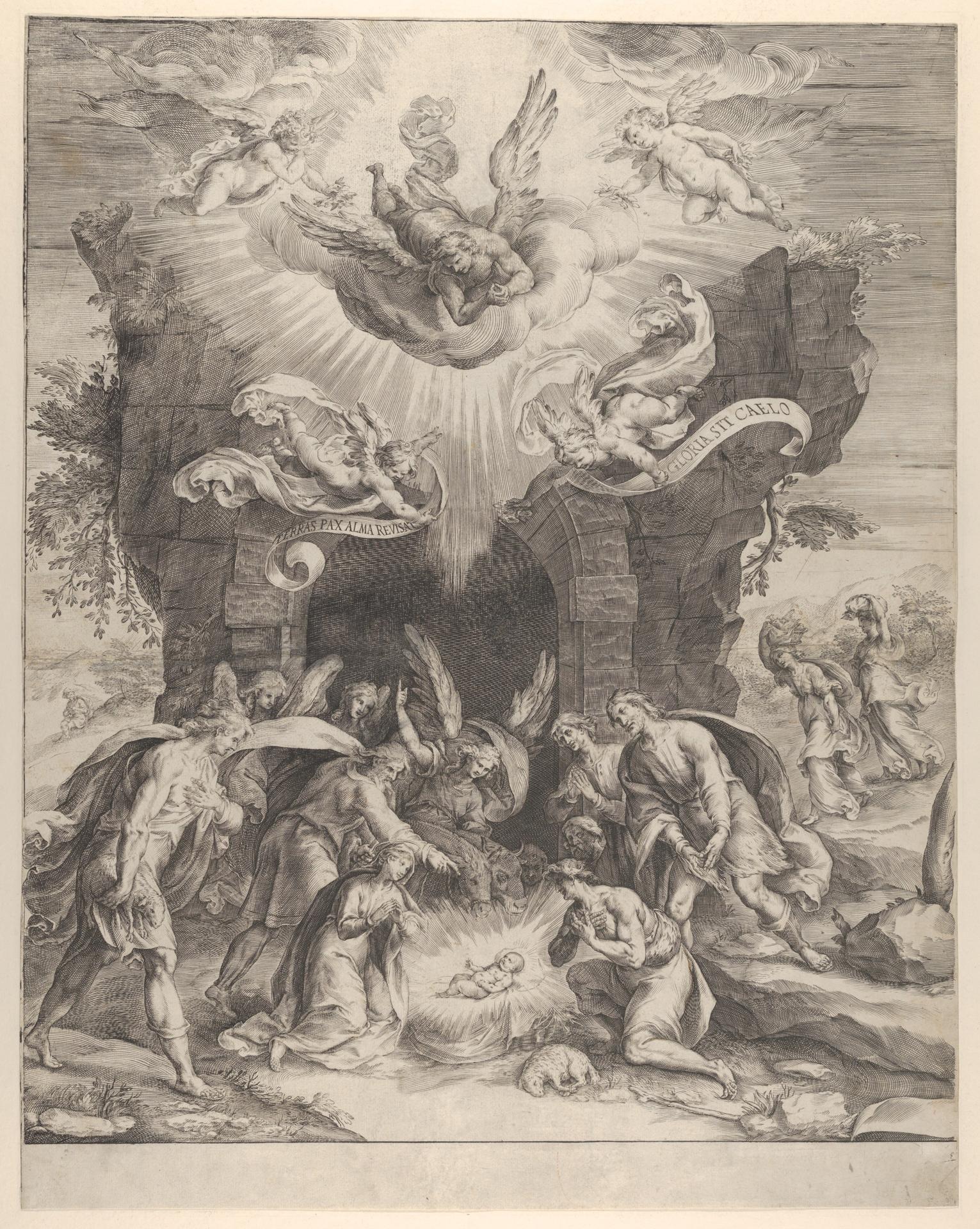
The Adoration of the Shepherds with the Christ Child at Center and Angels Above
Original title: The Adoration of the Shepherds with the Christ Child at center and angels above
kurzbeschreibung
Cherubino Alberti, also known as Zaccaria Mattia, made this engraving between about 1570 and 1600. It depicts the Adoration of the Shepherds, with the Christ Child at the center and angels above. What survives is a proof before letters, sheet size 59 by 46.7 cm.
Description
The Christ Child lies at the center of the image, surrounded by shepherds in Renaissance garments. Angels hover above them, some with wings spread wide. Rocks and trees close off the background, forming a natural landscape. Light falls from above, highlighting both the angels and the figures in the foreground. The whole is kept monochrome in shades of gray, with densely set lines and worked-out shadows.
Context
Alberti, a mannerist engraver and painter, worked in Rome and Florence. His engraving dates from 1570 to 1600, a period of active church art production after the Council of Trent. In the Counter-Reformation, the Adoration of the Shepherds was valued because it emphasizes the Incarnation of Christ. The existence of a proof before letters points to an early state of the print.
Impact
Calm and devotion emanate from the layout, which makes the child the center and orders the figures symmetrically. The mood is solemn thanks to the light falling from above and directing the gaze to the main figure. The precisely drawn lines and the shadows give the sheet an almost sculptural quality.
Technique
The drawing was etched into a metal plate, so the process is intaglio. The present impression was made before letters or inscriptions were added. Gradations in gray result from the varying density of lines and hatching.
AI-generated description text
Source: Metropolitan Museum of Art · Public Domain (CC0 1.0)