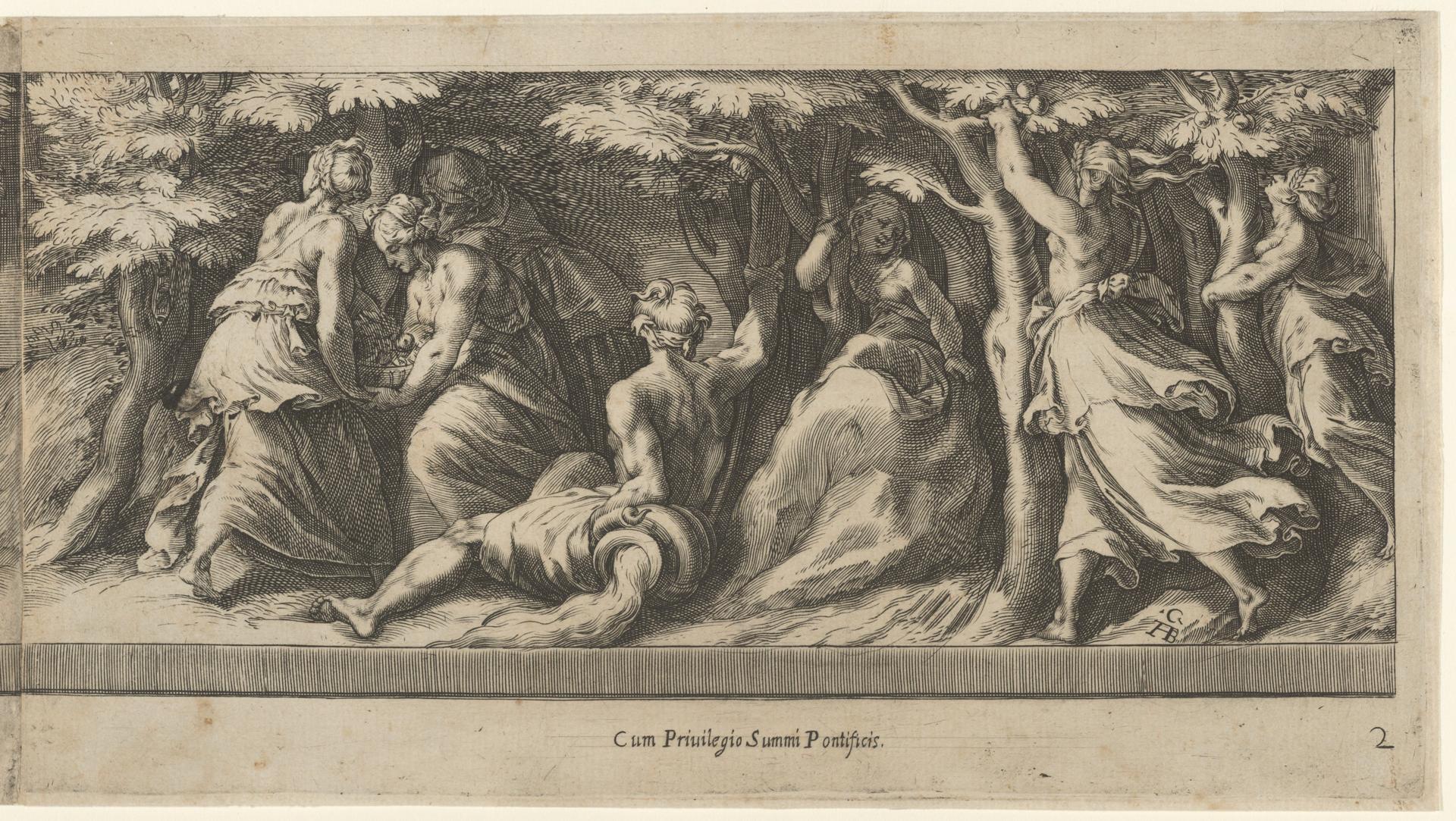
The Taking of the Golden Apples, from Perseus and the Golden Apples
Original title: The taking of the Golden Apples, from Perseus and the Golden Apples
kurzbeschreibung
Cherubino Alberti (Zaccaria Mattia) made this engraving, The Taking of the Golden Apples, between 1570 and 1615. It brings to life an episode from the Perseus legend, showing a group of figures in a woodland setting connected to the golden apples of the Hesperides.
Description
At first the eye is drawn to the wide, spread-out arrangement: several women and men stand in various poses in the foreground of a forest. Some wear ordinary garments, others are barefoot and plainly dressed; some turn toward each other, while others remain apart. Trees and plants frame the action, and the figures are placed in the middle of the image. Light falls evenly, without strong shadows or highlights, and the detailed lines and hatching stand out clearly on the figures and their surroundings.
Context
Cherubino Alberti, an Italian engraver and painter of the late Renaissance, became known for reproductive prints after works by major artists. This sheet dates from his most productive period, when he published numerous mythological and biblical subjects. The motif of the golden apples comes from Greek mythology, where they play an important role in the Perseus saga as part of the Gardens of the Hesperides. Alberti's engraving was likely made as part of a larger Perseus series for collectors and art lovers.
Impact
A calm, balanced mood greets the viewer, who can follow the fine linear work and classical storytelling of the print. The even distribution of light and the detailed rendering of the figures create a clear, almost contemplative atmosphere that invites close looking.
Technique
For this engraving, lines were incised into a copper plate and then printed on paper. Alberti used fine parallel hatching and cross-hatching to create shading and volume, as was typical of Renaissance printmaking. The precise linework allows for high detail in the figures and the forest setting.
AI-generated description text
Source: Metropolitan Museum of Art · Public Domain (CC0 1.0)