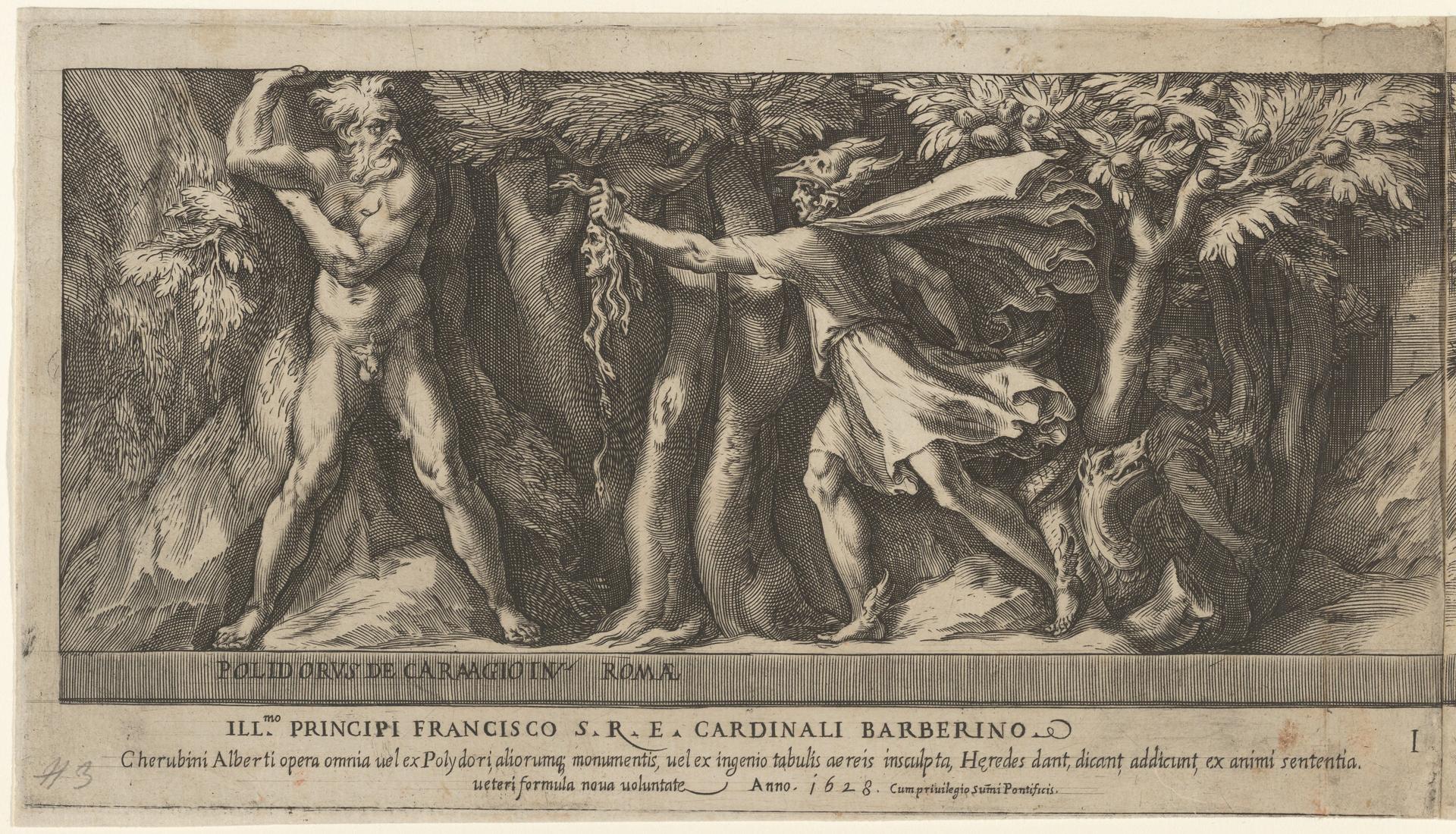
Perseus changing Atlas into a mountan with the head of Medusa, from Perseus and the Golden Apples
Original title: Perseus changing Atlas into a mountan with the head of Medusa, from Perseus and the Golden Apples
kurzbeschreibung
Between 1570 and 1615, Cherubino Alberti (Zaccaria Mattia) made this print: Perseus thrusts the severed head of Medusa at Atlas, who turns to stone. The artist took up a Greek myth and rendered it as a finely worked etching in the spirit of the Renaissance.
Description
Perseus is shown holding a figure—likely Atlas—against a tree and presenting the head of Medusa with its snake hair. The beleaguered Atlas carries a load on his back, stands upright, and himself holds the Medusa head in his hands. Trees and rocks frame the pictorial space, giving the arrangement a symmetrical border. Black and white with graded gray tones that arise from the depth of the etching; the lines are clearly drawn and rich in detail, as was typical of the Renaissance.
Context
Cherubino Alberti (1553–1615), an Italian engraver and painter of the late Renaissance, became known above all for reproductive engravings after works by other great artists. This print belongs to a series reproducing scenes from Ovid's Metamorphoses and treats the episode of Perseus and the golden apples. Alberti worked in Rome and Florence and produced numerous prints with mythological and biblical subjects. The work reflects the contemporary interest in ancient mythology and its moral interpretation.
Impact
Clearly drawn, precise lines render figures and landscape with many details. The symmetrical layout and strongly graded gray tones bring out the contrast between Perseus and Atlas. Viewers are drawn into the mythological action through the carefully worked details.
Technique
In etching, the engraver scratches the drawing into a metal plate, which is then treated with acid; this produces fine lines and shading. Alberti used copperplate engraving to achieve a precise and detailed reproduction. The prints were pulled in black and white on paper, with the varying depth of the lines creating different gray tones.
AI-generated description text
Source: Metropolitan Museum of Art · Public Domain (CC0 1.0)