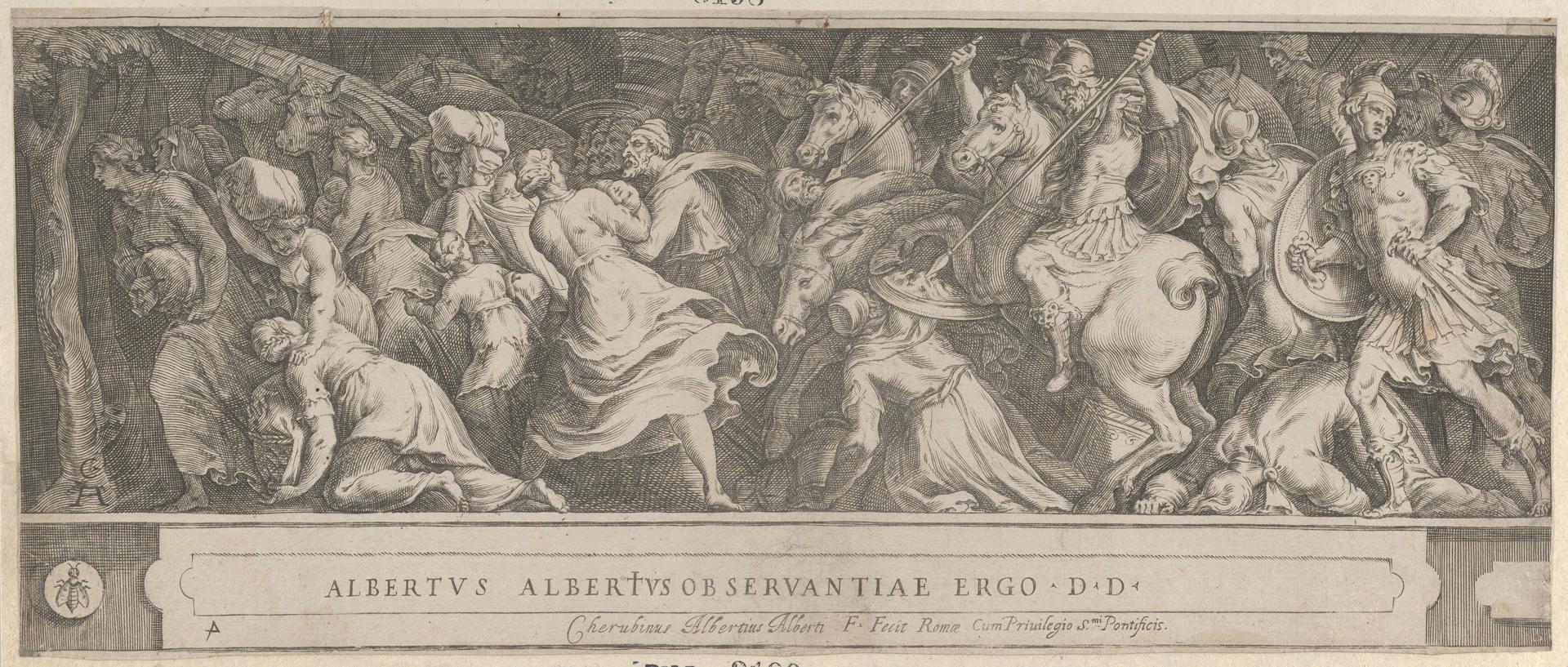
The Triumph of Two Roman Emperors (left-hand side)
Original title: The Triumph of Two Roman Emperors (left-hand side) with soldiers on horseback and men, women, and children fleeing
kurzbeschreibung
Two Roman emperors ride in splendor on richly adorned horses, flanked by mounted soldiers, while men, women and children flee in the distance. Cherubino Alberti (Zaccaria Mattia) engraved this triumphal scene between 1570 and 1615. The sheet belongs to a series and measures 16.3 × 39 cm.
Description
Both emperors wear traditional Roman dress and helmets, seated on horses whose trappings are heavy with ornament. Around them gather armed riders, their mounts shifting restlessly. Barefoot men, women and children hurry away in plain clothes, and their panic gives the whole print its uneasy pulse. The arrangement pulls the eye toward the rulers and fixes their importance there. Evenly balanced grays draw out contours and small details alike.
Context
Cherubino Alberti, a late-Renaissance Italian engraver and painter, became best known for reproductive prints after other artists' work. This sheet comes from a series of triumphal processions of Roman emperors, a favorite sixteenth-century subject that glorified antiquity. Just how it was made is not recorded; such engravings often served to spread classical imagery and to display technical skill.
Impact
Restless horses and fleeing figures give the image a dramatic, unsettled atmosphere. Crisp contours and densely worked detail feel precise and storytelling, drawing the viewer almost bodily into the action.
Technique
For this engraving, lines were cut into a copper plate and then printed onto paper. The method allows delicate shading and sharp particulars, visible in the draperies and faces. Its monochrome range of grays is characteristic of the process.
AI-generated description text
Source: Metropolitan Museum of Art · Public Domain (CC0 1.0)