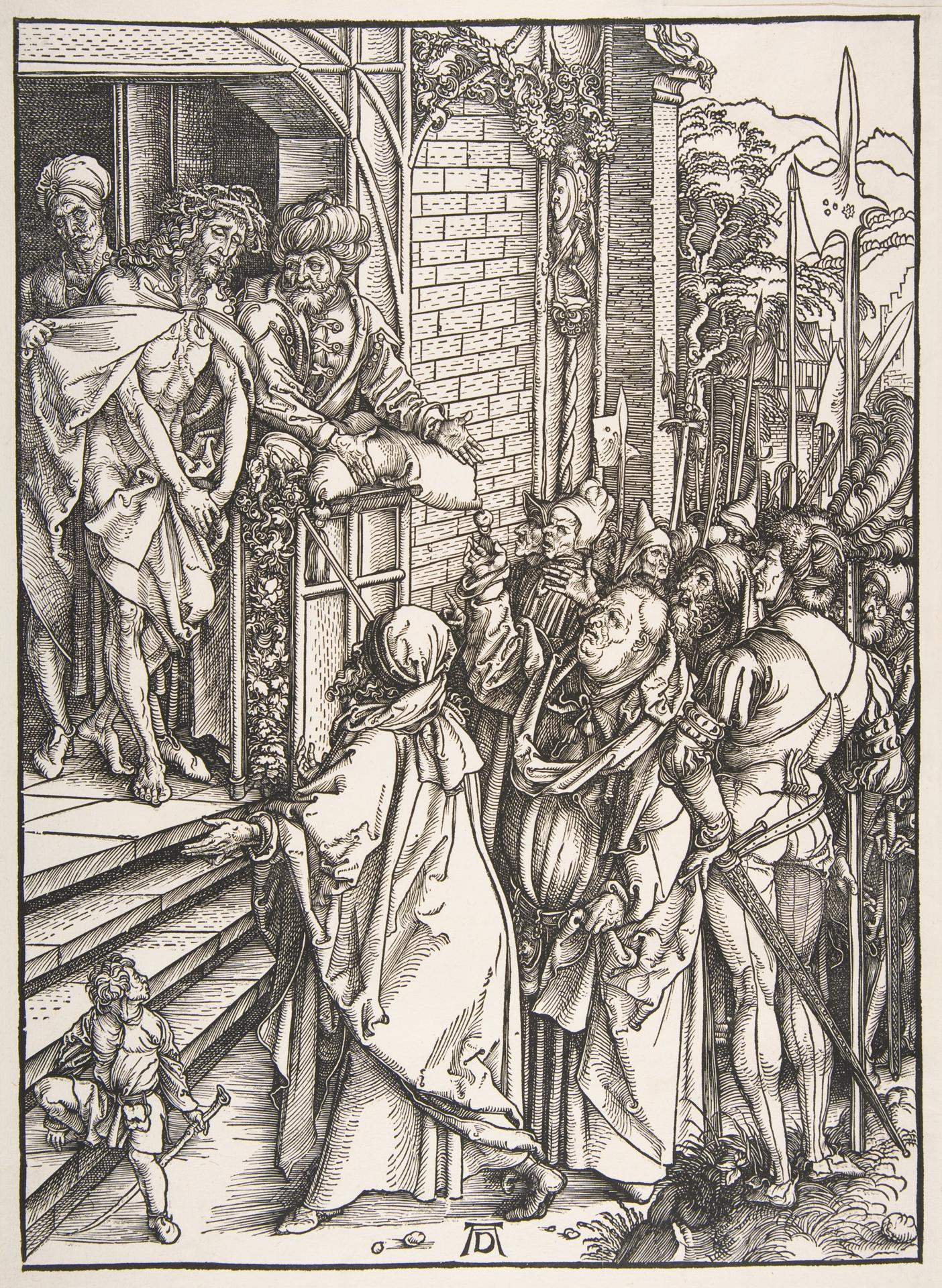
Ecce Homo
Original title: Ecce Homo, from the series The Large Passion
kurzbeschreibung
This woodcut by Albrecht Dürer, created around 1498–99, depicts the Ecce Homo scene from his series 'The Large Passion.' It shows Christ presented to the crowd by Pontius Pilate, surrounded by soldiers and onlookers. The work is a masterful example of early German printmaking.
Description
The composition centers on a figure identified as Ecce Homo, standing barefoot in a doorway, wearing a long robe held by another figure. Two men flank the doorway, while soldiers with weapons and other figures fill the scene, some wearing head coverings. The background includes trees and part of a building, adding depth. The faces are rendered with careful detail, and the overall arrangement is symmetrical, with the central figure anchoring the scene.
Context
Dürer created 'The Large Passion' as a series of woodcuts illustrating the Passion of Christ, published as a book in 1511. This particular print dates to his early career, around 1498–99, when he was establishing himself in Nuremberg. The series reflects the late medieval tradition of devotional imagery, but Dürer's innovative use of perspective and emotional expression set it apart. The woodcut was likely intended for a wide audience, as prints were relatively affordable and portable.
Impact
The stark black-and-white contrast and intricate linework give the scene a dramatic, almost theatrical quality. The central figure's calm demeanor contrasts with the surrounding crowd, drawing the viewer's eye and evoking a sense of solemnity. The detailed faces and gestures invite close inspection, making the print both visually engaging and emotionally resonant.
Technique
This work is a woodcut, a relief printing technique where the image is carved into a wooden block, inked, and pressed onto paper. Dürer used fine, precise lines to create shading and texture, a skill that became a hallmark of his printmaking. The absence of color focuses attention on the interplay of light and shadow achieved through the density of lines.
AI-generated description text
Source: Metropolitan Museum of Art · Public domain (CC0)