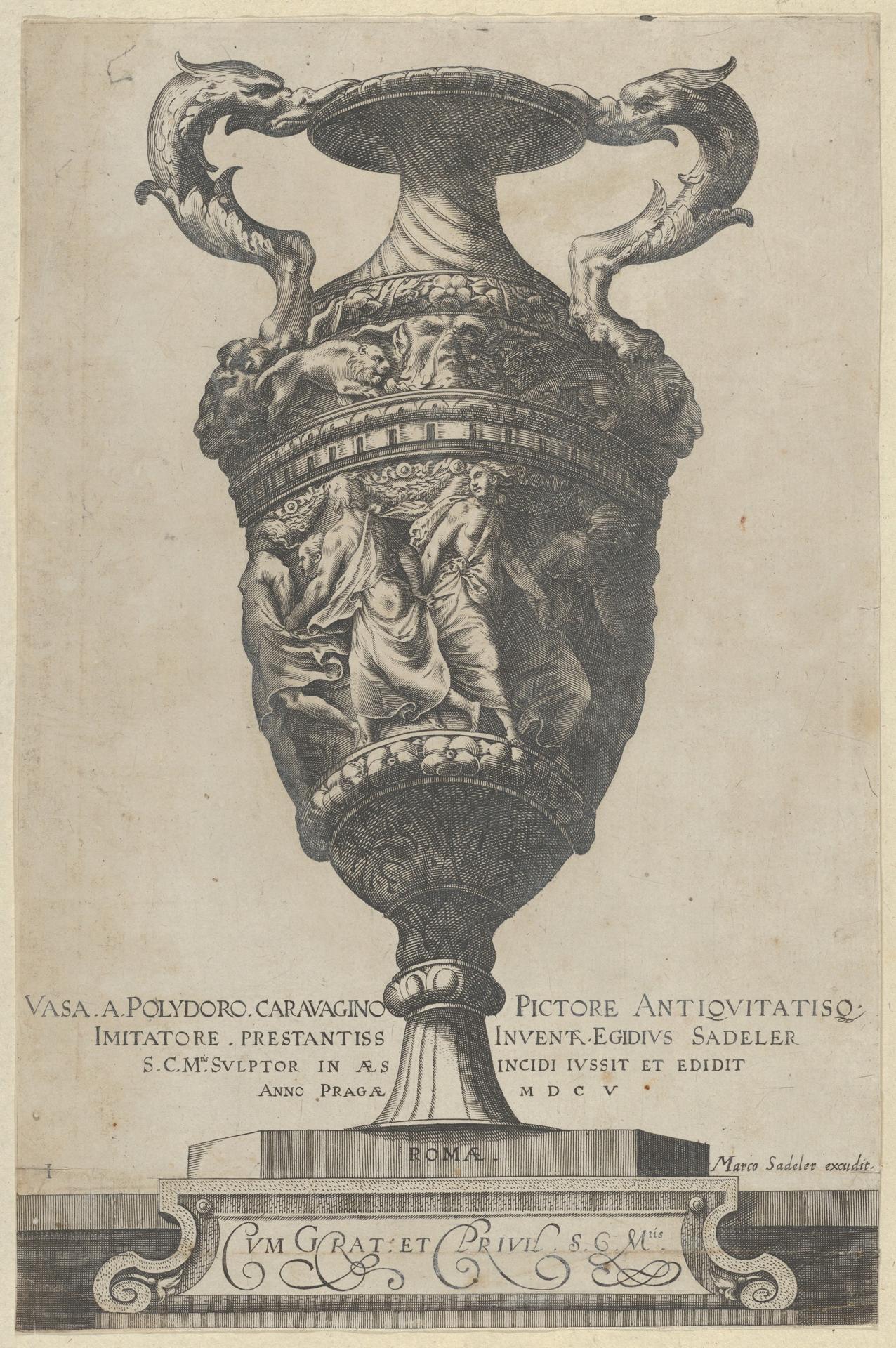
Title page depicting a two-handled base with dancing nymphs, from "Antique Vases" (Vasa a Polidoro Caravagino)
Original title: Title page depicting a two-handled base with dancing nymphs, from "Antique Vases" (Vasa a Polidoro Caravagino)
kurzbeschreibung
A twin-handled vase base ringed by dancing nymphs opens Aegidius Sadeler II's title page of 1605. Etched and engraved, this impression is the second of three states (Bartsch), and it introduced a collection of antique motifs.
Description
Two handles sweep upward to frame the vase foot set at the middle, where nymphs move in changing poses across its surface. Lions and other animals stand out as relief ornament, and one relief unfolds a lively dancing group. A stylized leaf ornament closes the bottom; texts and signatures line the margin. The whole image stays monochrome, as etching and engraving dictate.
Context
This sheet appeared in 1605, during the Renaissance revival of antiquity, when artists increasingly recorded Roman vases and reliefs. Aegidius Sadeler II, a Flemish engraver, worked for the imperial court in Prague and Vienna. The series 'Antique Vases' (Vasa a Polidoro Caravagino) draws on models attributed to the painter Polidoro da Caravaggio. Artists and collectors used such prints as reference material.
Impact
Stillness and movement sit close together here: the symmetrical layout and clean linework give the print a composed tone, while the dancing figure group brings liveliness. Ornament and dance scene hold each other in balance. Because the print remains monochrome, the details of the depiction stand out clearly.
Technique
Etching and engraving are combined here; fine lines and hatching belong to the printmaking of the early seventeenth century. Several states were pulled from the plate, and the present second already shows reworking. At roughly 27.2 × 17.9 cm, the paper has a format common for title pages of the period.
AI-generated description text
Source: Metropolitan Museum of Art · Public Domain (CC0 1.0)