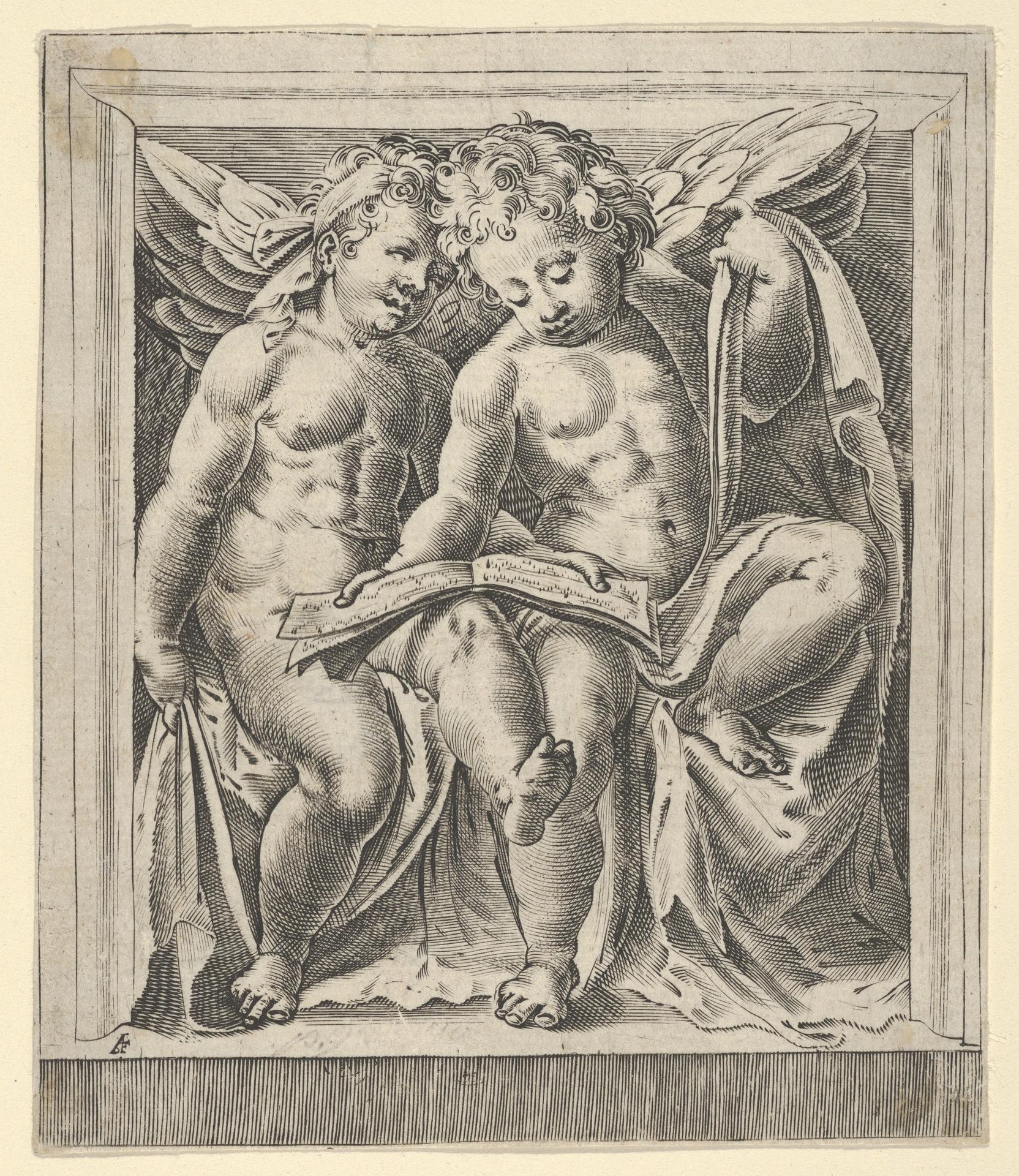
Two seated angels, facing left, reading from a song book, from The Angels' Concert (after 1583)
Original title: Two seated angels, facing left, reading from a song book, from The Angels' Concert
kurzbeschreibung
Two angels sit close together, reading from an open songbook. This sheet by Cherubino Alberti (Zaccaria Mattia) was made after 1583 and belongs to the series 'The Angel Concert'. It is a reverse copy in the medium of engraving.
Description
Pressed shoulder to shoulder and facing left, the two angels hold an open book. The left angel supports the book and looks off to the side, while the right angel also holds it and gazes downward. Both are barefoot, have wings and short wavy hair; a light drape falling from their shoulders barely covers their bodies. The book rests on the right angel's lap. The layout feels symmetrical, with even light and no harsh shadows.
Context
Cherubino Alberti (1553–1615) was an Italian engraver and painter of the late Renaissance. The print was made after 1583 as part of the series 'The Angel Concert'. As a reverse copy, it reproduces an existing composition in mirror image. Such reproductive engravings were widespread in the sixteenth century for making paintings or drawings available to a wider audience.
Impact
The scene feels calm and devout, helped by the symmetrical arrangement and even lighting. The delicate lines of the engraving give the figures a tender, almost ethereal quality that supports the meditative mood.
Technique
For this engraving, lines were incised into a copper plate and then printed on paper. The process allows fine, precise hatching, used here to work out the details of the wings, hair, and garments. The print is reversed from the original, as is typical for reproductive engravings.
AI-generated description text
Source: Metropolitan Museum of Art · Public Domain (CC0 1.0)