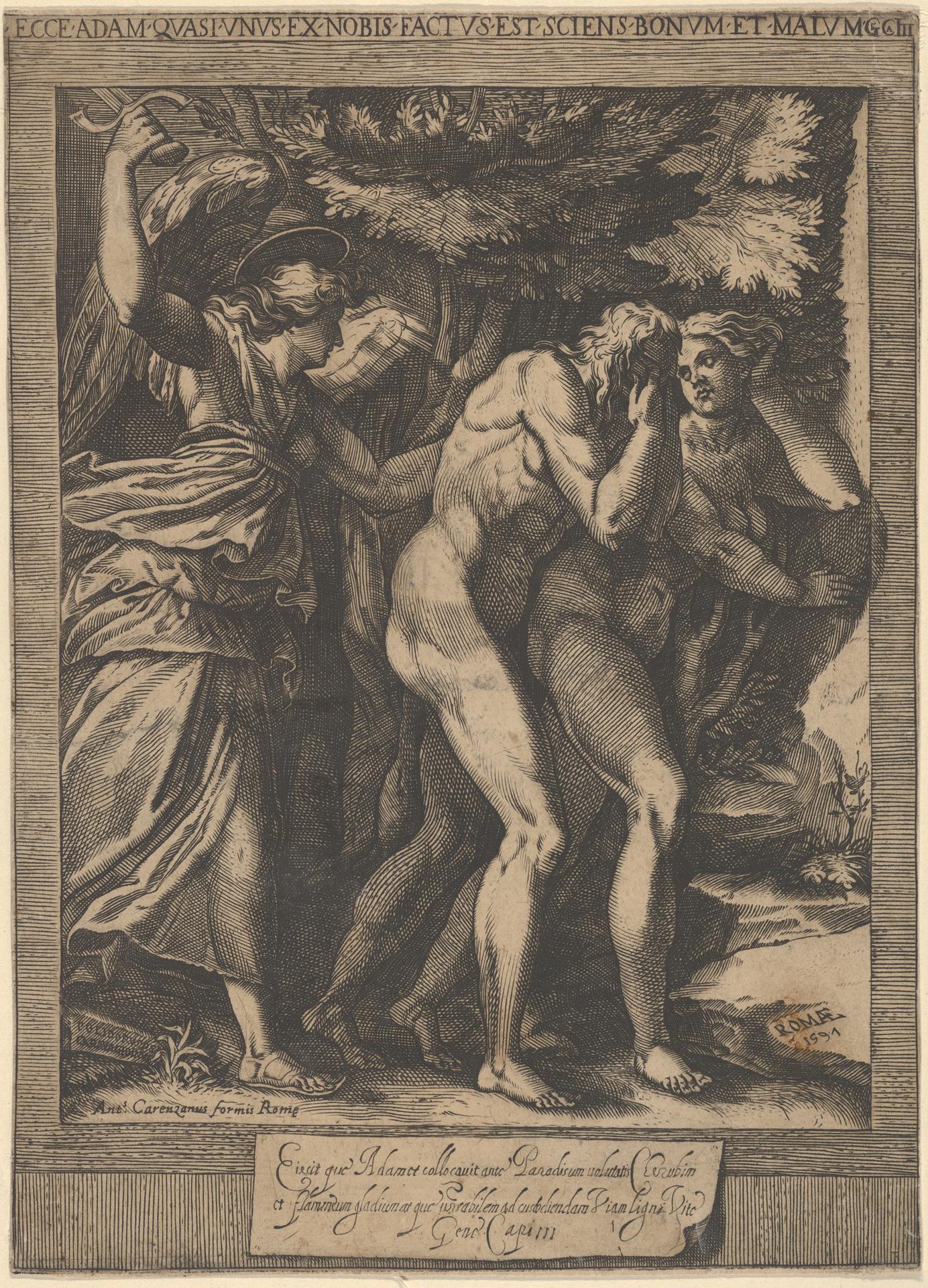
The Expulsion of Adam and Eve with an angel wielding a sword behind them
Original title: The Expulsion of Adam and Eve with an angel wielding a sword behind them
kurzbeschreibung
Cherubino Alberti produced this engraving in 1591 as a reverse copy after a lost model. It captures the moment Adam and Eve must leave Paradise; the first humans appear ashamed, while behind them an angel stands with raised sword.
Description
Adam and Eve stand at the front, covered by a loincloth and a leaf, their gazes lowered. Above them rises an angel in a robe, holding a sword in the right hand and raising it in threat or protection. Trees and plants in the background point to the Garden of Eden. A Latin text band with the biblical quote frames the motif, and at the bottom appears the publisher's address 'Ane. Carenzamus formis Rome'.
Context
The Italian Cherubino Alberti (1553–1615), a painter and engraver of the late Renaissance, became known above all for reproductive prints after other artists. That his sheet of 1591 is reversed, a copy in the opposite direction, suggests a model by another master. Such prints helped spread pictorial compositions widely in the 16th century. The Latin inscription refers to the biblical narrative in Genesis 3:22.
Impact
An urgent, dense image: the bent bodies of Adam and Eve contrast with the upright, commanding posture of the angel. Precise shading and finely drawn lines give the arrangement dramatic depth, making the moment of expulsion immediately palpable.
Technique
For the engraving, lines were cut into a copper plate and then printed on paper; this allowed fine details and an exact gradation of light and shadow to be captured. The sheet measures 21.5 × 15.5 cm. The reverse orientation of the print results from the printing process from the plate.
AI-generated description text
Source: Metropolitan Museum of Art · Public Domain (CC0 1.0)