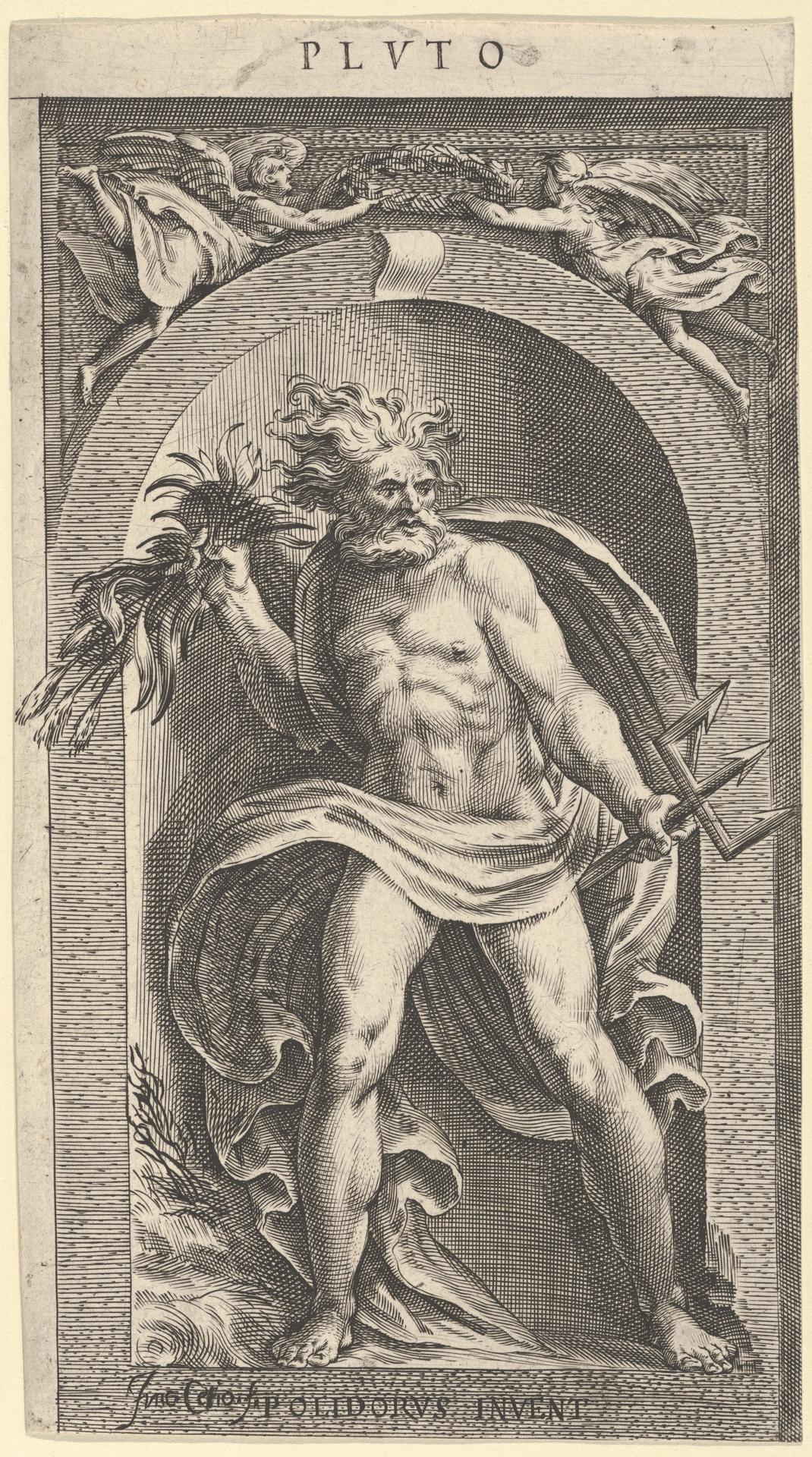
Neptune standing in a niche holding a trident in his left hand, foliage in his right
Original title: Neptune standing in a niche holding a trident in his left hand, foliage in his right
kurzbeschreibung
This engraving by Cherubino Alberti, made between 1570 and 1615, presents the sea god Neptune within a niche. The print is known in Bartsch's catalogue as the second state of two. An ancient deity and an architectural frame are brought together here.
Description
A male figure stands in a niche, his left hand grasping a trident, his right filled with foliage. Wild, unkempt hair surrounds his naked body. Two angels hover in the air of the background, while the arrangement is symmetrically disposed around the main figure. Black and white dominate the surface; varying line weights and hatching create the effects of light.
Context
Cherubino Alberti (1553–1615) worked as an Italian engraver and painter of the late Renaissance. His career coincided with a period in which printmaking gained considerable artistic and commercial weight in Italy. An ancient god framed by a niche reflects the interest in classical antiquity that shaped late sixteenth-century art.
Impact
Because the figure stands at the centre and the angels are distributed symmetrically, the print feels calm and monumental at once. The contrast between the god's powerful physique and the hovering angels gives the image its dynamic tension.
Technique
For this engraving, lines were cut into a copper plate with a burin, and prints were then taken on paper. The second state differs from the first through possible reworking or additions to the plate, as recorded in Bartsch's catalogue.
AI-generated description text
Source: Metropolitan Museum of Art · Public Domain (CC0 1.0)