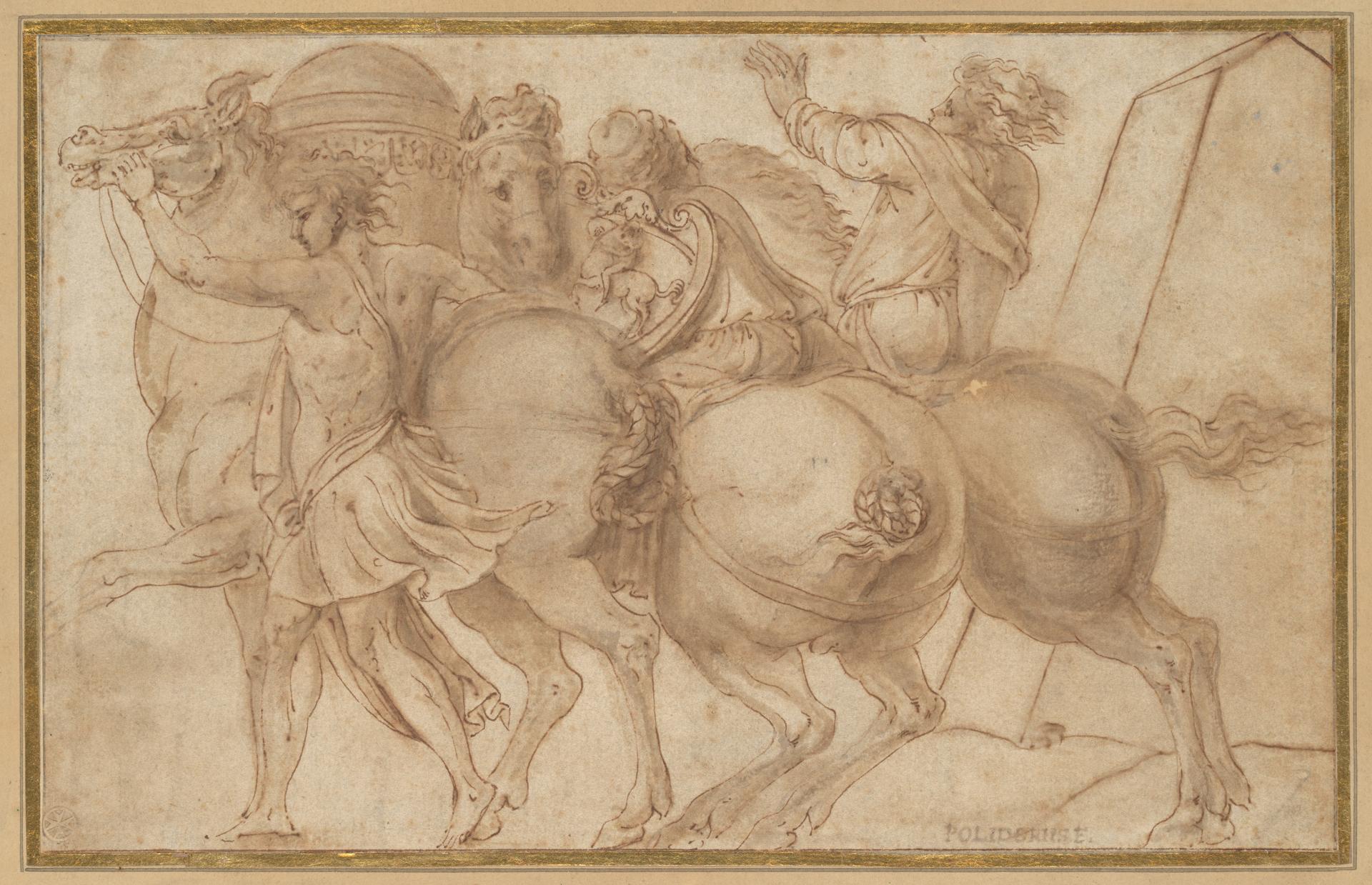
Frieze with Three Horsemen
Original title: Frieze with Three Horsemen
kurzbeschreibung
Unlike related equestrian depictions of the Renaissance, this sheet by Polidoro da Caravaggio places the three riders not in a landscape but lets them process across the paper as a narrow frieze. Drawn in the 1530s, the work is executed in pen and brown ink, with brush and brown and gray wash. Three mounted figures are arranged in lively movement into a continuous strip.
Description
Three horses with riders move from left to right across the sheet. The foremost rider thrusts a lance forward, the middle one wears a helmet and looks back, the rear one raises a hand in a defensive gesture. The animals' manes and tails are rendered with visible strokes, and the palette is limited to shades of brown and gray. With no indication of background, the gaze rests entirely on the figures and their staggered arrangement.
Context
Polidoro da Caravaggio is among the Renaissance artists who came to prominence chiefly through facade decorations in Rome. The 1530s saw a larger number of drawings that took ancient friezes and reliefs as models. This sheet belongs to a series of such designs intended for decorative cycles. Riders were a highly popular motif in the Renaissance, drawing on Roman triumphal imagery.
Impact
The staggered sequence of riders and their differing directions of gaze create a lively, almost narrative moment. The sheet feels restrained through its limitation to brown and gray, yet it possesses a palpable strength. The fact that the background is left blank makes the figures appear immediate and sketch-like.
Technique
Pen and brown ink define the execution of the sheet; fine lines precisely capture the internal drawing of horses and riders. Brush and brown and gray wash provide shading and volume, so that the figures stand out bodily. Ink and wash together were a common combination in Renaissance design for studies and models.
AI-generated description text
Source: Metropolitan Museum of Art · Public Domain (CC0 1.0)