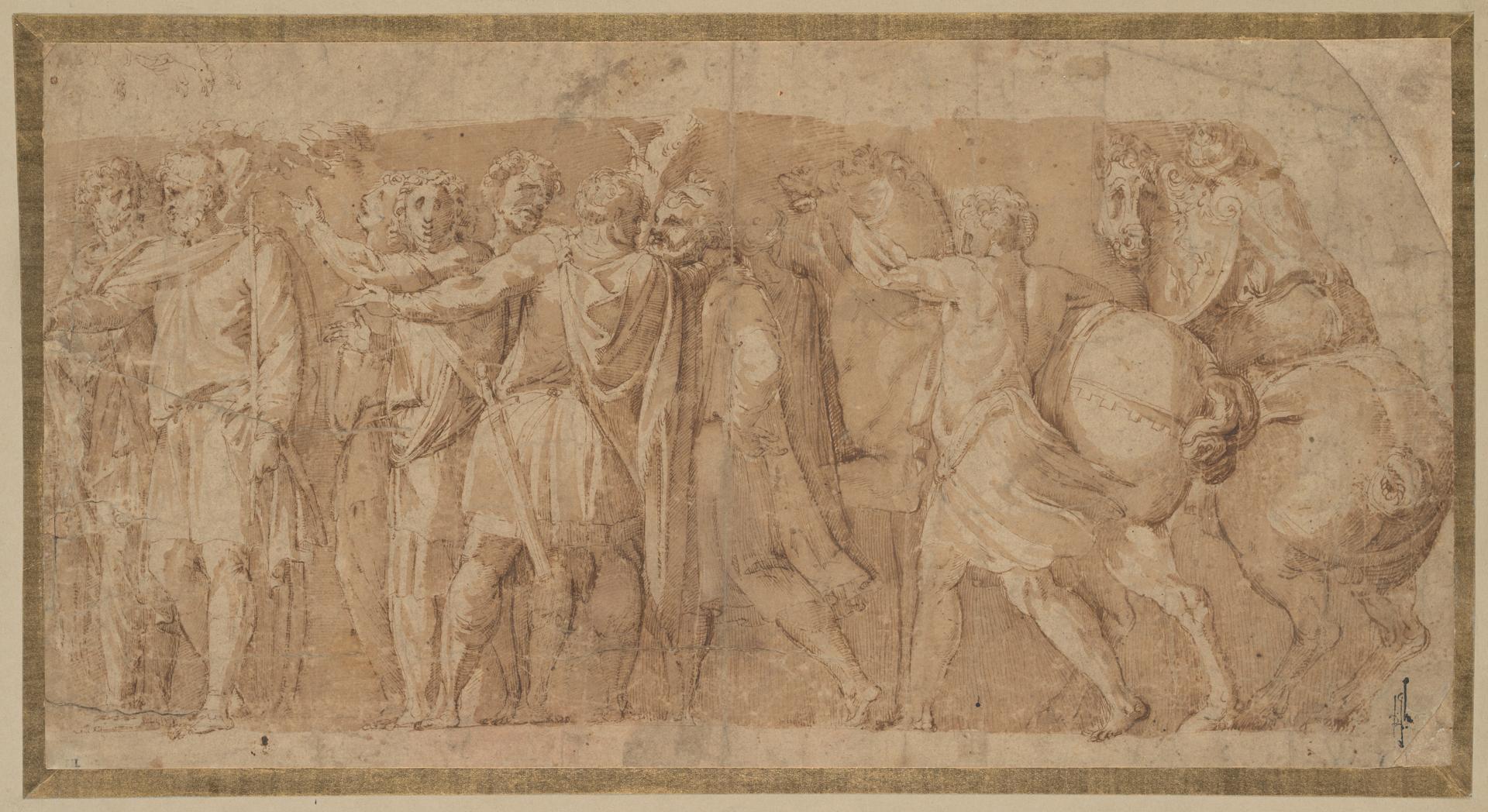
Frieze with Male Figures and Two Horses
Original title: Frieze with Male Figures and Two Horses
kurzbeschreibung
This frieze with male figures and two horses was made by Polidoro da Caravaggio in the mid-16th century. Executed in pen and brown ink with brown wash, the sheet presents a procession in the antique manner.
Description
Male figures in classicizing drapery move across the horizontal surface, some carrying poles, others mid-stride. At the right edge, two horses appear, led by the figures. Brown and beige tones dominate, a result of pen and ink. Light falls evenly, without cast shadows, which gives the rendering a flat quality.
Context
Polidoro da Caravaggio (c. 1499–1543) was an Italian High Renaissance painter, famed for his facade decorations and friezes after antique models. In the mid-16th century, when antique motifs were highly prized, this sheet was created. Such friezes often adorned building facades or interiors and drew on Roman reliefs.
Impact
The horizontal arrangement lends the image a calm balance. The precise drawing of figures and horses makes the frieze appear lively yet ordered.
Technique
Pen and brown ink, combined with brown wash, are used here. This allows both precise lines and broad shading, with the wash creating soft transitions. At 19.7 x 38.1 cm, the work has a compact format, as was usual for studies or smaller decorative designs.
AI-generated description text
Source: Metropolitan Museum of Art · Public Domain (CC0 1.0)