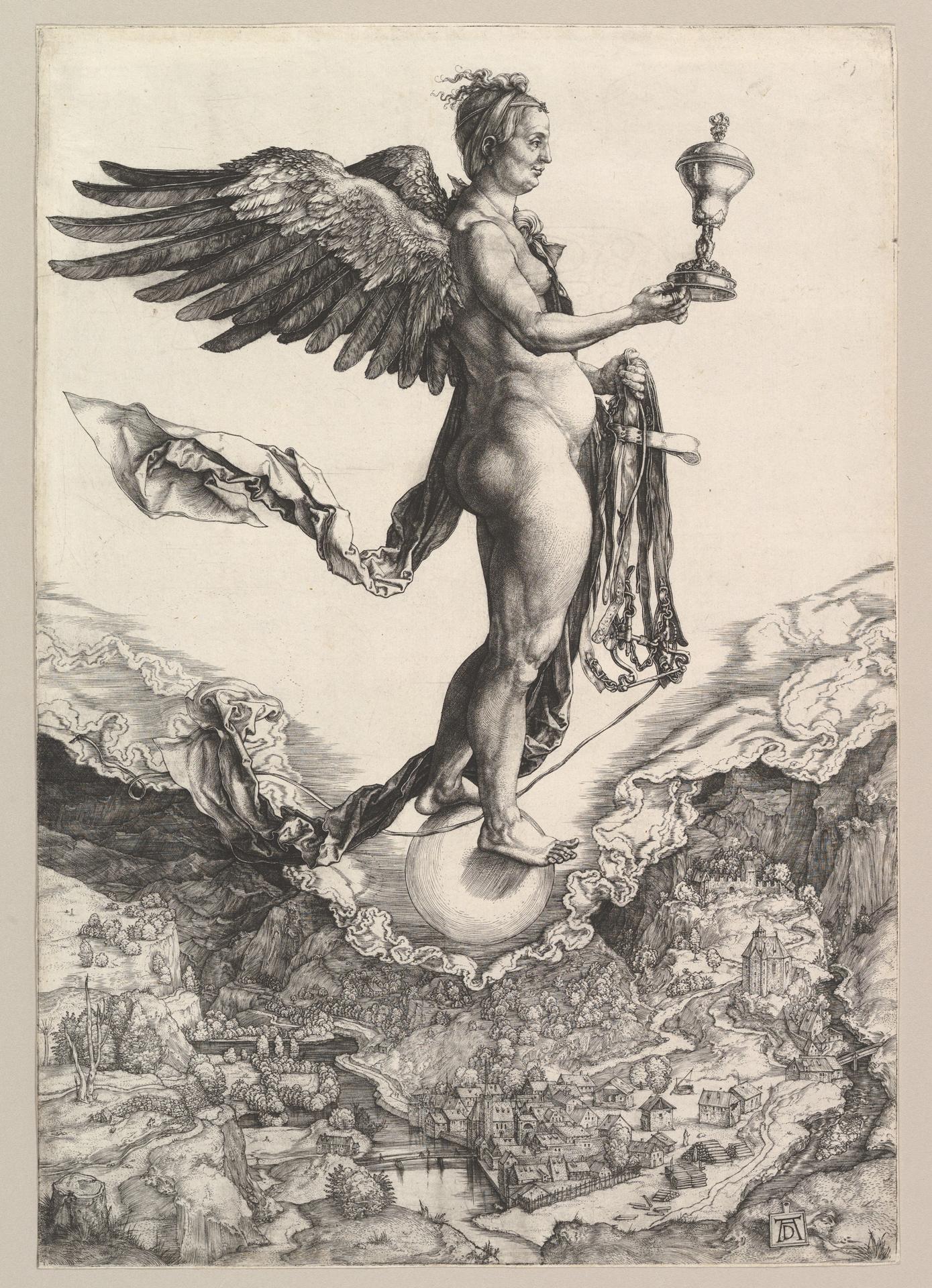
Nemesis (The Great Fortune)
Original title: Nemesis (The Great Fortune)
kurzbeschreibung
Albrecht Dürer's engraving 'Nemesis' (also known as 'The Great Fortune'), created in 1501–2, depicts the winged goddess of retribution standing on a globe above an alpine landscape. The work combines classical mythology with a detailed topographical background, showcasing Dürer's mastery of engraving.
Description
The central figure is a nude, winged woman seen from behind, balancing on a large globe that hovers amid swirling clouds. She holds a golden goblet in her right hand and a bridle in her left, while a flowing, torn garment billows behind her. Below, a vast landscape unfolds with a river winding through mountains, forests, and a walled town. The composition is symmetrical, with the figure dominating the upper half and the landscape providing a detailed, contrasting backdrop.
Context
Dürer created this engraving during his Nuremberg period, shortly after his second trip to Italy (1505–07), though the work is dated 1501–2. The figure of Nemesis derives from a poem by the Italian humanist Angelo Poliziano, and the landscape is based on the artist's own sketches of the Alps, likely made during his first journey to Italy in 1494–95. The engraving reflects Renaissance interest in classical antiquity and the fusion of ideal beauty with natural observation.
Impact
The image strikes a balance between idealized classical form and meticulous naturalism, making the goddess both ethereal and tangible. The dramatic contrast between the floating figure and the serene landscape creates a sense of tension and impending judgment. Dürer's precise linework lends the scene a crisp, almost metallic clarity that enhances its allegorical weight.
Technique
This is a copperplate engraving, a technique that involves cutting lines into a metal plate with a burin. Dürer's use of parallel and cross-hatched lines builds volume and texture, from the soft flesh of the figure to the rugged terrain below. The monochromatic print relies on the play of light and shadow to create depth, a hallmark of his graphic work.
AI-generated description text
Source: Metropolitan Museum of Art · Public domain (CC0)