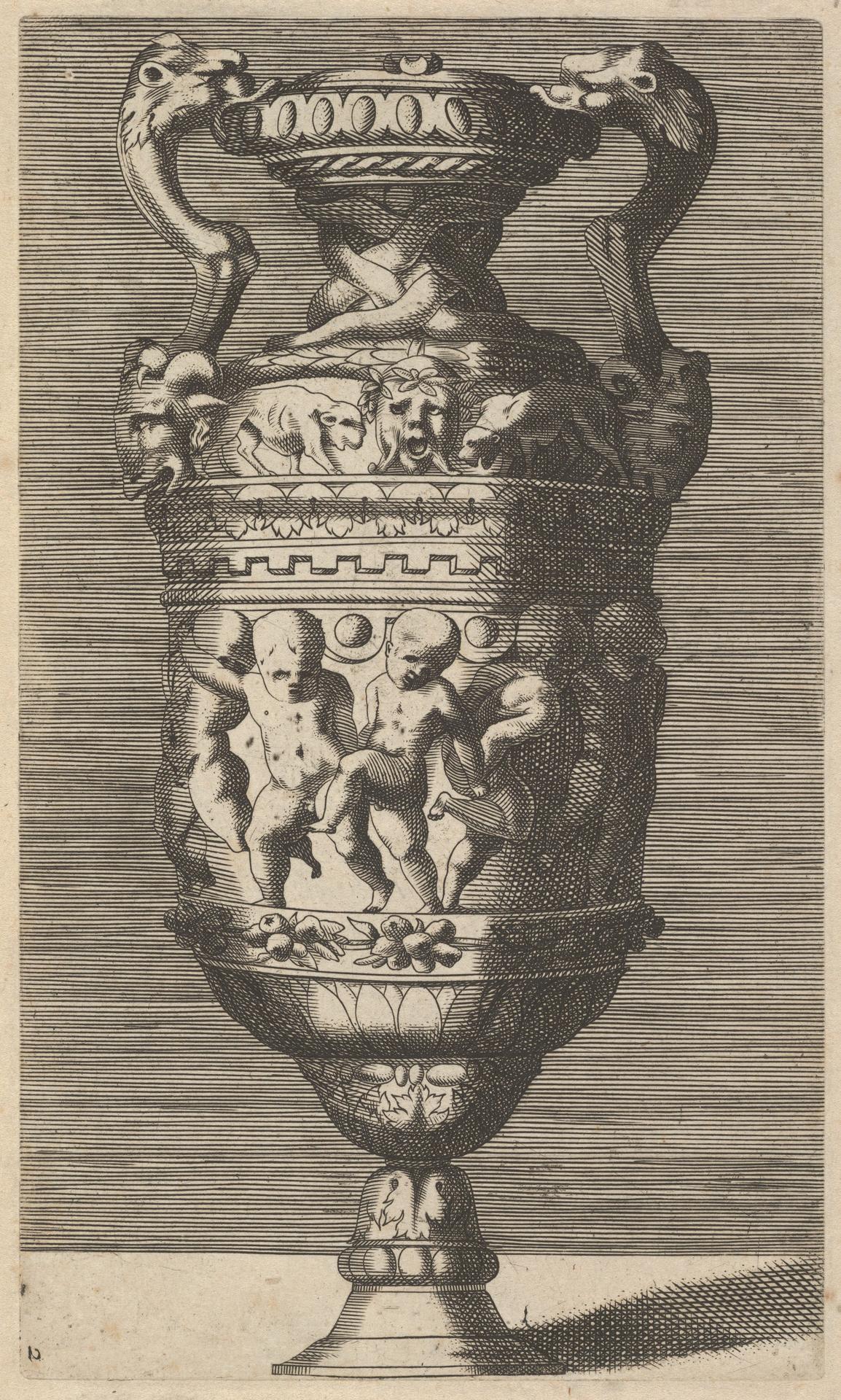
Vase with Dancing Putti
Original title: Vase with Dancing Putti
kurzbeschreibung
René Boyvin, whose printed output includes a steady strand of ornament sheets, here presents an antique vase covered in elaborate decoration. This tall format print from the late 17th century relies on thin lines and hatching, bringing together mythological figures alongside animal forms.
Description
Horizontal bands divide the body of the vase, each with its own ornament. At the top a figure crouches on a sphinx-like hybrid creature; below appear small animals such as sheep and goats. Two naked, muscular putti in dancing motion form the focal point. Flower and leaf motifs line the lower edge. The arrangement is symmetrical, and the placement of the figures reinforces the vessel's vertical structure.
Context
Boyvin was a French engraver of the Renaissance, known for ornament prints and reproductions after designs by artists such as Rosso Fiorentino. Vases with mythological subjects were a common theme in decorative graphic art in 16th- and 17th-century France and Italy. Prints of this kind often served craftsmen as models for metalwork or ceramics. This sheet belongs to a series of ornament prints held at the Metropolitan Museum of Art.
Impact
The clean linework and symmetrical layout give the sheet a calm, balanced quality. Against the strictly ordered ornaments, the lively putti at the center provide an animated accent. The whole reads as elegant and decorative, yet restrained.
Technique
The engraving is recognizable by its precise, thin lines and even hatching, which model volume and shadow. The monochrome printing emphasizes the graphic effect of the linework. The plate measures 19 by 11.3 centimeters and was presumably pulled on paper in an intaglio press.
AI-generated description text
Source: Metropolitan Museum of Art · Public Domain (CC0 1.0)