Burning Weeds
Original title: Burning Weeds
kurzbeschreibung
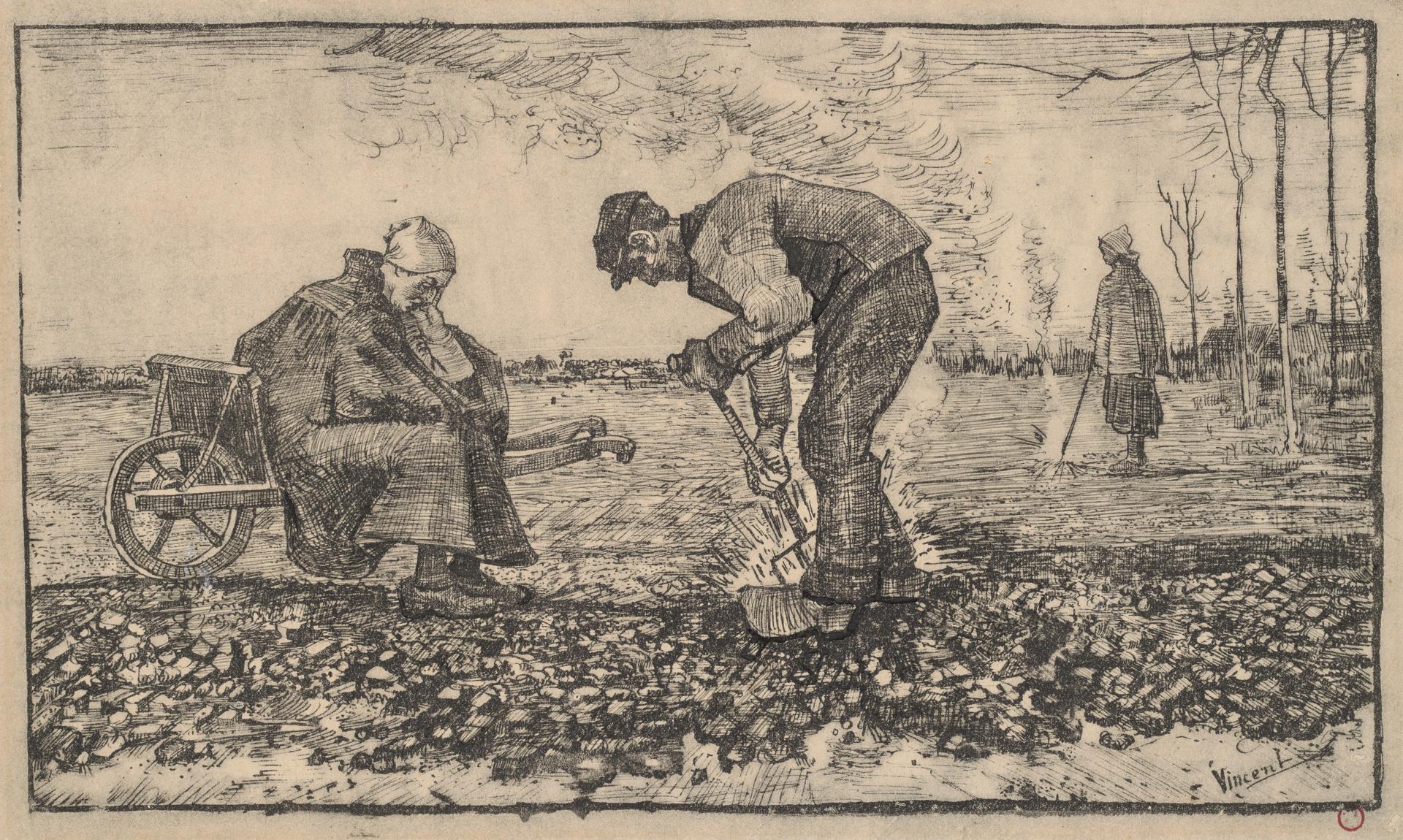
Unlike many of van Gogh's related sheets, this pen-and-ink lithograph from mid-July 1883 gives center stage not to a solitary field worker but to a small group engaged in labor. Two figures are busy in the fields, while a third stands further back. The monochrome execution matches the graphic technique of lithography.
Description
As opposed to similar scenes with a single figure, the action here is spread across several people: one sits on a cart, resting, while another bends over the ground, handling a tool. A third person stands further back in the landscape. The drawing remains in black and white, with even lighting that avoids targeted effects. The style is realistic with impressionistic touches, evident in the brushstrokes and the way the landscape is conceived.
Context
Van Gogh made this lithograph in July 1883 in The Hague, where he studied the depiction of rural laborers in depth. The sheet belongs to a series intended to capture the life of peasants and their work in the fields. Through the transfer lithography technique, he could transfer drawn effects directly onto the printing stone. Scholars consider the dating to mid-July 1883 as certain.
Impact
What sets this sheet apart from more animated scenes is its calm, horizontal arrangement, which creates a quiet, concentrated working atmosphere. The even distribution of light and the monochrome palette emphasize the simplicity of the rural subject. The realistic details and the slight impressionistic note give the view an immediate, authentic effect.
Technique
Unlike pure pen drawings, this is a transfer lithograph that was reworked with pen and ink. This allowed the original drawing to be transferred to the lithographic stone and then refined with ink. The material is paper, and the dimensions are 18.4 × 29.3 cm.
AI-generated description text
Source: Metropolitan Museum of Art · Public Domain (CC0 1.0)