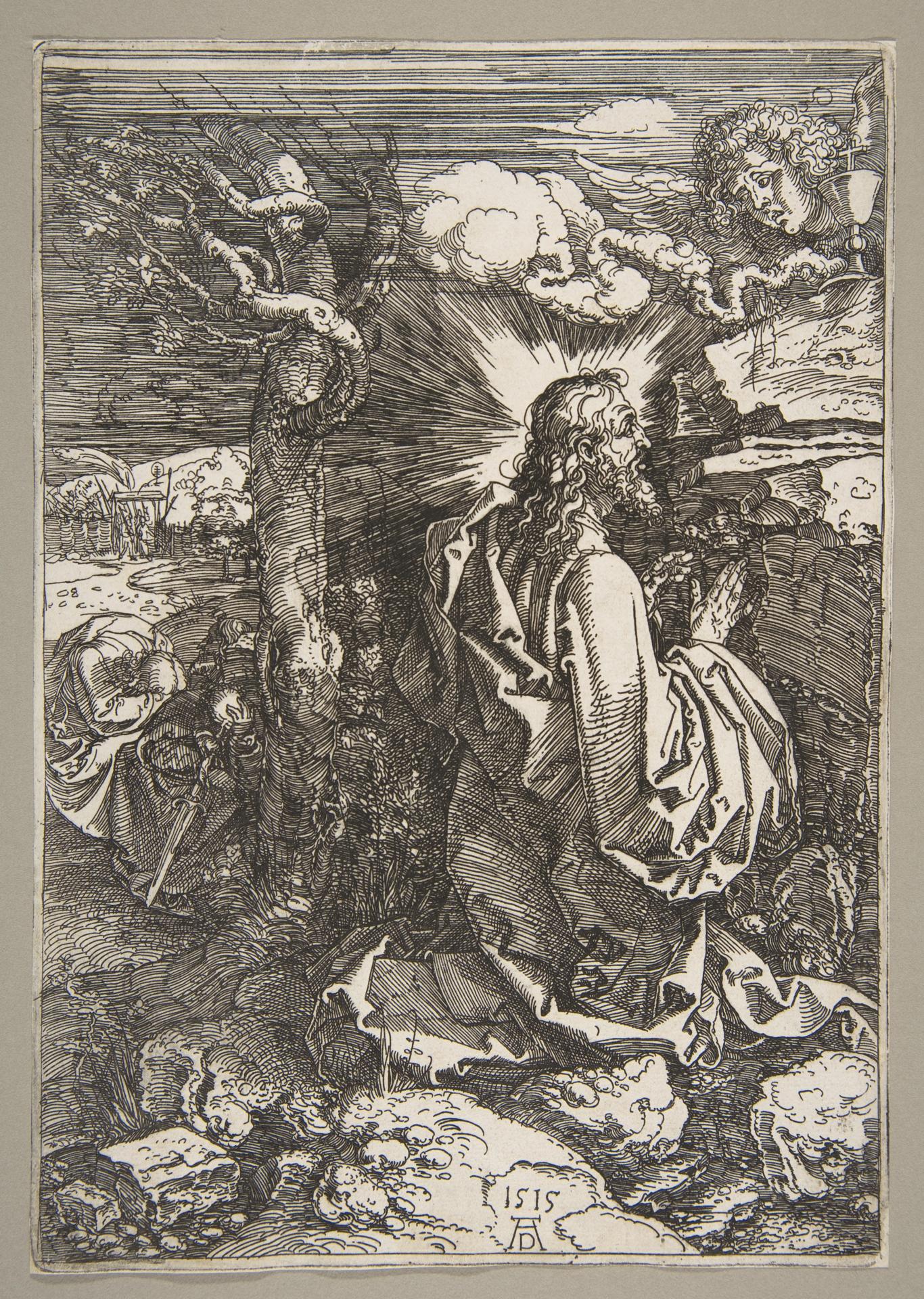
Agony in the Garden
Original title: Agony in the Garden
kurzbeschreibung
Agony in the Garden is an etching by Albrecht Dürer, dated 1515. The print depicts Christ praying in the Garden of Gethsemane, a scene from the New Testament. It is a monochrome work that showcases Dürer's skill in engraving and his attention to detail.
Description
In the center, Christ kneels in a long-sleeved tunic, his face illuminated by a radiant light descending from above. To the left, a female figure, possibly Mary Magdalene, kneels, while another figure, perhaps an angel or a disciple, is visible on the right. The background features trees and clouds, enhancing the mystical atmosphere. At the top, an angel holds a chalice, symbolizing the cup of Gethsemane. The composition is detailed, with fine hatching and linework creating depth and dramatic lighting.
Context
Dürer created this etching in 1515, during a period when he was exploring new techniques in printmaking. The subject of the Agony in the Garden was popular in Northern European art, reflecting the era's focus on religious devotion. Dürer's work was influential in spreading Renaissance ideas across Europe, and his prints were widely collected and copied.
Impact
The etching conveys a profound sense of spiritual intensity and drama. The contrast between light and shadow draws the viewer's eye to Christ's illuminated face, evoking a feeling of divine presence. The intricate details and emotional expressions invite contemplation and reflection.
Technique
This work is an etching, a technique where a design is incised into a metal plate, then inked and printed. Dürer employed fine lines and cross-hatching to achieve tonal variation and texture. The monochrome palette relies on the interplay of ink and paper to create depth and atmosphere.
AI-generated description text
Source: Metropolitan Museum of Art · Public domain (CC0)