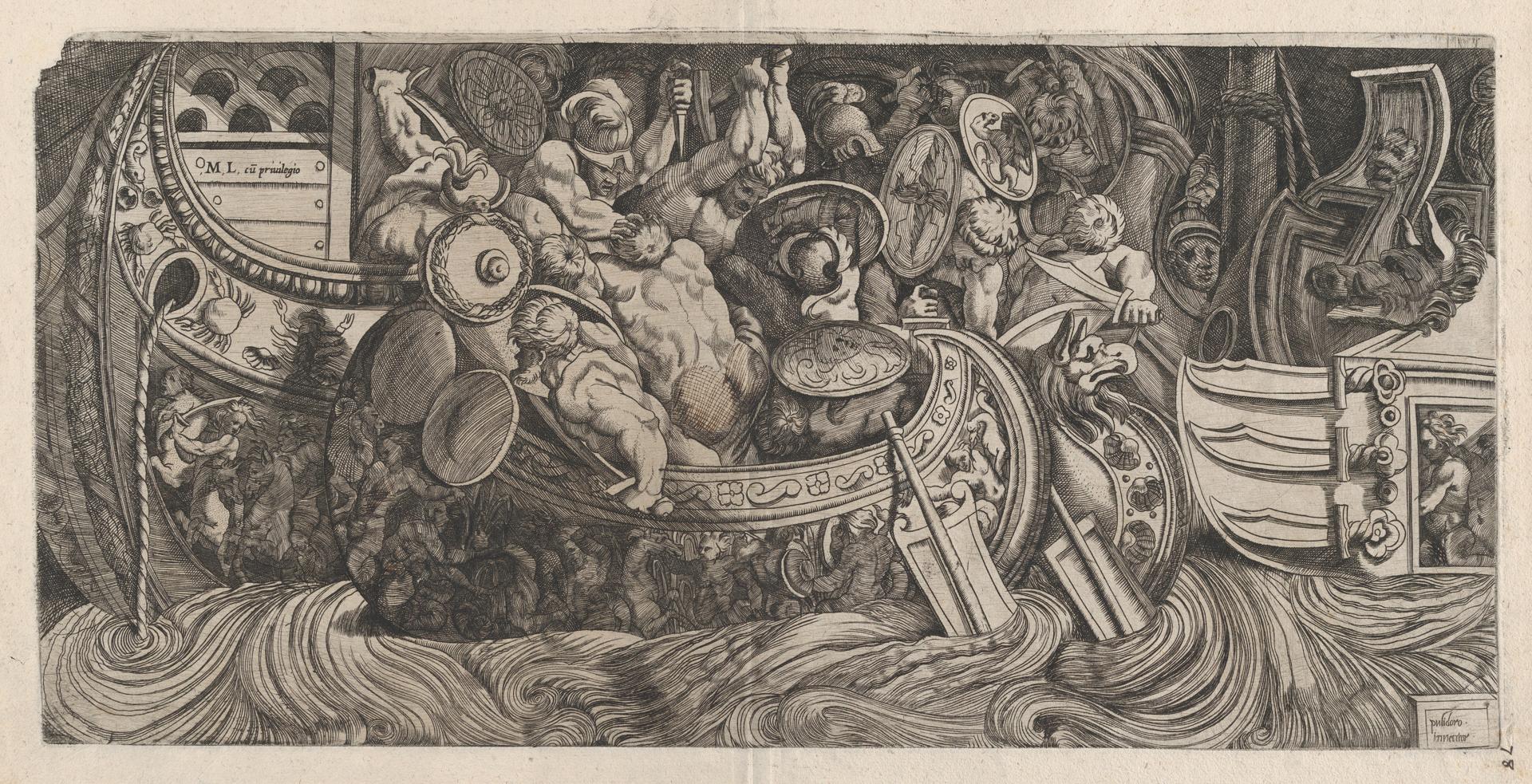
Naval Battle, from "Speculum Romanae Magnificentiae"
Original title: Naval Battle, from "Speculum Romanae Magnificentiae"
kurzbeschreibung
Unlike many contemporary prints of sea battles that break the action into separate episodes, Michele Lucchese's 16th-century etching packs the fight into one dense throng. The sheet belongs to the collection 'Speculum Romanae Magnificentiae' and measures 34.8 x 49.4 cm (plate: 21.8 x 44 cm). Several ships engage in a dramatic confrontation on churning water.
Description
A large, richly ornamented ship dominates the center, swarming with figures caught up in the fight—some wield weapons, others raise shields, suggesting an armed clash. More ships appear in the distance, also taking part in the battle. Curving wave lines emphasize the movement and dynamism of the event. The layout is tightly packed and full of activity, underscoring the intensity of the naval engagement.
Context
The etching dates from the 16th century, an era when sea battles were frequently taken up in printmaking. Michele Lucchese, an Italian engraver, was known for his detailed renderings. The sheet was included in the 'Speculum Romanae Magnificentiae', a collection of prints documenting monuments and events of Rome and the Roman Empire. Such prints often served to glorify military successes and spread news of historical events.
Impact
The close arrangement and detailed ship depictions create an intense, almost overwhelming effect. Dynamic wave lines and the multitude of figures convey movement and drama. The monochrome etching, with its sharp contours and fine shading, gives the scene a timeless, graphic quality.
Technique
Etching and engraving are combined here, a process that allows fine lines and precise details. The technique permits high accuracy in rendering ornaments and figures. Shading comes from varying line density and direction, which gives the image depth and volume.
AI-generated description text
Source: Metropolitan Museum of Art · Public Domain (CC0 1.0)