Title Plate to a Series of Prints after Polidoro
Original title: Titeplate to series of prints after Poloidoro
kurzbeschreibung
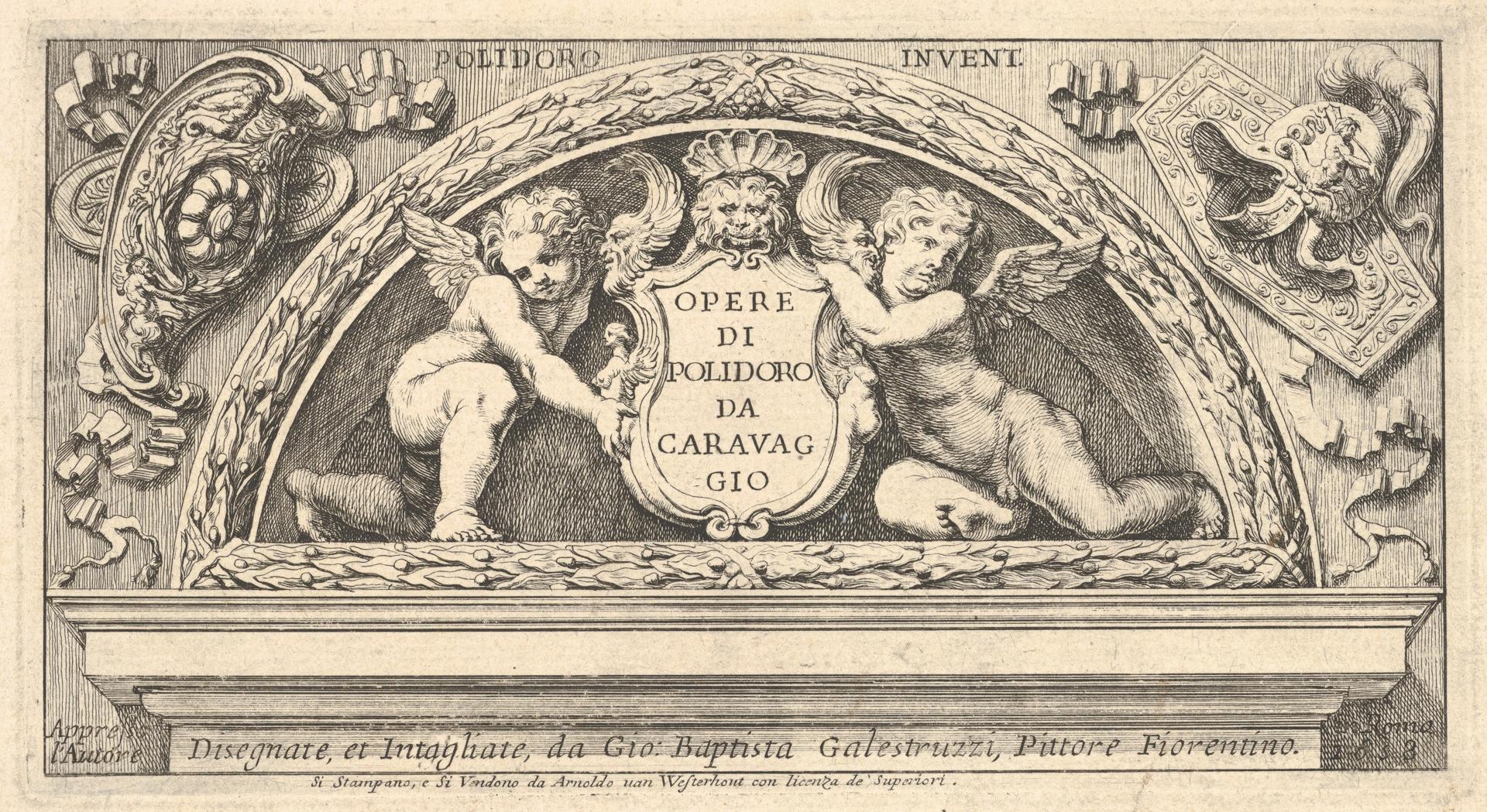
In 1658 Giovanni Battista Galestruzzi made this etching, in its second state, as the title page to a set of prints after designs by Polidoro da Caravaggio. Two putti hold a shield inscribed 'OPERE DI POLIDORO DA CARAVAGGIO', framed by ornamental flourishes and coats of arms with lion heads.
Description
Two winged putti with curly hair support a shield at the center of the sheet, bearing the Latin words 'OPERE DI POLIDORO DA CARAVAGGIO'. A border of foliage and ornament wraps around the shield. To either side appear two further framed coats of arms with lion heads. At the top one reads 'POLIDORO INVENT', and at the bottom the signature 'Disegnate, et Intagliate, da Gio: Baptista Galestruzzi, Pittore Fiorentino.' The image stays monochrome, its lines sharp and clear.
Context
Galestruzzi, a seventeenth-century Florentine painter and printmaker, created this sheet as the opening of an etched series reproducing works by the Renaissance painter Polidoro da Caravaggio. Polidoro was known above all for his facade decorations in Rome, which served as models for such prints. The inscriptions name Polidoro as the inventor of the designs and Galestruzzi as the draughtsman and engraver.
Impact
Symmetrically arranged and rich in ornament, the sheet feels balanced and formal. The putti add a playful note, while the coats of arms and lettering give the title page an official character.
Technique
As an etching, the print was made by biting lines into a metal plate; acid deepened the exposed areas. The second state indicates reworking after the first printing. Crisp, finely drawn lines attest to precise engraving, as required by the detailed rendering of ornaments and figures.
AI-generated description text
Source: Metropolitan Museum of Art · Public Domain (CC0 1.0)