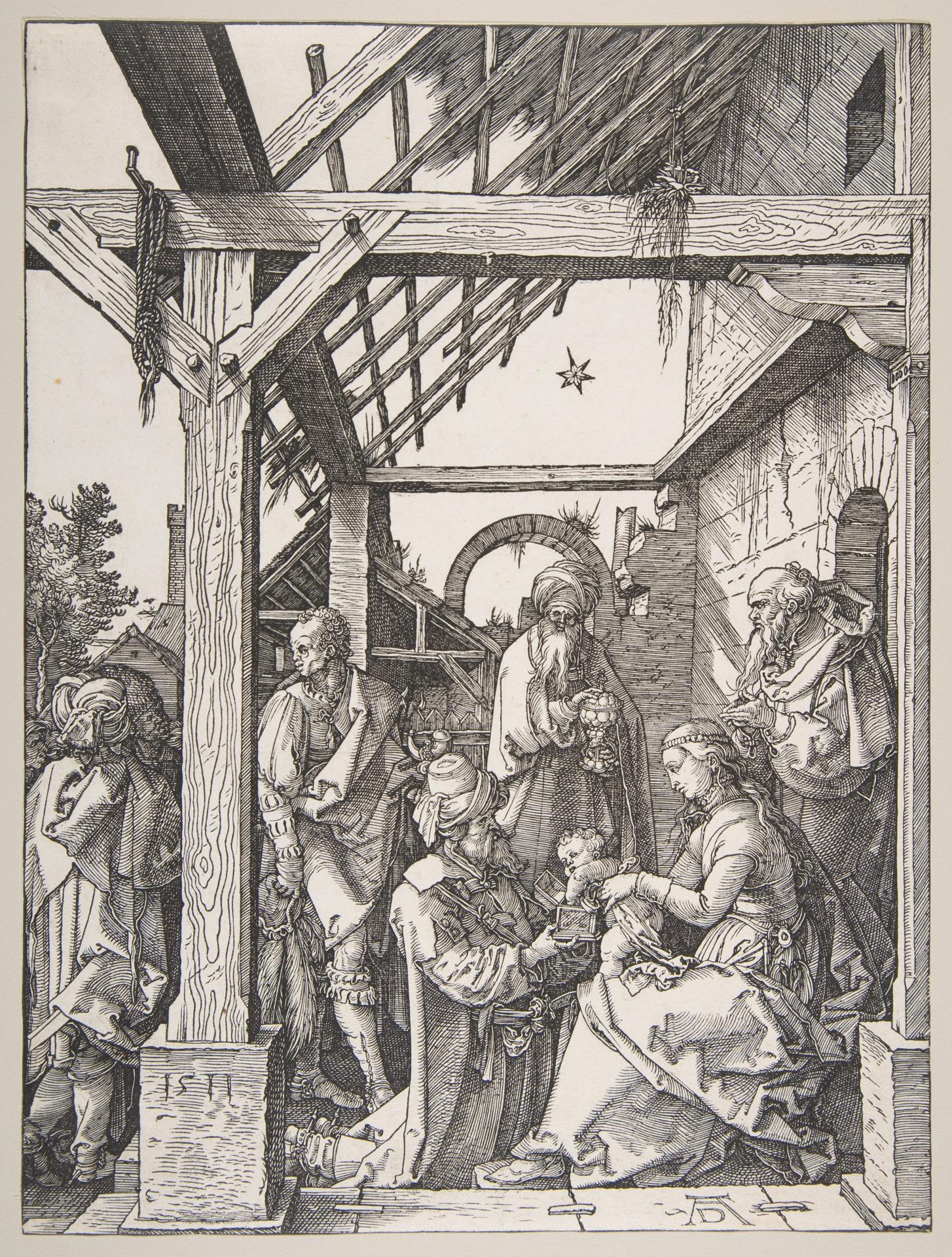
The Adoration of the Magi
Original title: The Adoration of the Magi
kurzbeschreibung
Albrecht Dürer's woodcut from 1511 depicts the biblical scene of the Magi presenting gifts to the infant Jesus. The print showcases Dürer's mastery of the medium, with intricate lines and careful composition. It is a prime example of Renaissance printmaking.
Description
The composition centers on the Christ child, who lies in a stable, while the three kings approach from the left, clad in ornate, period-specific garments. The Virgin Mary stands on the right, framed by the ruined architecture of the stable. Above, a star shines, guiding the Magi, and the background details, such as the broken walls and wooden beams, are rendered with precise line work. The monochrome image relies on varying line density to convey depth and texture.
Context
Dürer created this woodcut in 1511, during a period of high productivity after his second trip to Italy, where he absorbed Renaissance ideas. The print was part of a series on the Life of the Virgin, a project that showcased his skill in translating religious narratives into accessible visual form. Dürer's woodcuts were widely distributed and helped establish his reputation across Europe, reflecting the growing market for printed art in the early 16th century.
Impact
The woodcut draws the viewer's eye to the central figures, creating a sense of reverence and intimacy. The detailed textures of the robes and the ruined architecture add a tactile quality, making the scene feel both historical and immediate. The interplay of light and shadow, achieved through line work, gives the image a dramatic, contemplative mood.
Technique
This is a woodcut, a relief printing technique where the image is carved into a wooden block, inked, and pressed onto paper. Dürer's skilled use of cross-hatching and varied line weights allowed for subtle tonal gradations, a hallmark of his printmaking. The block was likely cut from a fine-grained wood, enabling the intricate details seen in the final print.
AI-generated description text
Source: Metropolitan Museum of Art · Public domain (CC0)