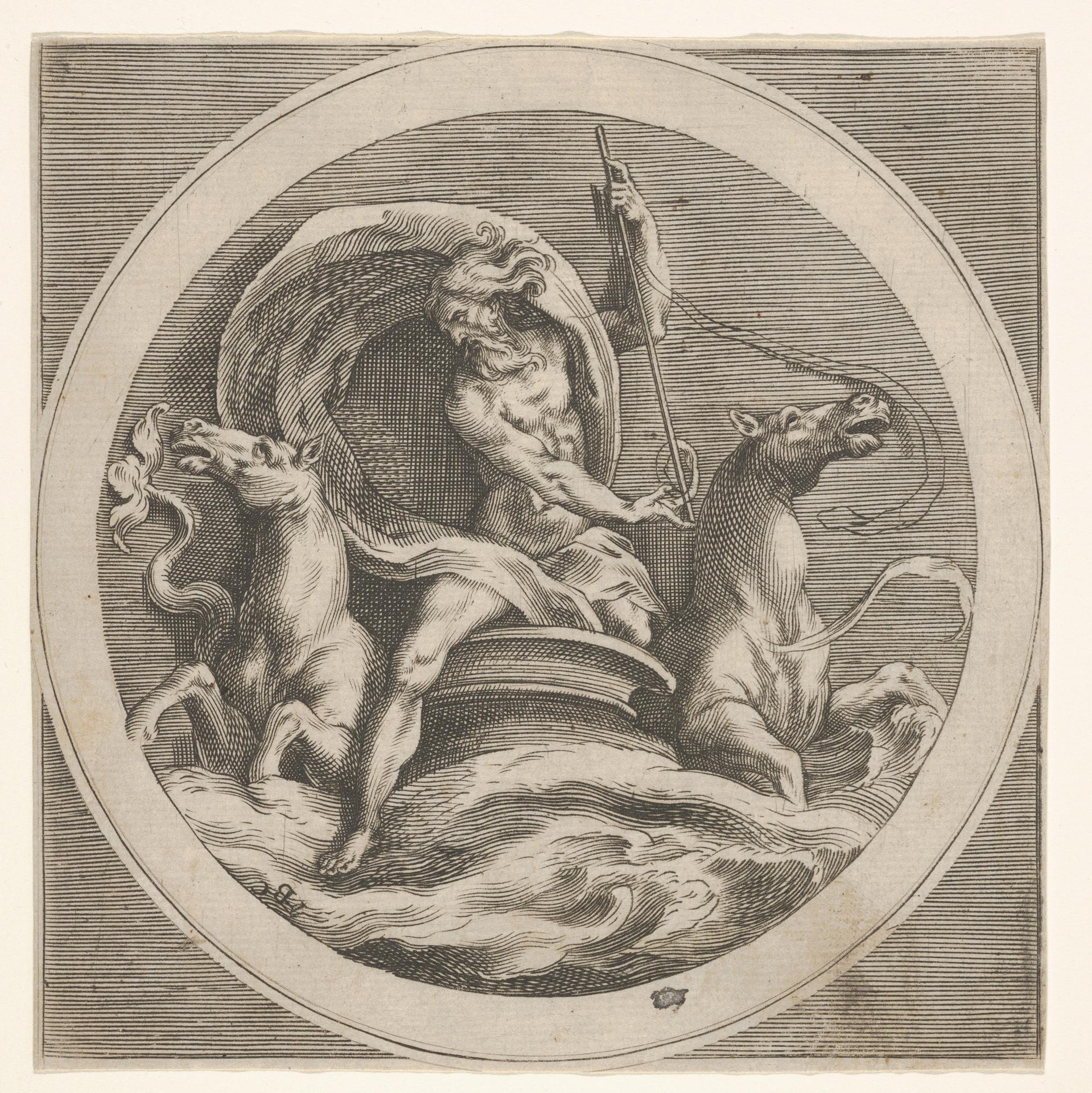
Neptune rising from the sea and bearing a staff, accompanied by two horse-headed sea creatures, reverse copy after a series of engravings by Cherubino Alberti of mythological scenes after Polidoro da Caravaggio
Original title: Neptune rising from the sea and bearing a staff, accompanied by two horse-headed sea creatures, reverse copy after a series of engravings by Cherubino Alberti of mythological scenes after Polidoro da Caravaggio
kurzbeschreibung
Neptune rises from the waves, holding a staff; two horse-headed sea creatures disport themselves at his sides. This anonymous engraving dates from the second half of the 16th century. It is a reverse copy after a series of prints by Cherubino Alberti, which in turn draws on designs by Polidoro da Caravaggio.
Description
An oval frame encloses the image, itself surrounded by a larger oval border. Neptune emerges from the middle of the water, while two horse-headed hybrid creatures appear between the waves on either side. Fine lines and precise hatching model the bodies, bringing out muscles and movement. Horizontal lines structure the ground and create depth as well as a sense of motion. The whole sheet is in shades of grey, as is typical of engraving.
Context
Made between about 1550 and 1600, this print belongs among the anonymous copies after a series by Cherubino Alberti that goes back to models by Polidoro da Caravaggio. Polidoro, a pupil of Raphael, left numerous mythological scenes that circulated widely through prints. The fact that it is a reverse copy points to a later reproduction, of the kind made for the art market or for collectors.
Impact
Calm and movement balance each other in this arrangement: Neptune's power is as palpable as the surging sea. Careful hatching and delicate linework give the scene plasticity. The viewer's gaze follows the rising figure and then glides to the animals in the flood, which bring the mythological world to life.
Technique
In engraving, the design is incised into a copper plate and then printed on paper. Fine lines and hatching produce graduated greys and shadows that make figures and waves stand out in space. At 14.7 x 14.5 cm, the sheet is small, which invites close looking.
AI-generated description text
Source: Metropolitan Museum of Art · Public Domain (CC0 1.0)