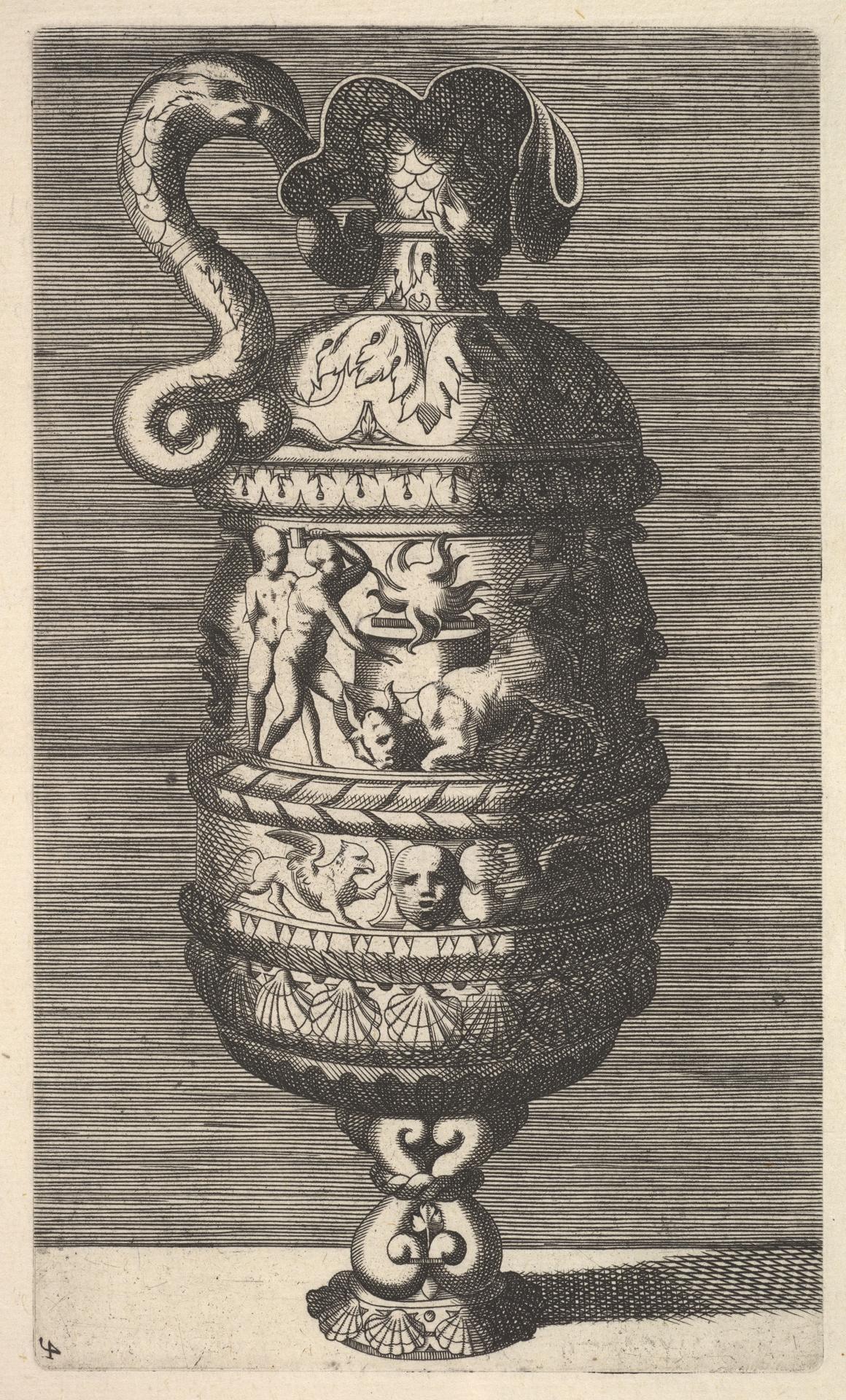
Vase with a Sacrificial Scene (17th century)
Original title: Vase with a Sacrificial Scene
kurzbeschreibung
A sacrificial ritual at a table, framed by elaborate vase ornament, unfolds in René Boyvin's 17th-century engraving Vase with a Sacrifice Scene. Measuring 26 by 17.6 cm, the sheet belongs to the Metropolitan Museum of Art's graphic collection.
Description
The vase is divided horizontally into several zones of varying decoration. At the top a snake coils, below which appears a shield with a bird. In the middle section two figures bend over a table bearing an animal; to either side are a face and another bird. Shell motifs form the lower termination. The layout is symmetrical with figures placed centrally, drawn in fine, precise lines.
Context
René Boyvin, a French copperplate engraver of the Renaissance, is known for his reproductive engravings after designs from the School of Fontainebleau. This print was made in the 17th century and belongs to a series of ornamental plates devoted to antique vases and vessels. Such prints served artists and craftsmen as models for decorative work. The sheet forms part of the Metropolitan Museum of Art's extensive graphic collection, which offers it as a public-domain work.
Impact
Calm and balanced, the print owes its poise to the symmetrical arrangement and even linework. The meticulously rendered ornaments and figures lend it a decorative, almost calligraphic quality. The monochrome reproduction draws the eye to the fine drawing and the clear articulation of the structure.
Technique
In etching, lines are incised into a metal plate that has been bitten with acid. The even distribution of light and shade is typical of this process, which permits fine and precise lines. The sheet was printed on paper and measures 18.9 by 11.2 cm at the plate mark.
AI-generated description text
Source: Metropolitan Museum of Art · Public Domain (CC0 1.0)