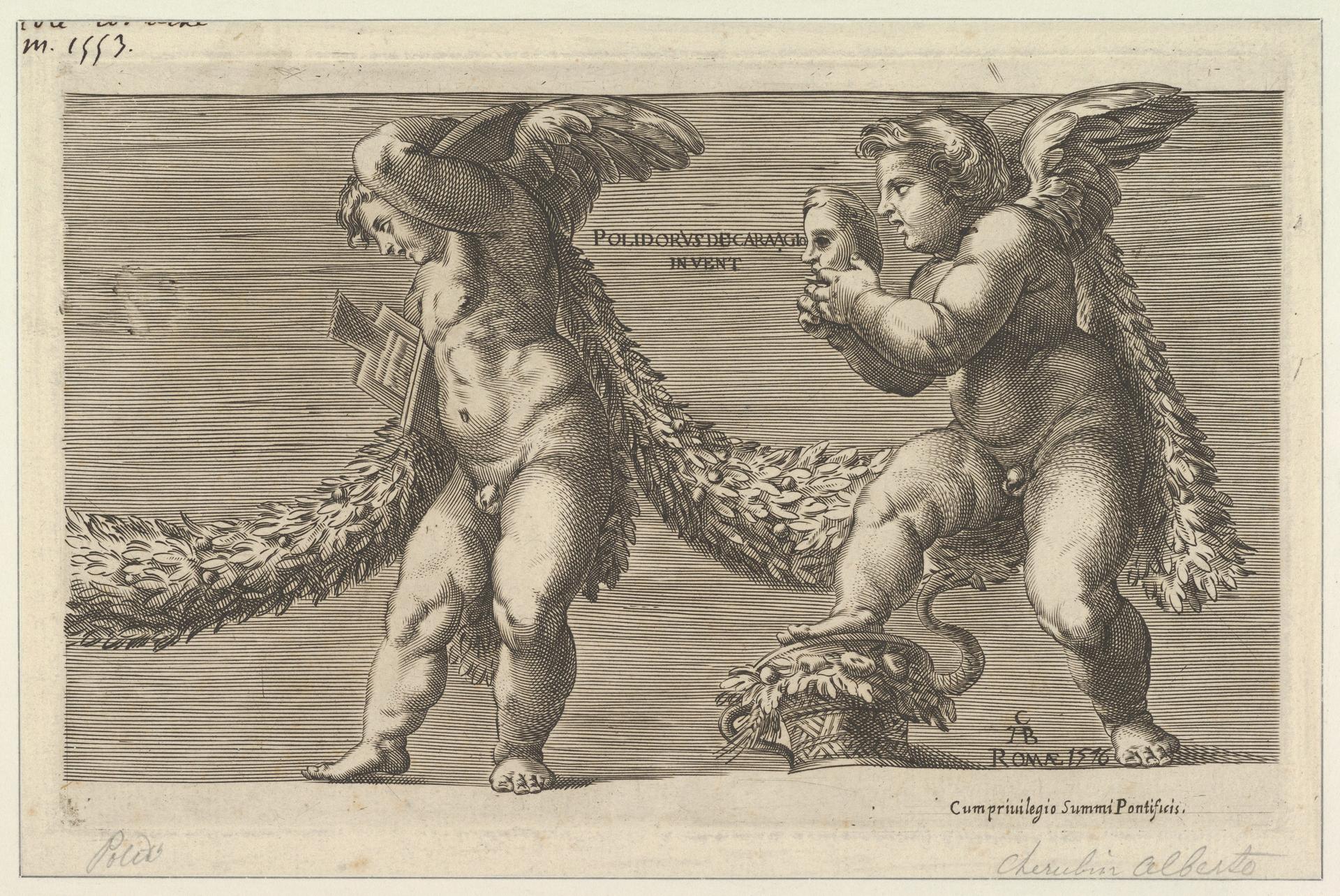
Two putti draped with a garland the one at right holding a mask
Original title: Two putti draped with a garland the one at right holding a mask
kurzbeschreibung
Cherubino Alberti engraved two winged putti within a laurel garland in 1596. The right putto holds a mask, the left has a book tucked under his arm. The invention is Polidoro da Caravaggio's, as the inscription “POLIDORV DUCARAJE INVENT” indicates.
Description
Two naked, winged putti stand symmetrically about a vertical axis, linked by a curving laurel garland. The right one holds a mask before his chest with both hands; the left clamps a book under his left arm. Fine vertical lines divide the surface; a coat of arms with a sheep's head appears at lower right. The inscription “ROMA 1576” at lower right dates the source, while the figures remain in calm, classical poses.
Context
Alberti engraved this sheet in 1596 as a reproductive print after an invention by Polidoro da Caravaggio. Polidoro was known for façade decorations and grotesques, which often took up mythological or allegorical themes. Alberti, a sought-after copper engraver in Rome, reproduced such models for a broad circle of collectors. The inscription “ROMA 1576” probably refers to an earlier version or a Roman model that Alberti used as reference.
Impact
The symmetrical arrangement of the putti and the floating garland produce a balanced, decorative image. Mask and book give the scene an allegorical touch, evoking theater and scholarship. Fine lines and clear contours leave an elegant, graphic impression.
Technique
The etching is made by incising lines into a metal plate and biting them with acid. This allows fine, even hatching, used here to model the bodies and articulate the background. At 15.9 × 24.1 cm the sheet is relatively small and counts among the usual collectible prints of the period.
AI-generated description text
Source: Metropolitan Museum of Art · Public Domain (CC0 1.0)