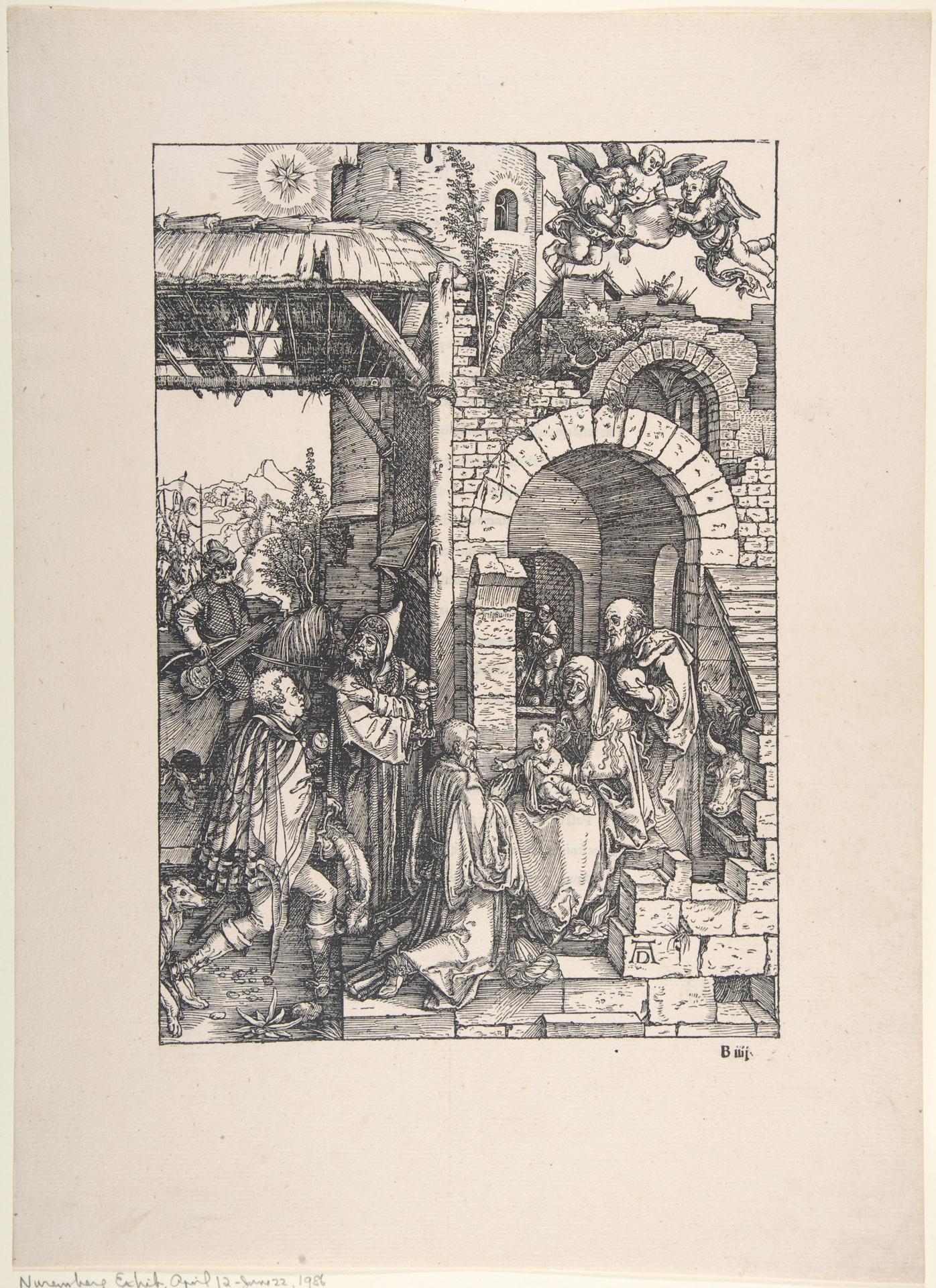
The Adoration of the Magi, from "The Life of the Virgin"
Original title: The Adoration of the Magi, from "The Life of the Virgin"
kurzbeschreibung
This woodcut by Albrecht Dürer, dated around 1502, depicts the Adoration of the Magi as part of his series "The Life of the Virgin." The scene shows the three wise men presenting gifts to the infant Jesus, set in a rustic architectural environment. Rendered in stark black-and-white, the print exemplifies Dürer's mastery of the woodcut medium.
Description
The composition centers on the Virgin Mary holding the Christ Child, flanked by the three Magi who kneel in reverence, each offering a gift. The setting includes a crumbling wall, a pointed arch, and a wooden roof with a lantern, creating a intimate yet monumental space. In the upper register, angels hover in the sky, while additional figures appear in the background, adding depth. The strong diagonal lines of the architecture guide the eye toward the central figures, and the use of light and shadow models the forms with dramatic contrast.
Context
Dürer created this woodcut as part of his ambitious "Life of the Virgin" series, which he published in Nuremberg around 1502. The series was intended to compete with the popularity of engravings and to showcase Dürer's skill in printmaking. The Adoration of the Magi reflects the Northern Renaissance interest in detailed naturalism and devotional imagery, drawing on biblical narratives and contemporary religious practices.
Impact
The print impresses with its intricate linework and balanced composition, drawing the viewer into the sacred event. The contrast between the dark background and the illuminated central group creates a sense of divine presence, while the detailed textures of the architecture and robes invite close inspection. Dürer's ability to convey emotion through posture and gesture lends the scene a quiet, reverent atmosphere.
Technique
Dürer employed the woodcut technique, carving the design into a wooden block, inking it, and pressing it onto paper. The fine, parallel lines and cross-hatching demonstrate his precision and control, allowing for subtle gradations of tone. This print likely used a single block, with the image printed in black ink, characteristic of Dürer's mature graphic style.
AI-generated description text
Source: Metropolitan Museum of Art · Public domain (CC0)