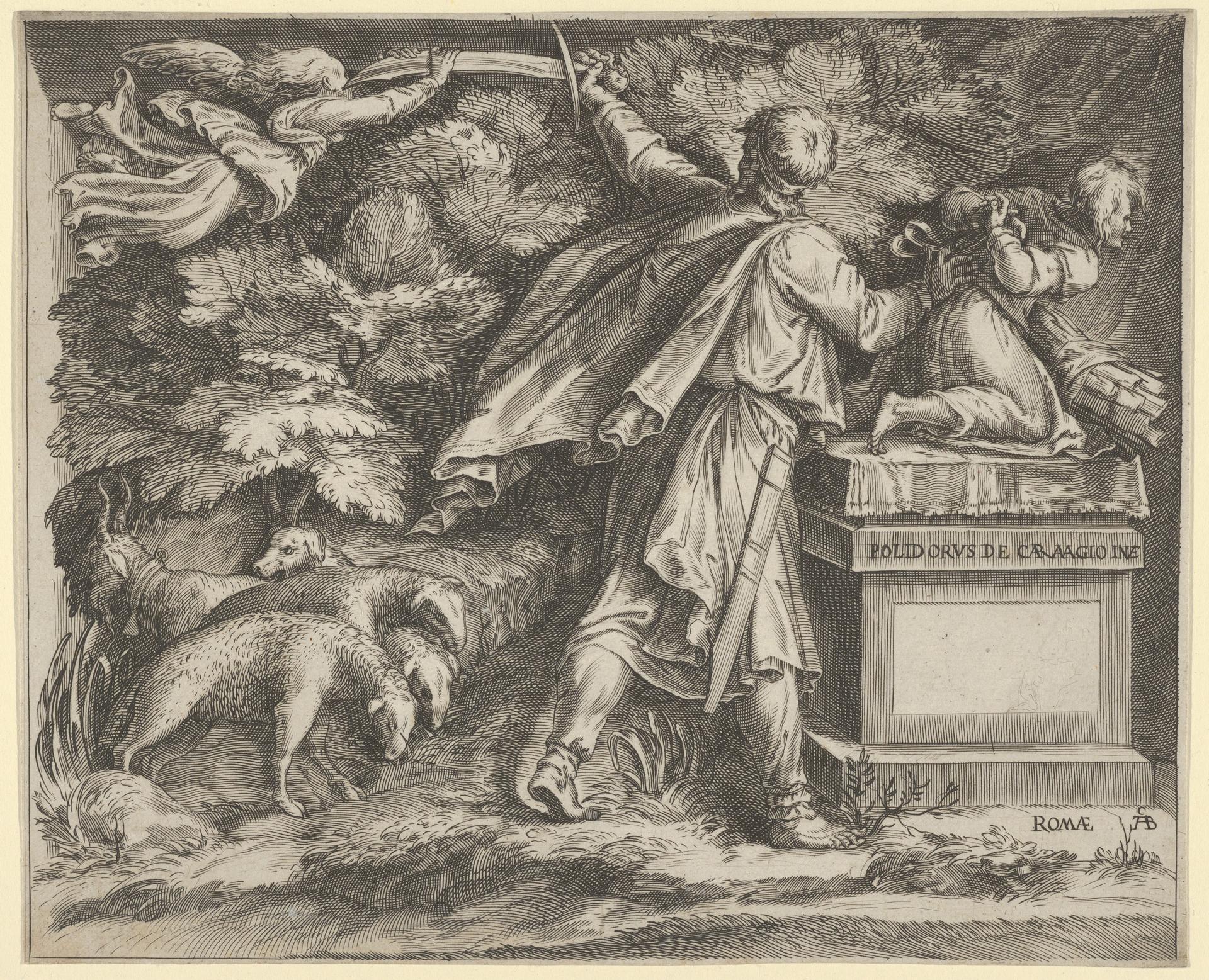
The Sacrifice of Isaac
Original title: The Sacrifice of Isaac set in a landscape with a flock of sheep at left and an angel guiding Abraham's sword at upper left
kurzbeschreibung
Abraham raises his hand to strike, but an angel turns his sword aside. This engraving by Cherubino Alberti (Zaccaria Mattia), made between 1570 and 1615, presents the biblical scene with delicate, hatched lines. The paper measures 18.1 × 22.3 cm.
Description
Abraham stands at the center, sword in his left hand, his right hand resting on the altar. Isaac lies upon it, arms raised in fear or despair. Above the group hovers an angel with outstretched wings, pointing a sword at Isaac—a sign of rescue. To the left, sheep graze peacefully among trees and bushes. The entire print is in shades of gray, as is typical of engraving.
Context
Cherubino Alberti, a late-Renaissance Italian engraver and painter, is best known for his reproductive prints. Biblical scenes were common in printmaking of his time, serving both religious and artistic purposes. Alberti produced many engravings after his own designs and after works by other artists, demonstrating his versatility. The patron or original purpose of this print is not recorded.
Impact
The arrangement is dynamic and draws the eye to the figures, especially the tension between Abraham's sword and the angel's intervention. Fine lines and hatching create detailed depth that underscores the emotional weight of the moment. The calm landscape contrasts with the dramatic action, heightening the narrative effect.
Technique
In engraving, lines are cut into a copper plate and then printed on paper. Cross-hatching and fine lines produce tonal gradations and textures characteristic of this printmaking method. The shades of gray arise solely from the line work, without added color—a hallmark of printmaking of the period.
AI-generated description text
Source: Metropolitan Museum of Art · Public Domain (CC0 1.0)