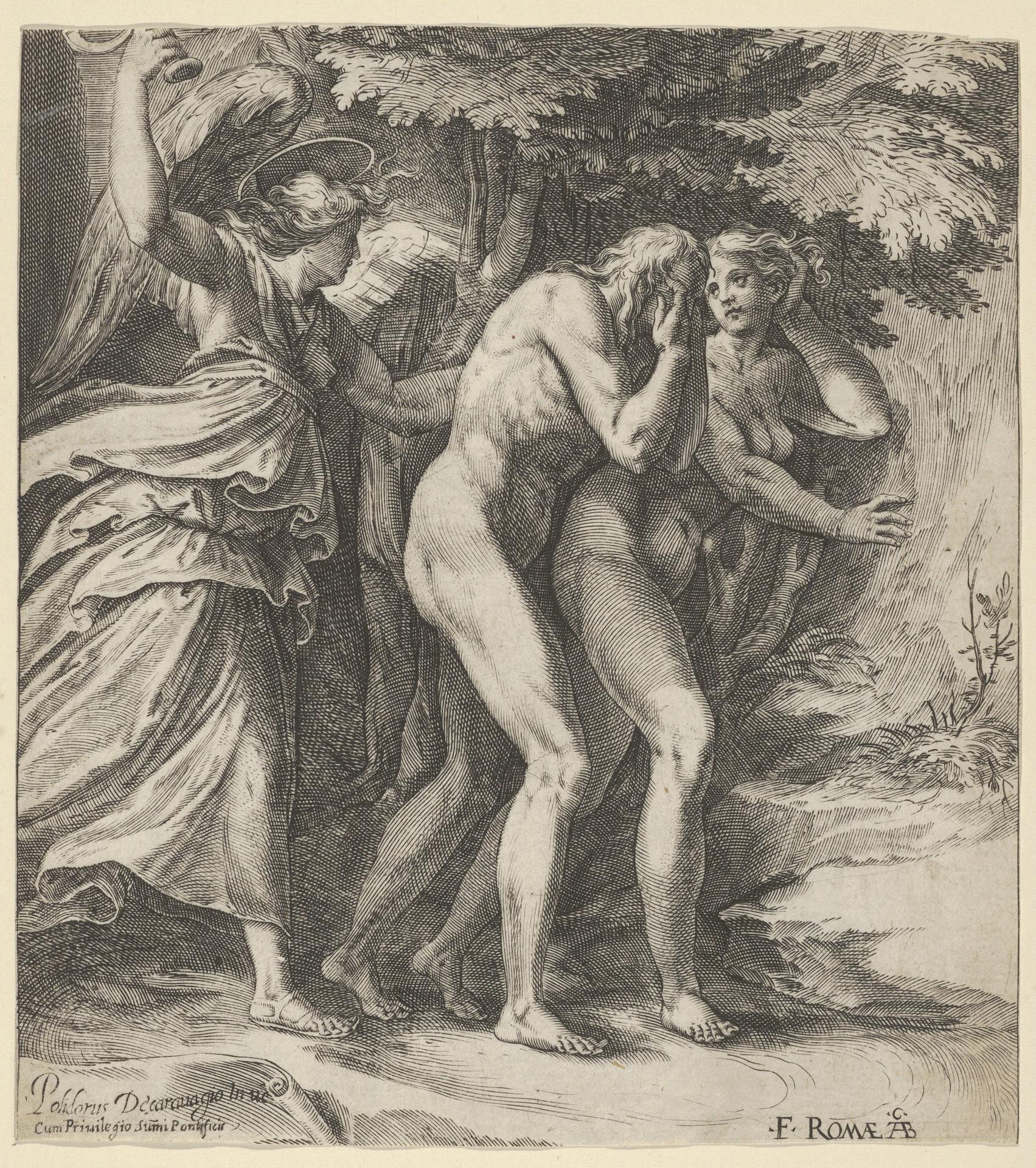
The Expulsion from Paradise with an Angel wielding a sword behind Adam and Eve
Original title: The Expulsion from Paradise with an Angel wielding a sword behind Adam and Eve
kurzbeschreibung
Cherubino Alberti (Zaccaria Mattia) engraved this print sometime between 1570 and 1615, capturing the biblical moment when Adam and Eve must leave the Garden of Eden. Behind the pair an angel rises, swinging a sword and driving them forward. They cover their bodies in shame, while the bearing and linework still carry the stamp of the Renaissance.
Description
Adam and Eve stride to the right, hands raised to shield themselves, as an angel towering at their backs presses them on with lifted sword. Firm contours and fine hatching give the figures their solidity. Trees and bushes behind them hint at the paradisiacal setting the couple is leaving behind. The sheet stays monochrome, with strong contrasts of light and dark that carry the drama of the instant.
Context
Cherubino Alberti was an Italian engraver and painter of the late Renaissance, known above all for reproductive prints after other artists' works. This sheet was likely made as a standalone piece or as part of a series of biblical scenes. The Expulsion from Paradise was a favourite subject in Christian art, since it dealt with original sin and its consequences. Alberti worked in Rome and Florence; Mannerism and Roman antiquity shaped his output.
Impact
Dense hatching and expressive postures generate a tension the viewer feels at once. The monumental figures of Adam and Eve lend the biblical event an almost theatrical presence. Because the print stays black and white, the eye is drawn to the drawing and the layout.
Technique
For this engraving the lines were cut into a metal plate and then printed on paper. Alberti used cross-hatching and fine parallel lines to work out shadow and volume. The precise burin technique allows high detail and nuanced transitions between light and shade.
AI-generated description text
Source: Metropolitan Museum of Art · Public Domain (CC0 1.0)