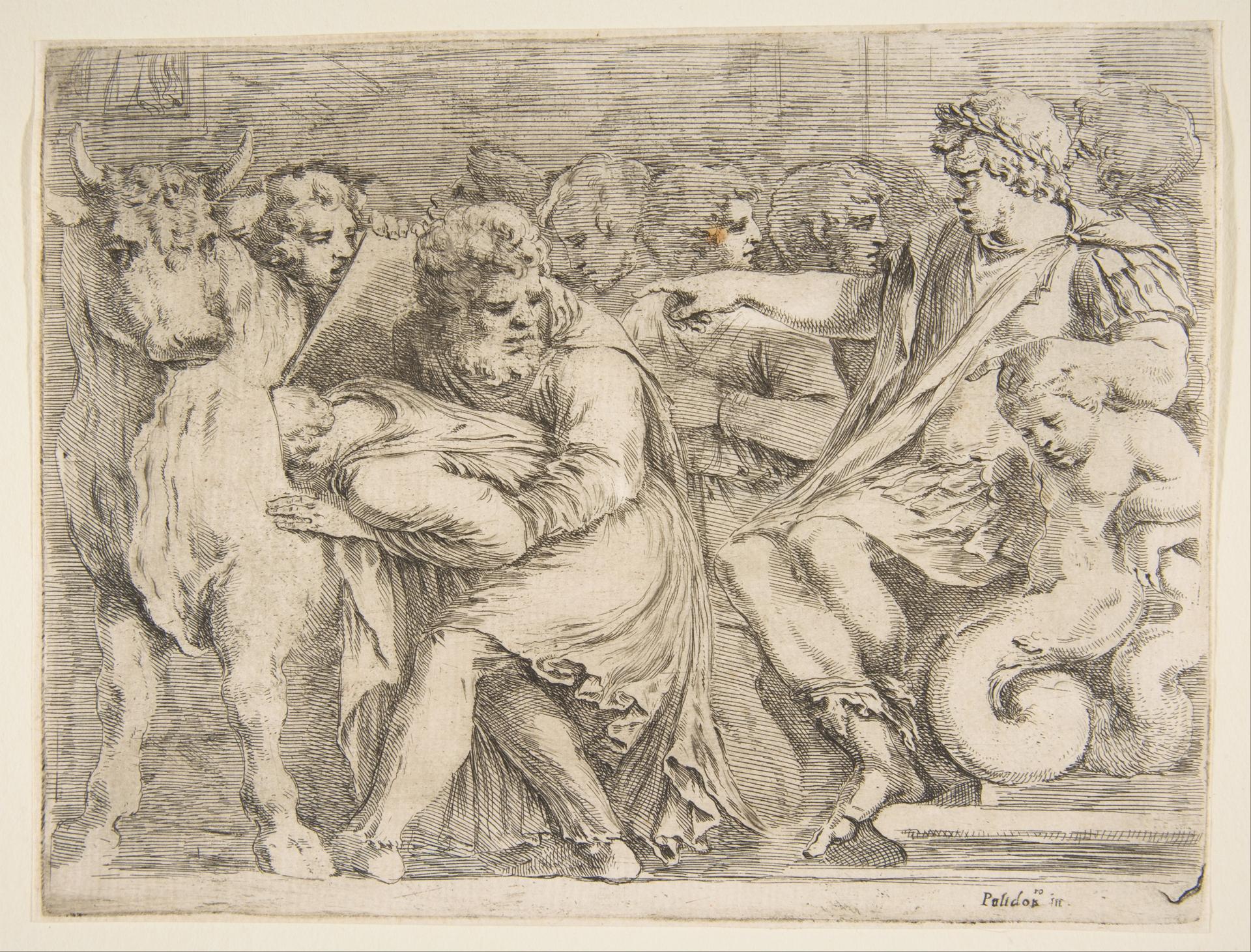
Phalaris Having Perillus Thrown into the Bronze Bull
Original title: Phalaris Having Perillus Thrown into the Bronze Bull
kurzbeschreibung
Stefano della Bella produced this etching in the 17th century, illustrating an ancient form of punishment: the tyrant Phalaris orders the inventor Perillus to be thrown into the bronze bull. The print is executed as an etching with additional engraving and exists in the second of three states.
Description
At the heart of the action, Phalaris and Perillus grapple with each other, while the bronze bull stands to the left. Wrapped in a robe, the tyrant holds the prisoner firmly with one hand; the captive is already inside the bull. Around them stand other figures, some watching, some taking part; on the right, a child has settled on a seat-like support. Fine hatching and clusters of lines give the garments volume and create a scattered light with dark shadows.
Context
The print recounts the legend that Perillus presented the tyrant Phalaris of Akragas with a bronze bull as an instrument of torture, in which people were burned; Phalaris is said to have subsequently had the inventor himself perish inside it. Della Bella probably made this sheet in the 1640s, when he was working for the Medici in Florence and later in Paris. It belongs to a series of scenes of ancient punishments and historical events.
Impact
The dynamic arrangement and precise drawing immediately draw the eye to the brutal contest of strength between ruler and victim. The monochrome printing technique and dense hatching give the event a gloomy, tense atmosphere that emphasizes the harshness of the action.
Technique
The print was made using etching with additional engraving, visible in the uniformly fine lines and strong strokes. This method allows precise details in faces and garments, while the shadows are built up from closely spaced lines. The present impression is the second of three states, indicating that the plate was reworked.
AI-generated description text
Source: Metropolitan Museum of Art · Public Domain (CC0 1.0)