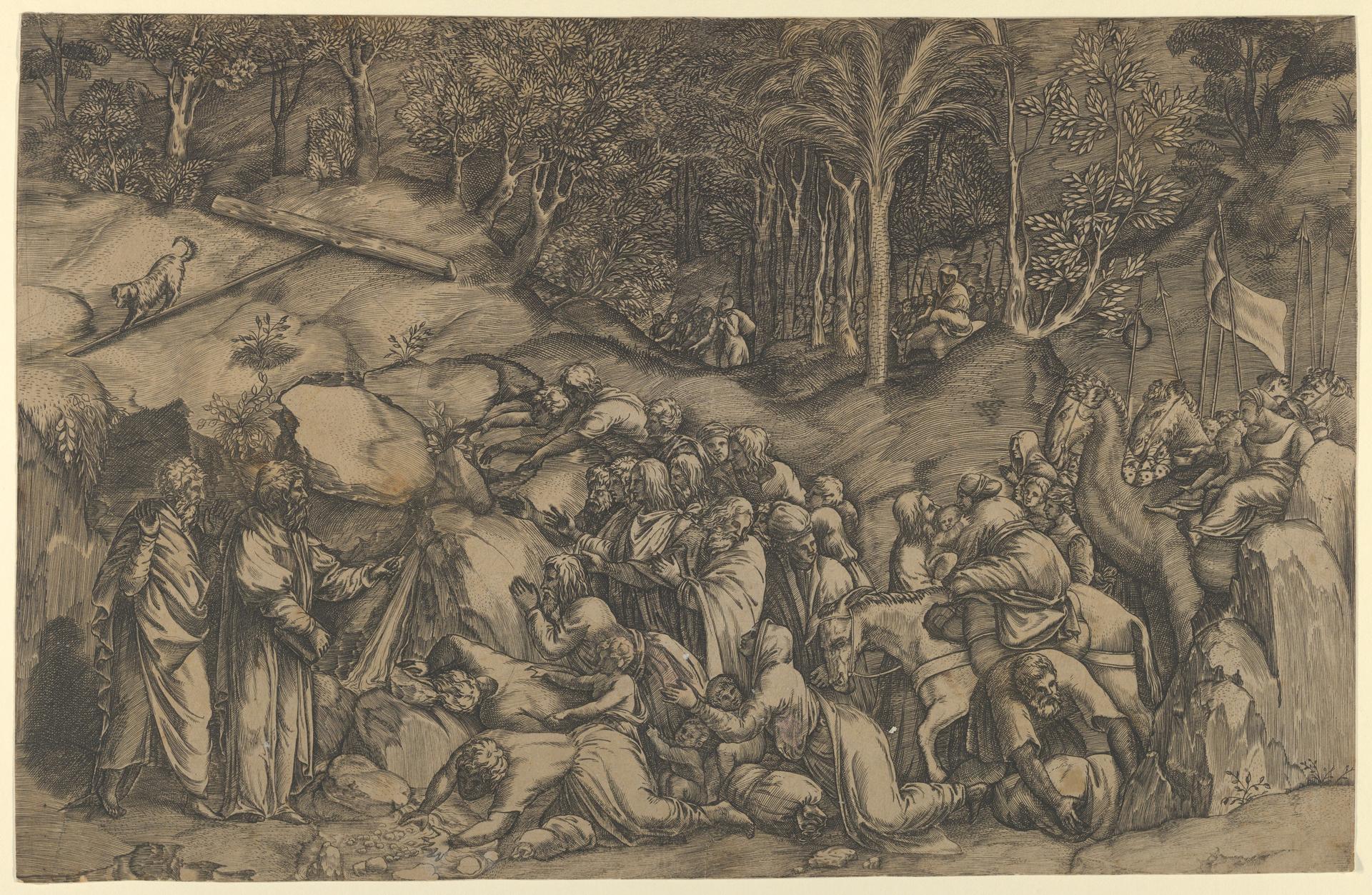
Moses striking the Rock
Original title: Moses striking the Rock
kurzbeschreibung
An anonymous Italian engraver of the sixteenth century produced this copperplate engraving between 1530 and 1550. It depicts the biblical story in which Moses strikes a rock with his staff, bringing forth water for the people of Israel. The sheet measures 26.8 x 42 cm and is executed as an engraving.
Description
Moses stands at the center, raising a club to strike the rock, closely surrounded by a crowd. Some of the bystanders kneel or lie on the ground, while others remain on horseback, all pressing toward the action at the center. Trees and a hilly landscape suggest a natural setting behind them. A few figures farther back seem to be moving, perhaps toward the rock. The sheet remains monochrome; hatching and lines create the play of light and shadow.
Context
The print was made in Italy in the first half of the sixteenth century, when biblical subjects circulated widely in printmaking. It is based on the Old Testament narrative (Exodus 17:6), in which Moses, at divine command, strikes water from a rock. The unknown engraver likely belonged to the circle of Italian Renaissance printmaking, known for its precise linework and wealth of detail. Prints of this kind often served religious instruction and were issued in substantial numbers.
Impact
What first strikes the viewer is the crowded press of figures and Moses's violent gesture, which lend the scene movement and tension. Subtly graded lines and shadows produce a calm yet insistent visual effect that draws the eye into the biblical event. Because the format stays monochrome, attention falls on the narrative details and the postures of the figures.
Technique
This sheet is a copperplate engraving: the design is incised into a copper plate and then printed on paper. Fine lines and cross-hatching generate graduated tones and sculptural effects. The careful execution reveals high craftsmanship, as was common in Renaissance printmaking.
AI-generated description text
Source: Metropolitan Museum of Art · Public Domain (CC0 1.0)