Abduction of Proserpine
Original title: Abduction of Proserpine
kurzbeschreibung
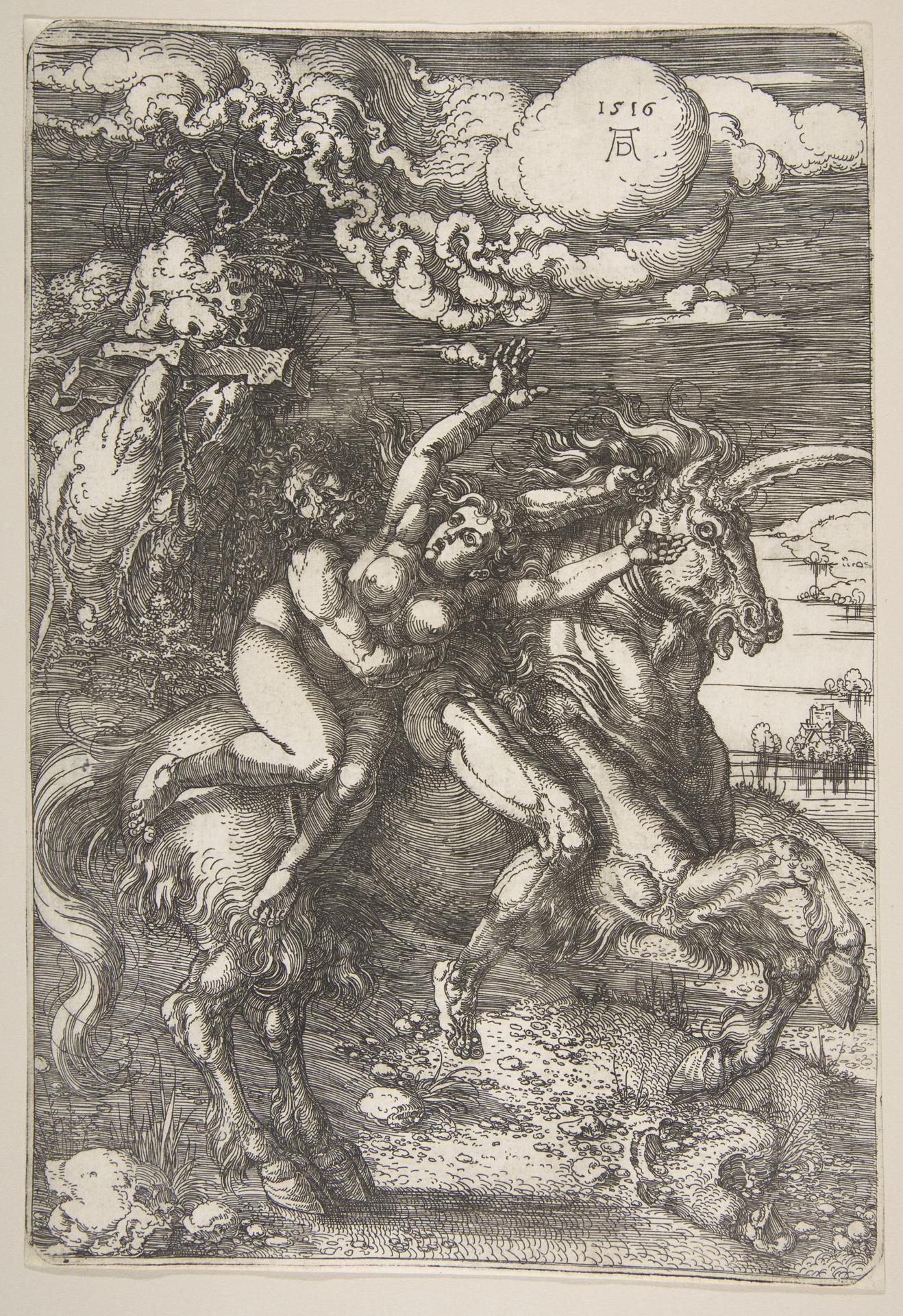
Albrecht Dürer's etching 'Entführung der Proserpina' dates from around 1516 and presents a mythological event: Pluto, depicted here as a satyr, abducts Proserpina. The print is executed as an etching, measuring 31.4 x 21.4 cm.
Description
A satyr charges in on horseback, gripping a female figure; her arms are raised, her face contorted into an expressive grimace. The satyr's posture is supple and lively, underscoring the energy of the movement. Behind him clouds pile up, and another horse gallops. The execution remains monochrome, carried by delicate lines and graduated shading. In the upper right is the engraved date 1516.
Context
This etching belongs to Dürer's late creative years, when he increasingly turned to classical and mythological subjects. The abduction of Proserpina comes from Roman tradition, in which Pluto carries Ceres's daughter off to the underworld. Dürer incorporated influences from the Italian Renaissance that he had absorbed during his travels to Italy.
Impact
The dynamic composition and the expressive gestures of the figures create a tension that draws the viewer directly into the action. Despite the dramatic event, the etching technique maintains a fine elegance characteristic of Dürer's printed oeuvre.
Technique
In this etching, an acid-resistant ground was applied to a copper plate, and the artist incised the drawing into it before the plate was bitten in acid. Dürer used this process to achieve fine lines and gentle hatching that model the figures with a sense of volume. Because the plate was trimmed to the very edge, the composition relies entirely on dense linear shading to build light, shadow, and the dynamic energy of the abduction scene.
AI-generated description text
Source: Metropolitan Museum of Art · Public Domain (CC0 1.0)