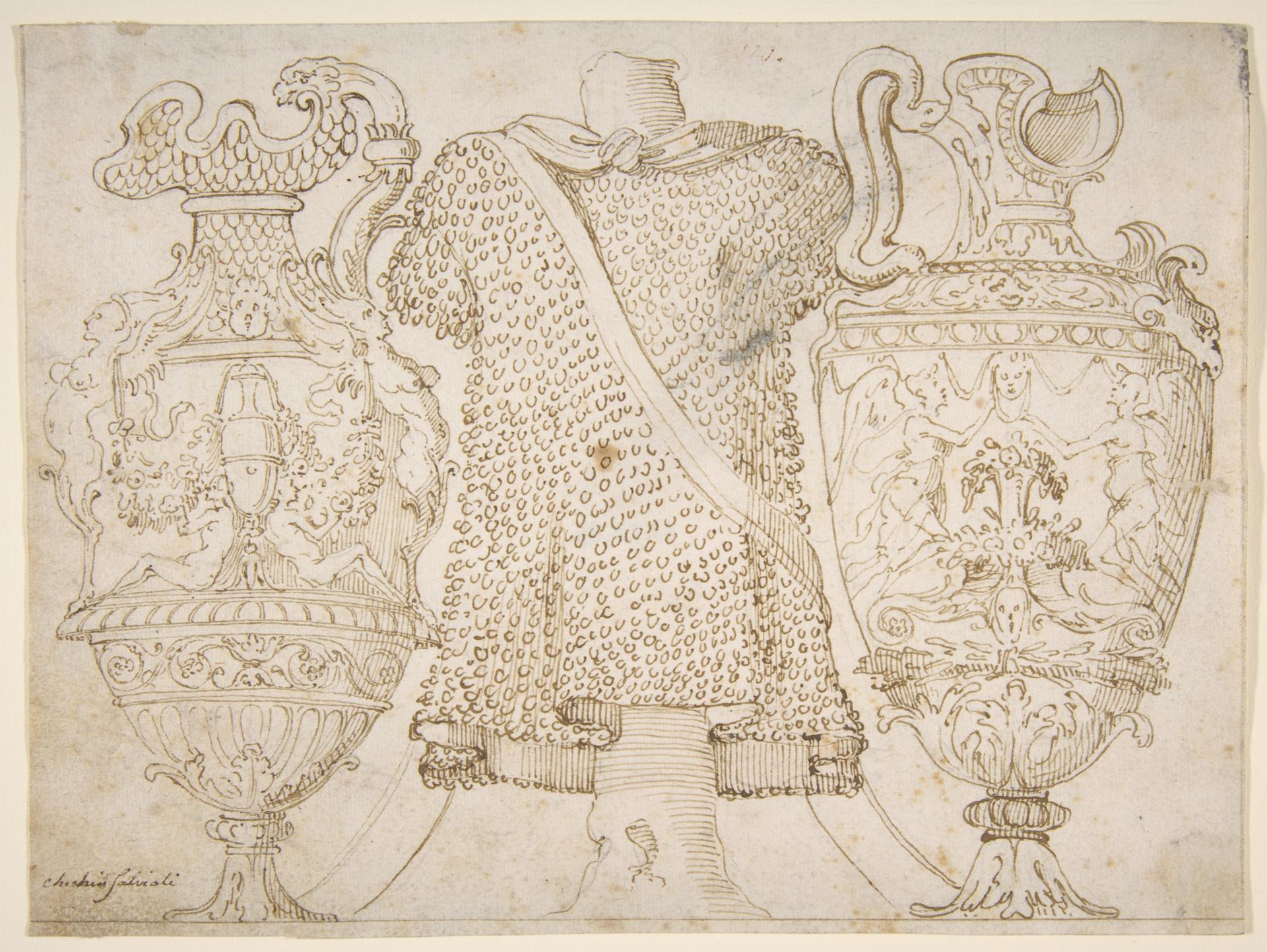
Ornamental Design with Amphore and Antique Style Armor
Original title: Ornamental Design with Amphore and Antique Style Armor
kurzbeschreibung
Polidoro da Caravaggio made this symmetrical ornament design in the 16th century, in which two elaborately decorated amphorae frame a piece of armor in the middle. The sheet is executed in pen and brown ink over traces of black chalk or leadpoint.
Description
Two amphorae are arranged in mirror image around a central armor piece. In the left amphora a figure holds a chalice, in the right one a figure holds a sword. The middle armor section has a dotted texture and various decorated zones. Brown and black tones dominate the monochrome image, and the light is evenly distributed.
Context
Polidoro da Caravaggio, an Italian painter of the Renaissance, is known for his facade decorations and ornamental designs. The drawing dates from the 16th century, when antique motifs and grotesques were highly popular in ornamentation. Such designs often served craftsmen as models or functioned as studies for larger decorative projects.
Impact
The eye is immediately drawn to the clear symmetry, then glides to the richly detailed ornaments. The delicate linework and balanced arrangement convey calm and equilibrium. Looking longer, one discovers ever new details and recognizes in them the skill of Renaissance ornamentation.
Technique
Pen and brown ink, applied over traces of black chalk or leadpoint, define the execution. A partial framing line encloses the composition. This technique allows precise and fine lines, as are typical for ornamental designs.
AI-generated description text
Source: Metropolitan Museum of Art · Public Domain (CC0 1.0)