The Story of Niobe (n.d., Met-Objekt 2240)
Original title: The Story of Niobe
kurzbeschreibung
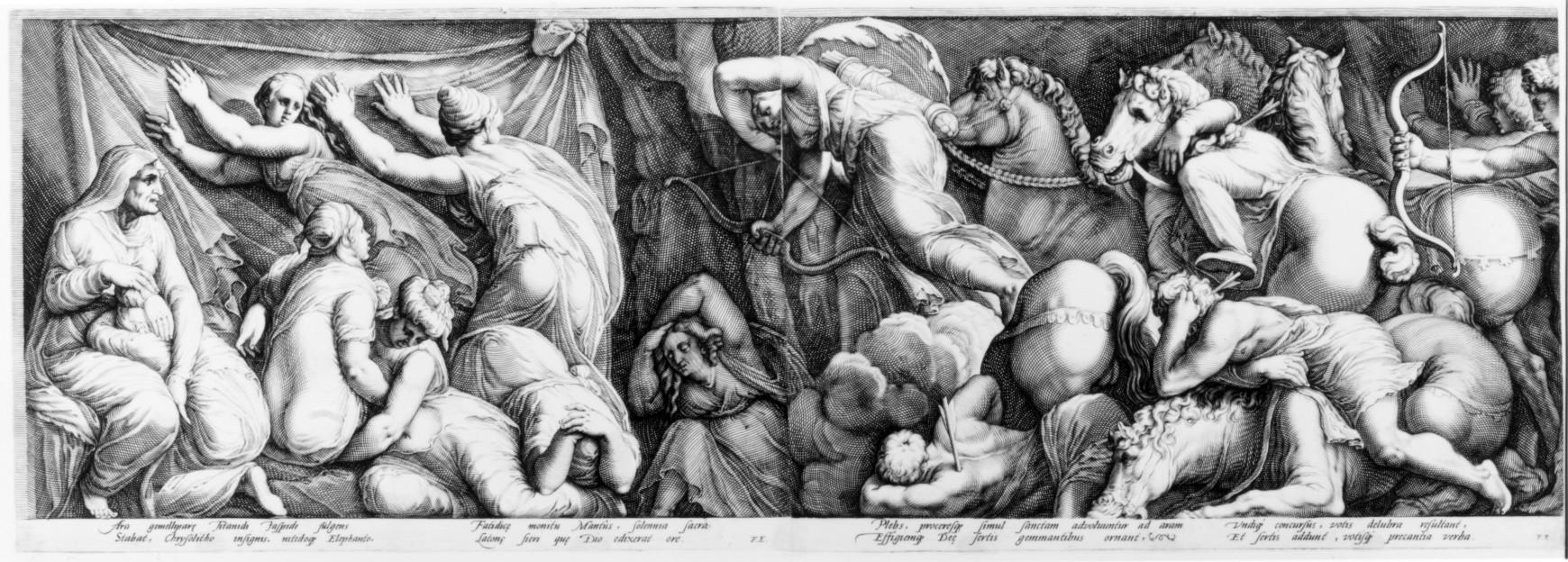
The death of Niobe's children, struck by the arrows of Apollo and Diana, is the subject of this engraving by Jan Pietersz. Saenredam, likely from the late 16th or early 17th century. The sheet is a first state, in which the inscription of the final stanza has been covered with a piece of paper bearing the corrected text in brown ink.
Description
Figures lie on the ground to the right and in the middle, struck down or already dead; some still hold bows and arrows. On the left, women sit or raise their arms in poses that convey despair and grief. Further back, more figures aim bows at those fallen. The layout is densely packed and full of movement, the rendering of drapery and poses detailed and classically inflected, all in monochrome.
Context
Jan Saenredam, a Dutch engraver, was known for his careful reproductions as well as his own designs. This print was made around 1600, a time when Dutch art absorbed strong influences from antiquity and the Italian Renaissance. The story of Niobe from Ovid's Metamorphoses was widely popular then. Saenredam often worked after other artists' designs, but an independent composition can be assumed here.
Impact
The crowded arrangement of figures and their expressive poses create an intense drama that emphasizes the tragic event. At the same time, the even distribution of light and precise linework give the sheet a calm, almost analytical distance that invites the viewer to look closely.
Technique
This is an engraving, in which lines are incised into a copper plate. The present version is a first state: the inscription of the last stanza has been pasted over with a strip of paper and replaced by corrected text in brown ink. At 76.5 cm wide, the paper is unusually broad, suggesting a plate that was costly to produce.
AI-generated description text
Source: Metropolitan Museum of Art · Public Domain (CC0 1.0)