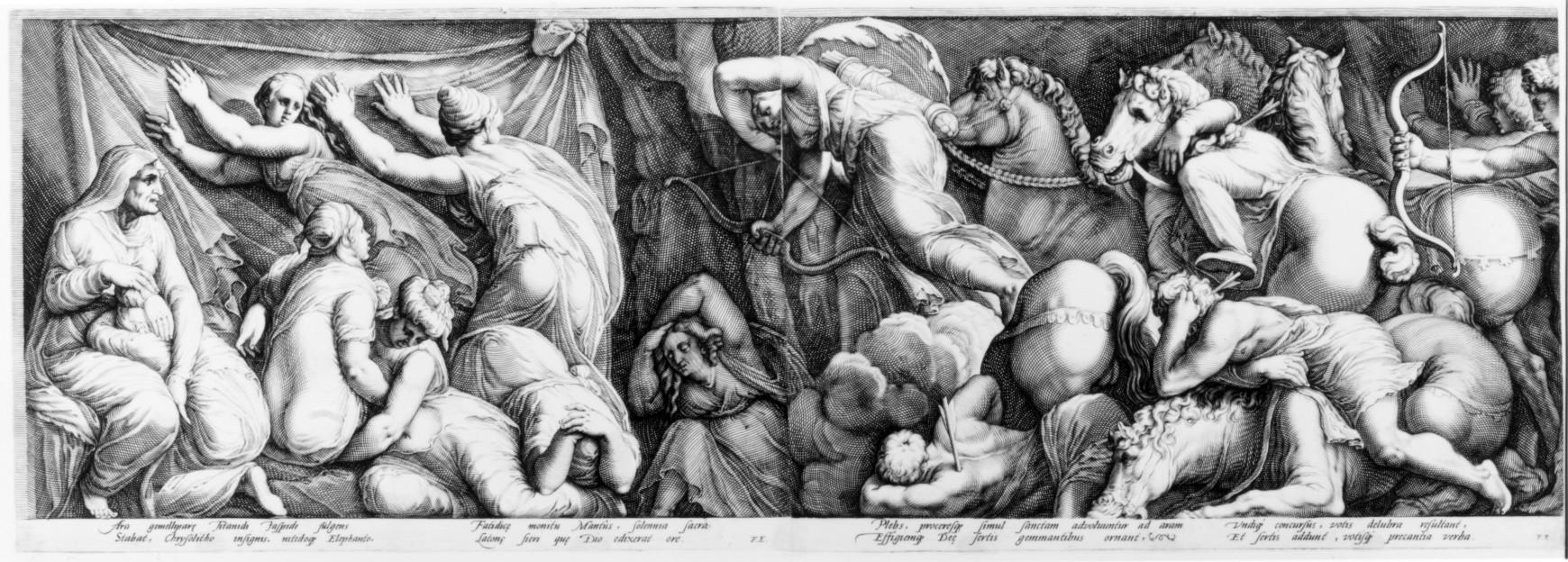
The Story of Niobe (n.d., Met-Objekt 2239)
Original title: The Story of Niobe
kurzbeschreibung
Jan (Pietersz.) Saenredam takes up the Niobe myth in this undated engraving, presenting it as a figure-packed sheet measuring 26.4 x 76.5 cm. Unlike many contemporary treatments of the subject, this first state focuses less on the isolated heroine than on the melee of the dying, the fleeing, and mounted archers. The tale of the death of Niobe's children unfolds here as a sprawling scene charged with movement.
Description
Scattered across the surface, several figures lie on the ground while others act with outstretched arms. Horses and bow-wielding figures suggest pursuit or combat. The layout feels densely packed; bodies move in various directions without forming a clear vanishing point. The image remains black and white, with light spread evenly over the sheet and shadows barely defined.
Context
Saenredam, a Dutch engraver of the Mannerist period, was known for his richly detailed graphics. The Niobe story belonged to the classical mythological repertoire and was frequently treated in art during the sixteenth and seventeenth centuries. The work was presumably made in the late sixteenth century, when mythological themes attracted wide interest in the Netherlands.
Impact
The close arrangement of the figures and their violent gestures create a palpable tension. Because shadows are absent and light is evenly distributed, the sheet gains a clear graphic presence that draws the eye to individual bodies. The viewer is led less into depth than across the surface.
Technique
As an engraving, the print relies on a drawing incised into the plate. The first state indicates an early impression made before further reworking of the plate. Extremely fine lines and a high degree of detail characterize the execution and correspond to Saenredam's usual working method.
AI-generated description text
Source: Metropolitan Museum of Art · Public Domain (CC0 1.0)