The Story of Niobe (n.d., Met-Objekt 2238)
Original title: The Story of Niobe
kurzbeschreibung
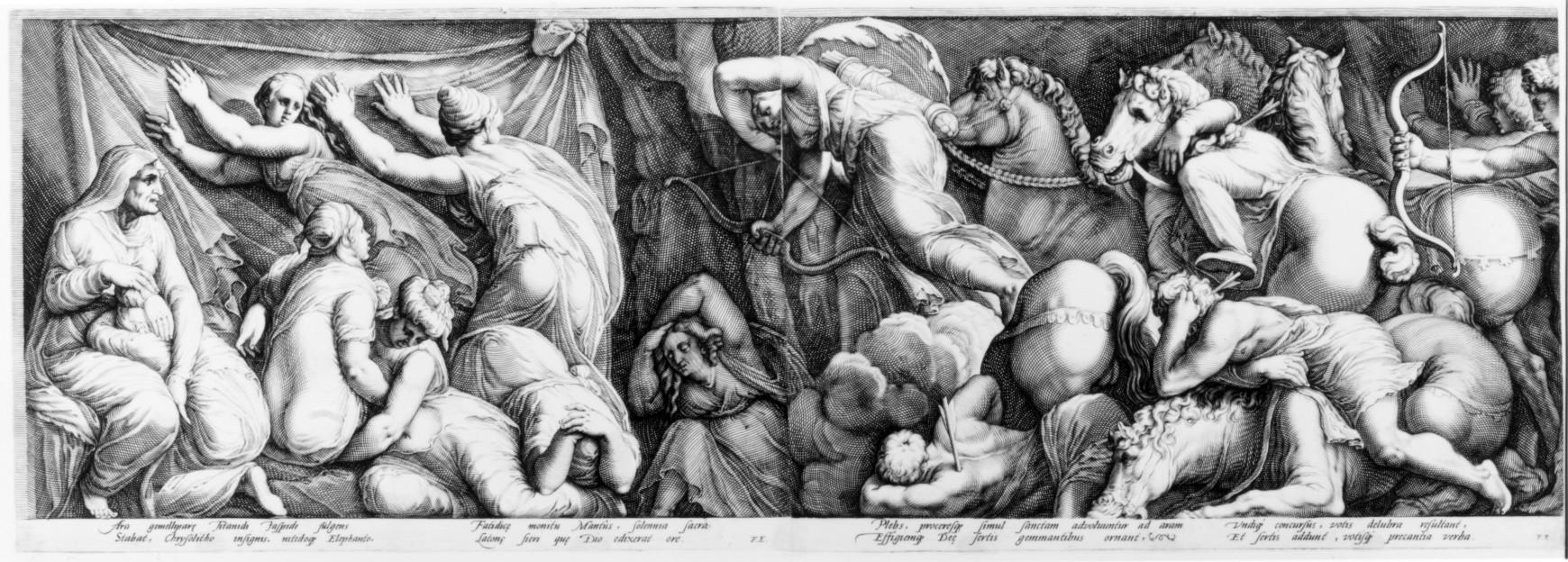
The myth of Niobe, grieving for her children, is the subject of this engraving by Jan Saenredam from around 1600. In the middle of the sheet, several figures appear in different emotional states: on the left, women in despair; on the right, riders on rearing horses. This impression is the first state.
Description
On the left, several women are shown in various poses, some lying on the ground, others hiding their faces with their arms. On the right, horses and riders dominate the action, the animals appearing disturbed or frightened. The figures wear traditional garments, indicating the mythological context. Executed in black and white, the print uses finely graded areas of light and shadow to bring out spatial depth and movement.
Context
Jan Saenredam, a Dutch engraver of the Renaissance, became known for his detailed reproductions after other artists' designs. The story of Niobe, who lost her children to the wrath of the gods, was highly popular in the sixteenth and seventeenth centuries. The sheet was likely made for a collector or as part of a series of mythological scenes.
Impact
The precise execution and dramatic staging of the figures immediately evoke emotion in the viewer. The contrast between the desperate women and the agitated horses heightens the impression of chaos and tragedy. Thus the viewer is drawn into the mythical action and experiences the intensity of the moment.
Technique
The print was made by engraving: lines are incised into a copper plate and then printed. Saenredam worked with fine, precise lines to bring out details and shading. The first state refers to the earliest printed version, distinguished by particular sharpness and clarity.
AI-generated description text
Source: Metropolitan Museum of Art · Public Domain (CC0 1.0)