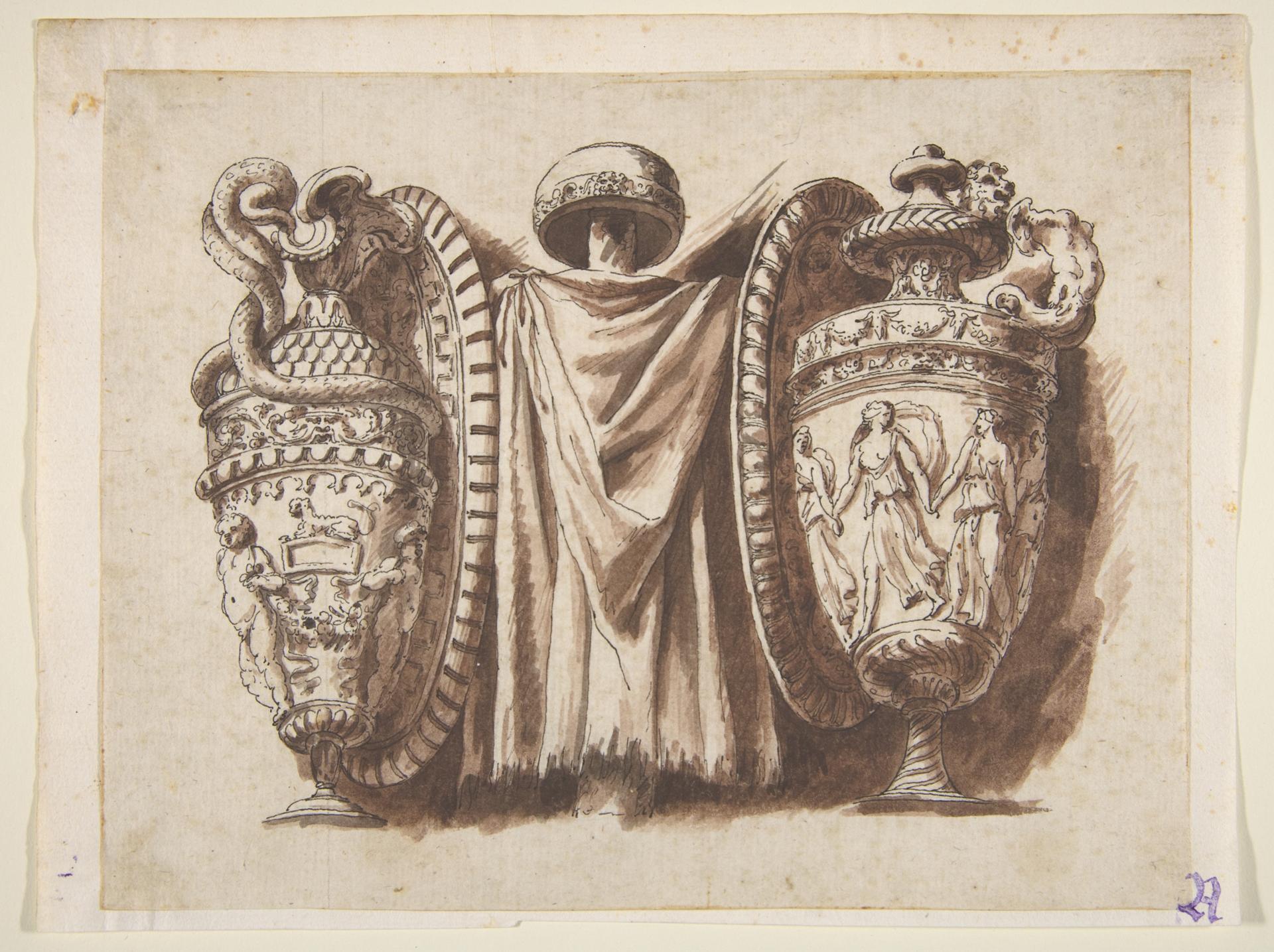
Trophy with Two Vases
Original title: Trophy with Two Vases
kurzbeschreibung
Two elaborately decorated antique vases and an object partly hidden by a cloth form the focus of this drawing by Polidoro da Caravaggio, made between 1600 and 1800. The sheet is executed in pen and black ink, with brush and reddish-brown wash over graphite.
Description
On the left vase, a dragon's head and serpent ornaments emerge, while the right vase carries figures of humans and possibly mythological creatures. Another vessel is partly veiled by a cloth or drapery, topped by a crowned or helmeted head. Light falls from the right, creating strong shadows and contrasts. The detailed, historical manner suggests a rendering of art objects from the Renaissance or Baroque.
Context
Polidoro da Caravaggio, a 16th-century Italian painter, is known for his grotesques and antique-style decorations. The dating of the drawing to 1600–1800 seems unusual, since the artist died in 1543; it may be a copy or a later work after his design. Trophy motifs of this kind were common in the Renaissance and Baroque for studying and collecting antique art objects.
Impact
The ornamental and figural details are rendered with great craftsmanship. Ink and brown wash give the sheet a warm, sculptural quality that underscores the antique theme. The viewer gains a close look at the decorative variety of the vases.
Technique
Pen and black ink form the basis, supplemented by brush and reddish-brown wash over a graphite underdrawing. This combination allows fine lines for details and soft tonal values for shadows, supporting the three-dimensional effect of the vases.
AI-generated description text
Source: Metropolitan Museum of Art · Public Domain (CC0 1.0)