Trophy with Two Ewers
Original title: Trophy with Two Ewers
kurzbeschreibung
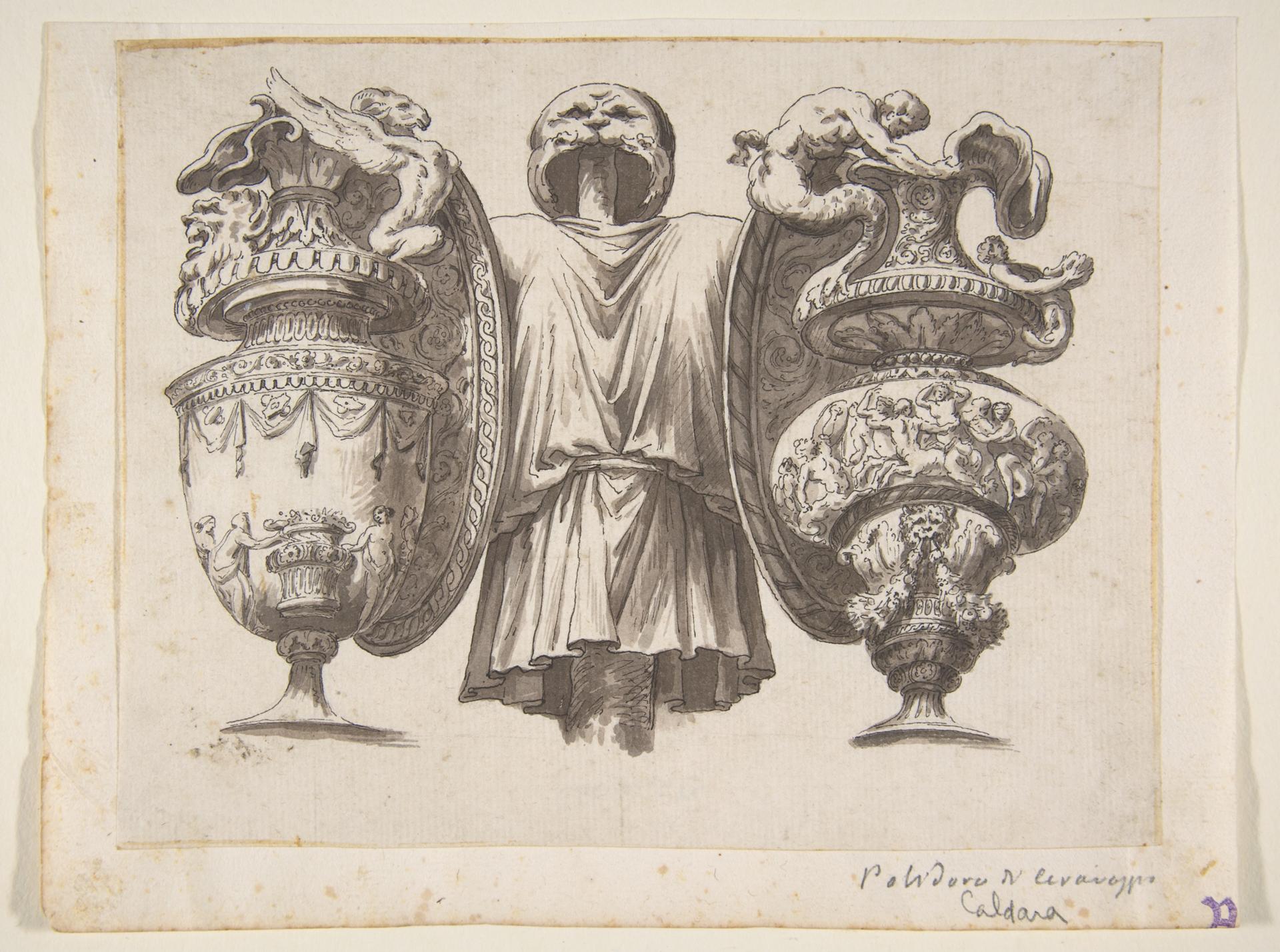
Two lavishly ornamented antique vases face one another, with a figure in classical dress standing between them. Polidoro da Caravaggio drew the sheet in pen and black ink, adding brush and grayish-brown wash over a graphite underdrawing; its making is placed somewhere between 1600 and 1800.
Description
The two vessels answer each other like mirror images, each covered with figural scenes and ornamental patterns. An elaborate lid crowned by a bird sits on the left one, while the right is likewise adorned with figures. Between them stands a drapery-wrapped figure with an animal-like head. The arrangement reads as clearly structured yet dense with detail, kept in black and white with gradations of gray. At the lower right appear the names "Polidoro da Caravaggio" and "Caldara."
Context
Polidoro da Caravaggio (around 1499–1543) was among the Italian painters of the Renaissance, known above all for his facade decorations and motifs drawn from antiquity. Since the dating of 1600–1800 falls well after his death, the sheet most likely comes from a later copy or an imitation of his style. Trophy and vase motifs were widely popular in the Renaissance and Baroque as decoration modeled on Roman antiquity. The attribution to Polidoro speaks to the esteem later artists held for his work.
Impact
Calm and balanced, the sheet meets the viewer, carried by precise contours and delicate washes. The ornamental richness of the vases sets up a tension with the plain figure between them, giving the whole a decorative and at the same time enigmatic quality.
Technique
Pen and black ink lay the foundation, while brush and grayish-brown wash supply the shading. Beneath the ink lies a graphite underdrawing that organizes the structure. At 14.6 x 18.7 cm the paper format is small, suggesting a study or a collector's piece.
AI-generated description text
Source: Metropolitan Museum of Art · Public Domain (CC0 1.0)