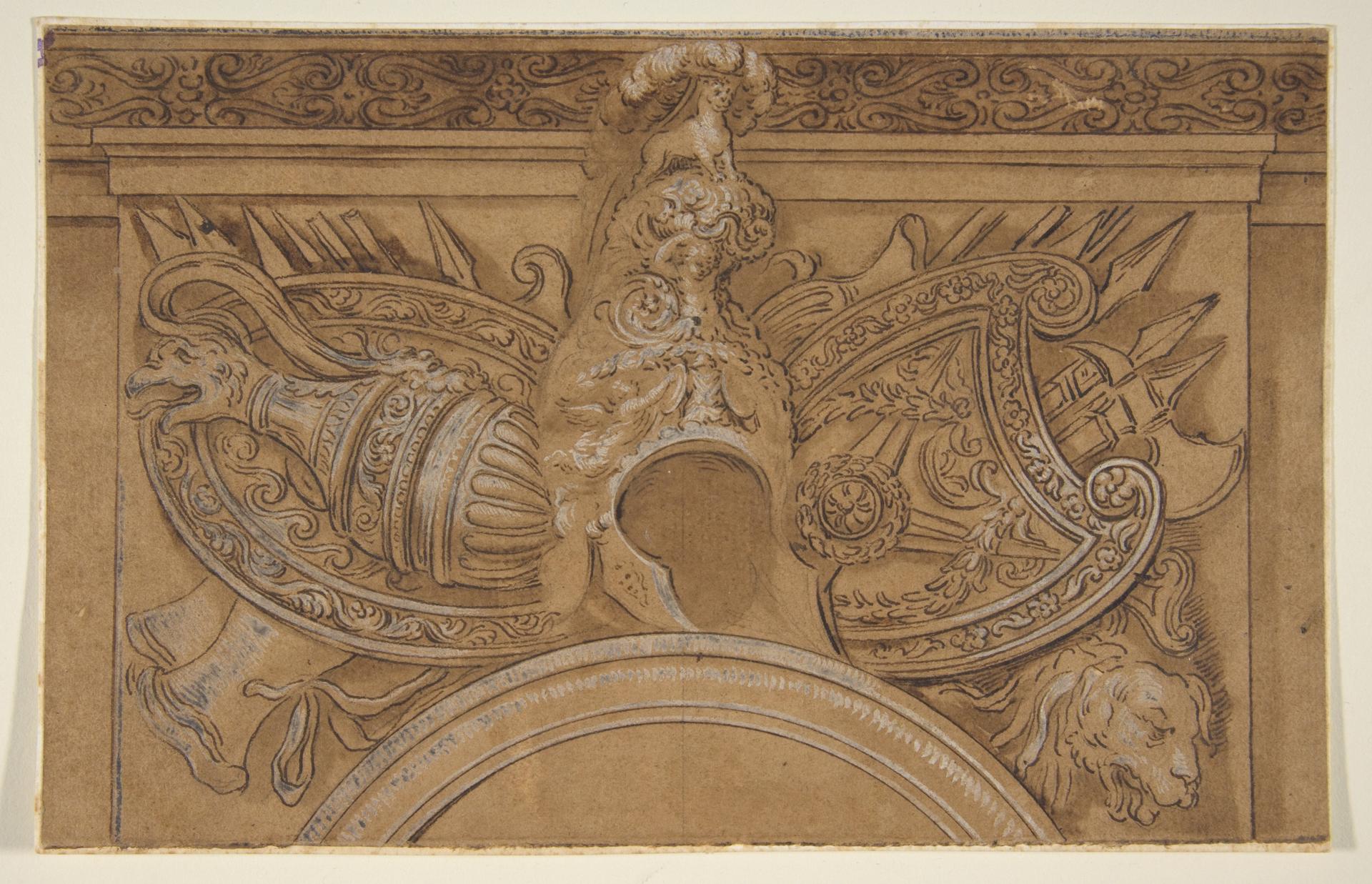
Armorial Trophy
Original title: Armorial Trophy
kurzbeschreibung
A lavish coat of arms featuring a lion, swords, and helmets fills this sheet, attributed to Polidoro da Caravaggio and dating from between 1600 and 1800. The drawing is executed in pen and brown ink, with brush and brown wash, and white heightening over graphite.
Description
A lion stands on a shield, wearing a sword and shield as a crown. Its paws are raised and its head is lifted—a dynamic pose. Above it sits another coat of arms with a helmet and crown, flanked left and right by identical ones. The layout is symmetrical and richly decorated with ornaments and heraldic figures. Brown tones dominate the palette, while white heightening emphasizes contours and details.
Context
Polidoro da Caravaggio (c. 1499–1543) was an Italian Renaissance painter, known above all for his façade decorations in Rome. This drawing, however, was made only between 1600 and 1800, which may indicate a later copy or an attribution to a follower. Heraldic trophies were common in heraldry and decorative art to represent noble families or institutions. Provenance and patron are not documented.
Impact
The symmetrical arrangement and detailed execution give the sheet a ceremonial, formal presence. Brown tones and white heightening create a contrast-rich, sculptural impression that brings out the ornamental splendor.
Technique
Pen and brown ink, brush and brown wash were used, along with white heightening over graphite. This allows precise contours and fine shading, while the white heightening sets light accents. The small paper format (13 x 20.4 cm) suggests a study or design sheet.
AI-generated description text
Source: Metropolitan Museum of Art · Public Domain (CC0 1.0)