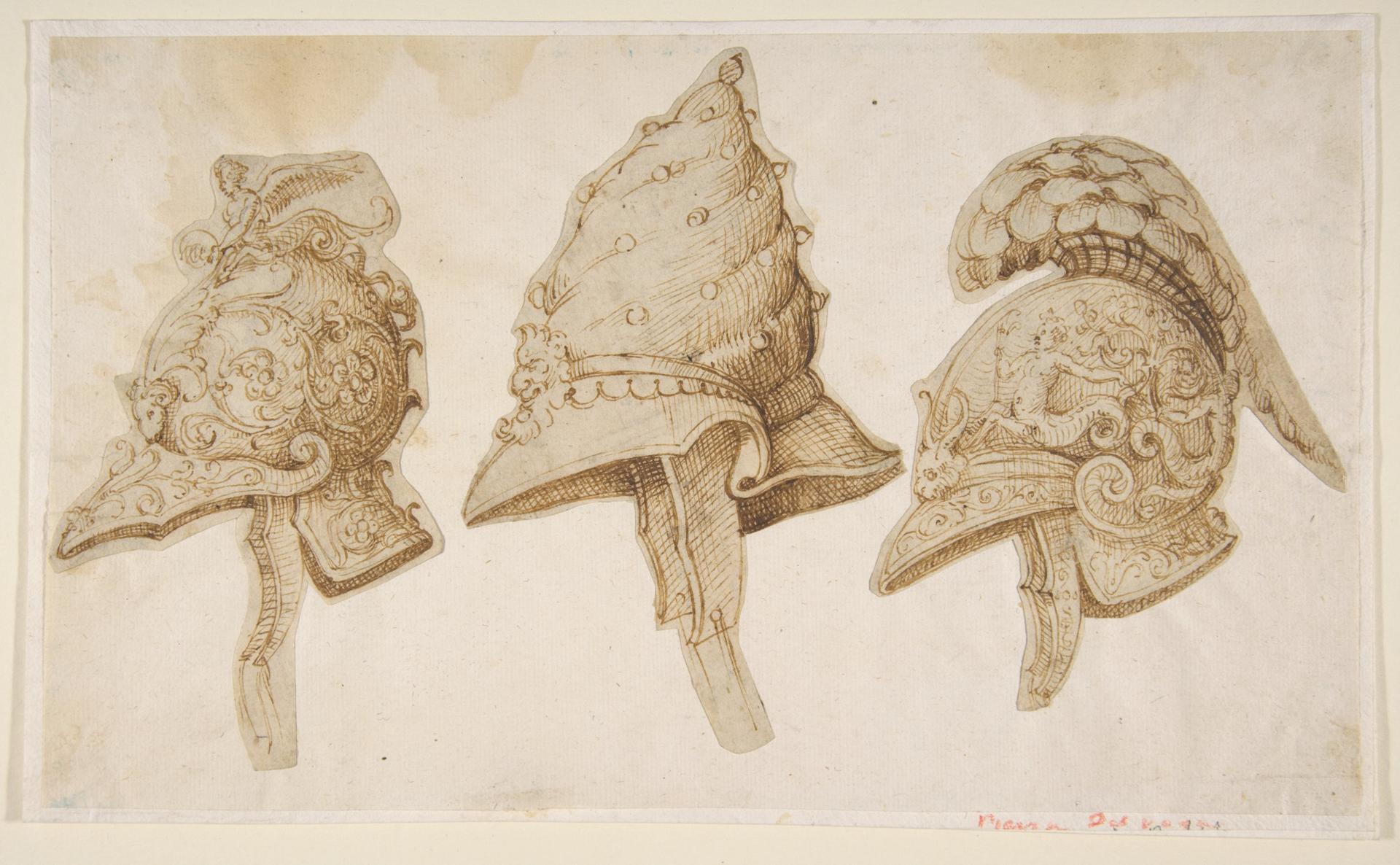
Three Designs for Helmets
Original title: Three Designs for Helmets
kurzbeschreibung
Unlike related helmet designs of the period, this sheet by Polidoro da Caravaggio presents three variants side by side. The 16th-century drawing is executed in pen and brown ink, brush and brown wash over leadpoint, and is glued onto a secondary paper support. It has been silhouetted and measures 16.7 x 28.4 cm.
Description
Three helmets are arranged in a row, each sketched in detail. The left helmet features a relief with a figure on a shield. The middle one has a conical structure with several rounded forms and small circular ornaments. The right helmet displays a complex floral pattern and a broad, curved brim. The helmets sit at the center of the sheet; brown tones and clear contours dominate the image.
Context
Polidoro da Caravaggio (c. 1499–1543) was an Italian Renaissance painter known for his facade decorations in Rome. This study likely served as a design for armor pieces produced in his workshop or in collaboration with goldsmiths. Adapting antique models for contemporary objects was typical of the era. The wash and pen work reveal the artist's precise style in rendering metal and ornament.
Impact
Clear lines and finely graduated brown tones give the helmets a sculptural presence. The ornamental details create a decorative appeal that underscores the artist's technical virtuosity. The arrangement of three designs on a single sheet conveys a sense of variation and artistic inventiveness.
Technique
Pen and brown ink, along with brush and brown wash over leadpoint, form the basis. The helmets were silhouetted and pasted onto a secondary, yellowish paper. This technique allowed for precise reproduction of details and shading, as was typical for Renaissance design drawings.
AI-generated description text
Source: Metropolitan Museum of Art · Public Domain (CC0 1.0)