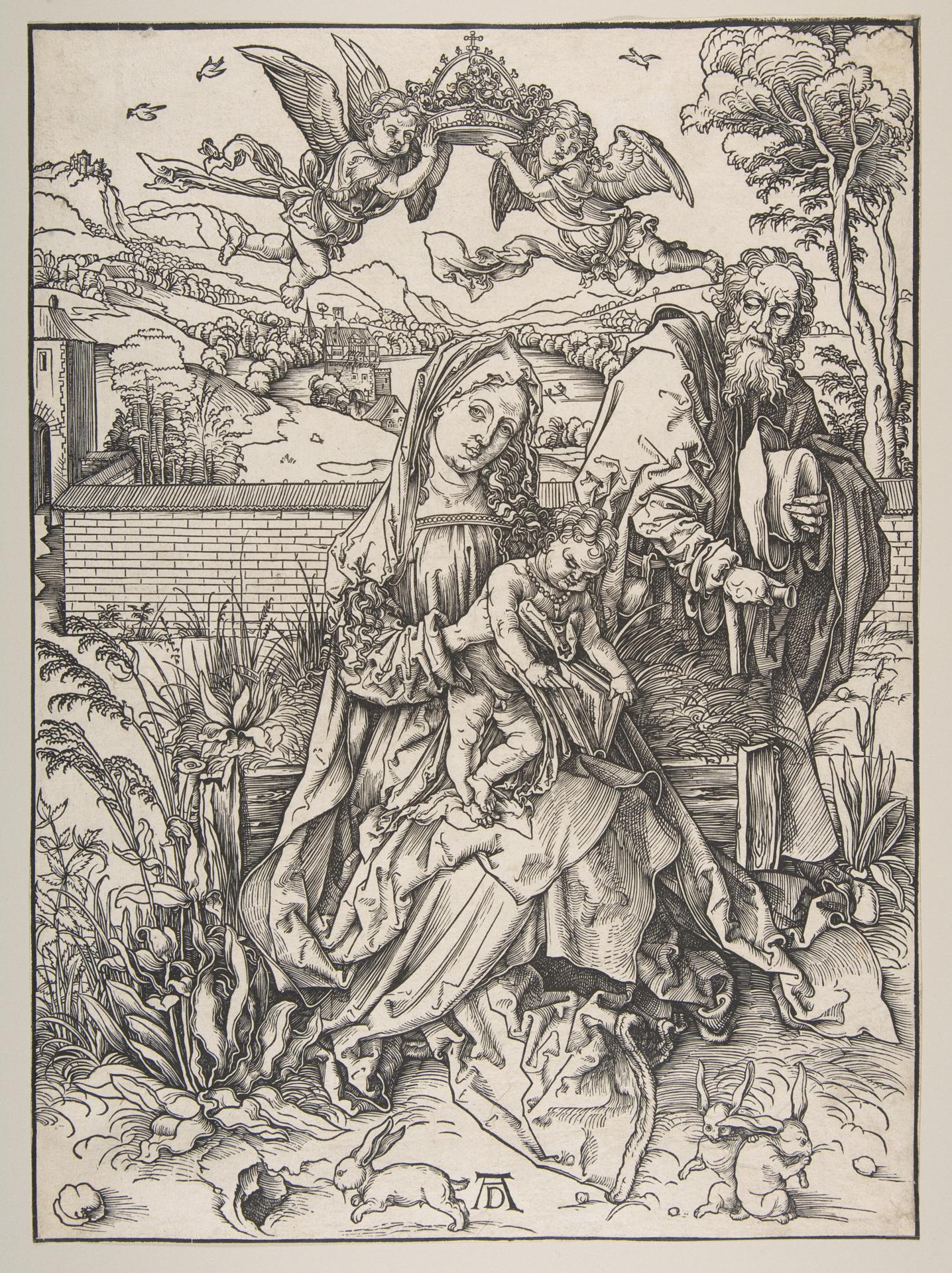
The Holy Family with Three Hares
Original title: The Holy Family with Three Hares
kurzbeschreibung
The Holy Family with Three Hares is a woodcut by Albrecht Dürer, dating to around 1497–98. It depicts the Virgin Mary seated with the Christ Child on her lap, while Saint Joseph stands beside them holding a book. The scene is framed by two angels holding a cross-bearing coat of arms, with hares in the foreground and a landscape beyond.
Description
The composition is symmetrical, with the Holy Family centered. Mary sits on a bench, the Christ Child on her lap, and Joseph stands to her right, holding an open book. In the background, two angels support a shield with a cross, and a landscape with trees, a house, and a distant city unfolds behind them. In the foreground, three hares sit on the ground, their forms rendered with careful, detailed lines. The image is monochrome, with even lighting and no strong shadows, typical of woodcuts.
Context
This woodcut was created around 1497–98, during Dürer's early period as a printmaker in Nuremberg. It is the first state of nine known states, indicating its popularity and the artist's continued refinement of the block. The subject of the Holy Family was common in Northern Renaissance art, reflecting the era's devotional focus on the domestic life of Jesus, Mary, and Joseph. Dürer's inclusion of hares and the landscape may symbolize fertility, vigilance, or the natural world, though no specific source is documented.
Impact
The print draws the viewer's eye to the serene central group, balanced by the angels and hares at the edges. The detailed linework gives the scene a delicate, almost tender quality, while the symmetrical arrangement conveys harmony and order. The monochrome palette emphasizes the draftsmanship, making the image feel both intimate and monumental.
Technique
This is a woodcut, a relief printing technique where the image is carved into a wooden block, inked, and pressed onto paper. Dürer's skilled use of fine lines and cross-hatching creates tonal variation and texture, despite the medium's inherent limitations. The print survives in nine states, suggesting Dürer made adjustments to the block over time, possibly to refine the composition or extend the block's life.
AI-generated description text
Source: Metropolitan Museum of Art · Public domain (CC0)