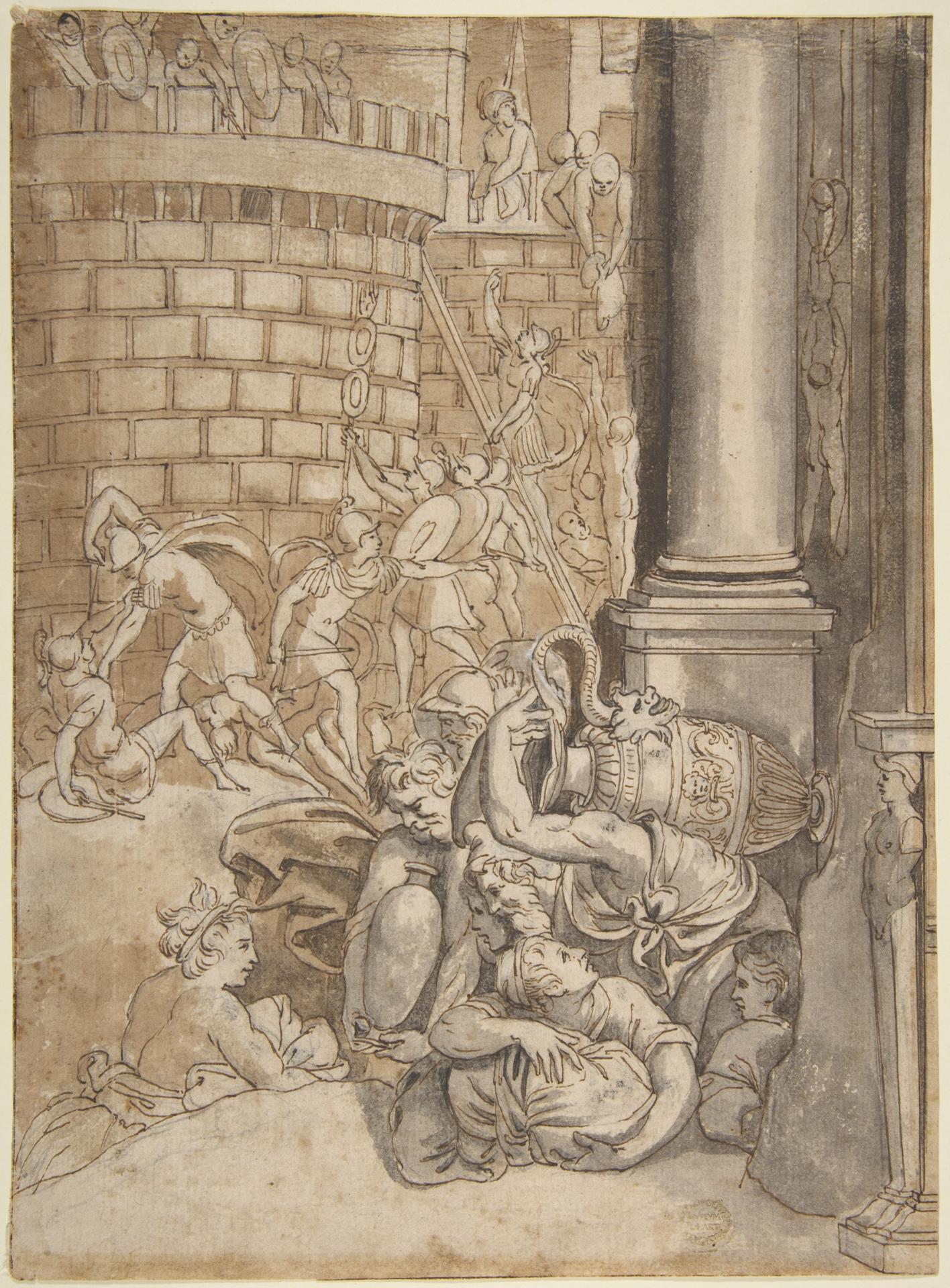
Sack of a City
Original title: Sack of a City
kurzbeschreibung
Drawn between 1499 and 1543 by Polidoro da Caravaggio, this sheet takes the plundering of a city as its subject. Executed in pen and brown ink, brushed with brown and gray washes over a charcoal underdrawing, it presents armed figures in armor and helmets moving through a columned interior.
Description
In the foreground several figures are locked in combat: some have fallen, others are still resisting. Armor and helmets point to a military conflict. From a raised platform or balcony behind them, more people watch the struggle. Columns and walls frame the setting as an interior. Brown tones dominate, broken here and there by passages of gray.
Context
Polidoro da Caravaggio, a Renaissance painter from Italy, was best known for his facade decorations in Rome. The drawing was probably made in the first half of the 16th century, a period when artists studied ancient reliefs and historical events. Roman models or literary accounts may have inspired the motif of the sacked city. The sheet could have served as a preparatory study for a larger painting or a print.
Impact
The lively, dramatic impression comes from the dynamic arrangement and the strong vertical structure created by the column and the wall opening. Fine pen strokes meet decisive washes, producing a contrast-rich and expressive overall effect. The action conveys an immediate, almost cinematic tension.
Technique
Pen and brown ink set the execution, supplemented by brush and brown and gray washes over a charcoal preliminary drawing. This mixed technique allows both precise line work and broad tonal areas. The charcoal underdrawing suggests a spontaneous, sketch-like working method.
AI-generated description text
Source: Metropolitan Museum of Art · Public Domain (CC0 1.0)