Rape of the Sabines
Original title: Rape of the Sabines
kurzbeschreibung
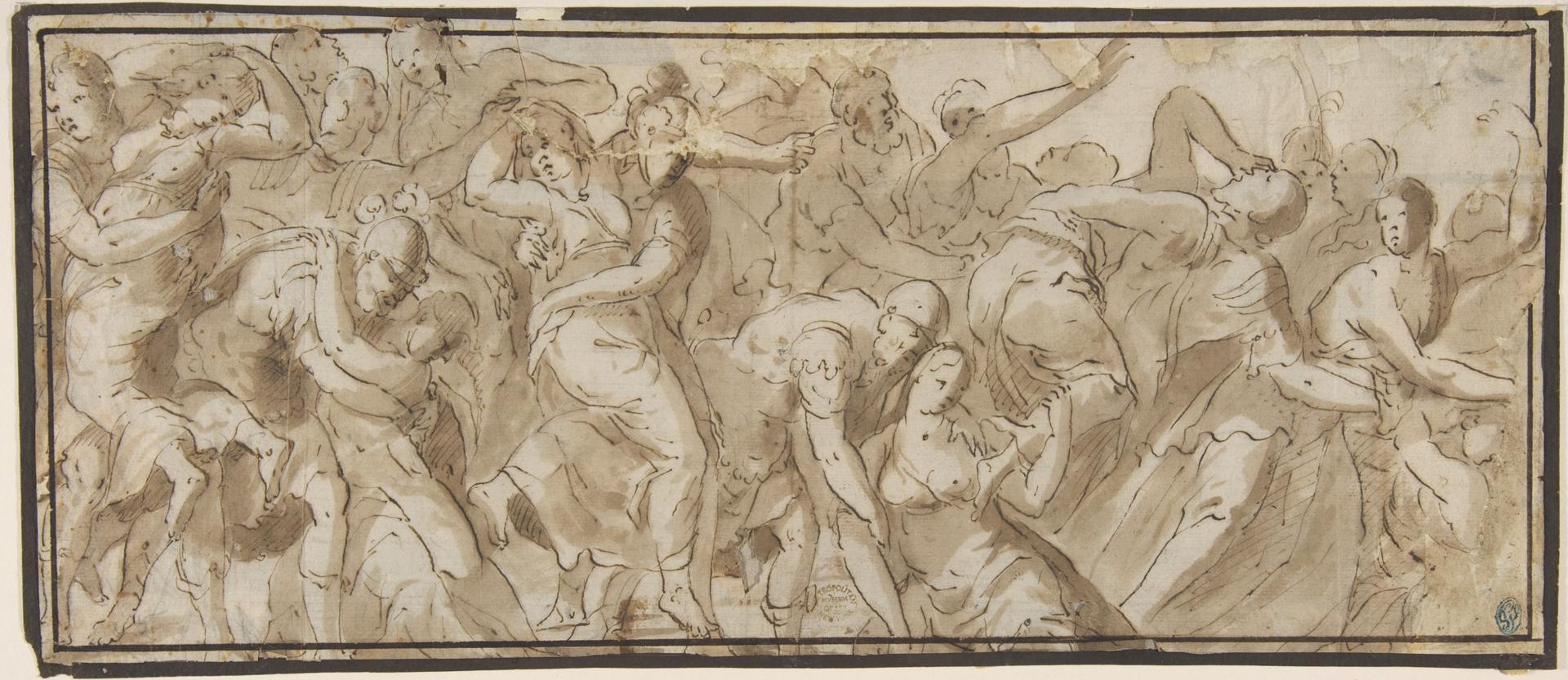
The abduction of the Sabine women, a legendary episode from early Roman history, comes alive here in a dense throng of bodies by Polidoro da Caravaggio (1499–1543). Drawn with pen and brown ink and worked with brush and brown wash, the sheet seizes the moment of violent seizure, when the Romans carry off the daughters of the Sabines.
Description
Bodies stack tightly across the horizontal format, some upright and in furious motion, others sunk to the ground. Gestures interlock, arms and drapery snagging into a knot from which individual figures emerge, barefoot or lightly clad. Brown tones of ink and wash dominate the sheet; light falls evenly over the whole scene without hard shadows. Pen strokes trace contours and lines of movement, while the brush lays in softer areas — a realistic touch in the handling.
Context
Polidoro da Caravaggio, a painter of the Italian Renaissance, is known for his facade paintings and drawings. The story of the Sabine women belongs to the early Roman legends that were often treated in art during antiquity and the Renaissance. This sheet was probably made as a study or as an independent work within an oeuvre shaped strongly by engagement with antique models.
Impact
From the crowding of bodies grows a restless, almost overheated tension that makes the violence of the event palpable. Because the light is spread without strong contrasts and the color is limited to browns, the eye stays fixed on the figures and their movements. The result is a concentrated, dramatic effect that draws the viewer close to the action.
Technique
Pen in brown ink and brush in brown wash on paper — a combination that allows both sharp contours and flowing shading. The visible strokes let the exploratory character come forward and give an impression of spontaneity. The sheet measures 16.6 x 38.8 cm; the horizontal format offers enough room for the numerous figures.
AI-generated description text
Source: Metropolitan Museum of Art · Public Domain (CC0 1.0)