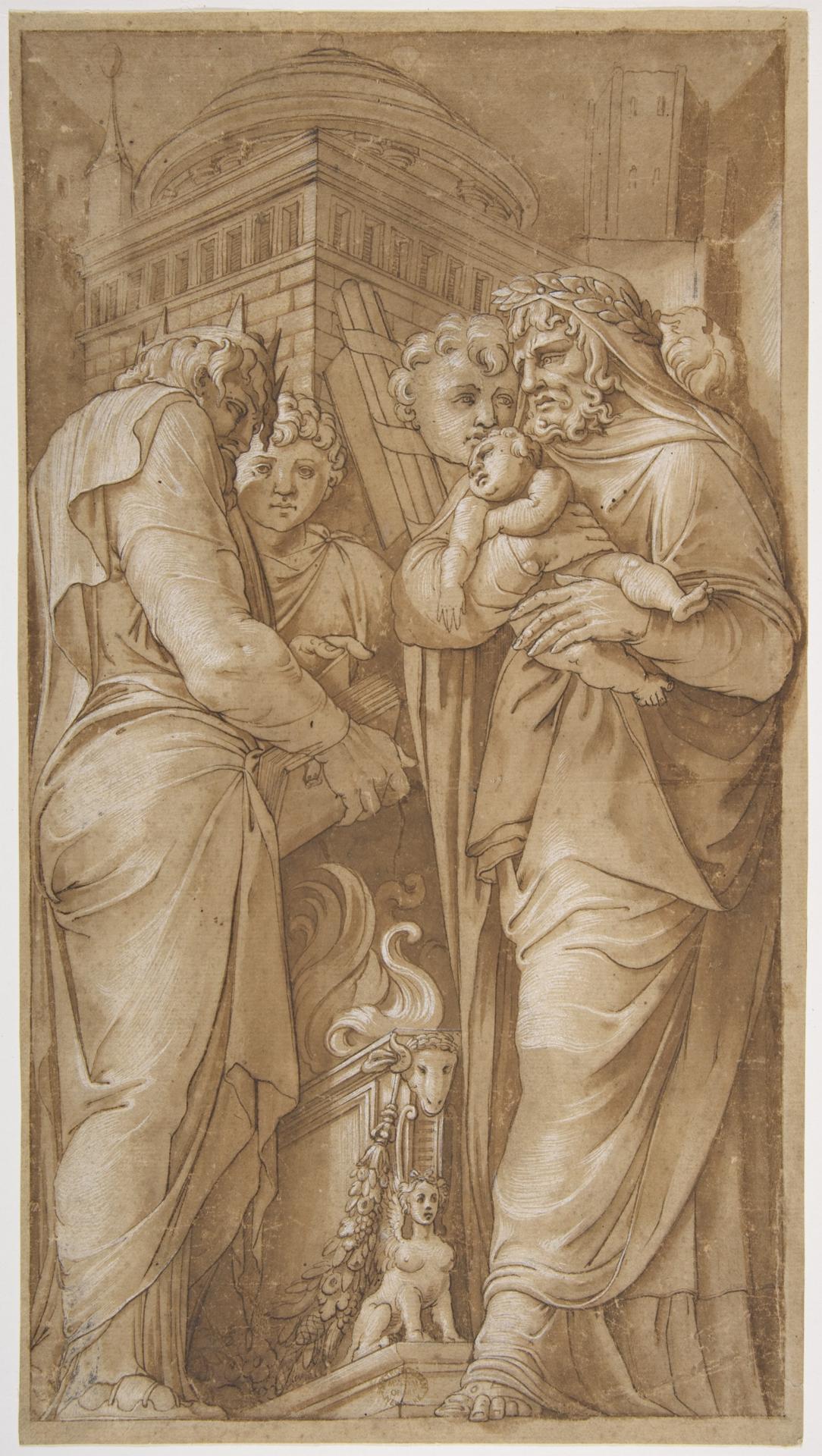
Roman Scene
Original title: Roman Scene
kurzbeschreibung
Pen and brown ink, laid in with brush and brown wash and touched with white: that is how Polidoro da Caravaggio (1499–1543) built up his Römische Szene, a densely populated sheet of figures in antique-style drapery dating from the first half of the 16th century.
Description
Two figures anchor the foreground: one holds a child, the other is caught mid-gesture. Long, folded garments wrap around both. The view closes at the back with a building of columns and a roof; beneath it, on a pedestal, stands another person with an animal at their side. Ink and brush produce the grey tonality, while graduated light picks out surfaces and fabrics.
Context
A pupil of Raphael, Polidoro da Caravaggio made his name above all with facade paintings in Rome, their programmes drawn from antique models. This sheet was probably intended as a preparatory study for a larger project, perhaps a wall design. In it one senses the Renaissance appetite for Rome's past, fed by excavations and the studies of the humanists.
Impact
Clear in its layout and calm, almost statuesque in the bearing of its figures, the sheet carries a monumental mood. The wash gives the space depth, so the scene stays alive even without colour.
Technique
The artist worked with a pen in brown ink; the brush followed with brown wash for the shading, and white highlights set the lights. This approach was common for preparatory studies of the High Renaissance, since it allows precise detail alongside soft transitions of tone.
AI-generated description text
Source: Metropolitan Museum of Art · Public Domain (CC0 1.0)