Festival Procession
Original title: Festival Procession
kurzbeschreibung
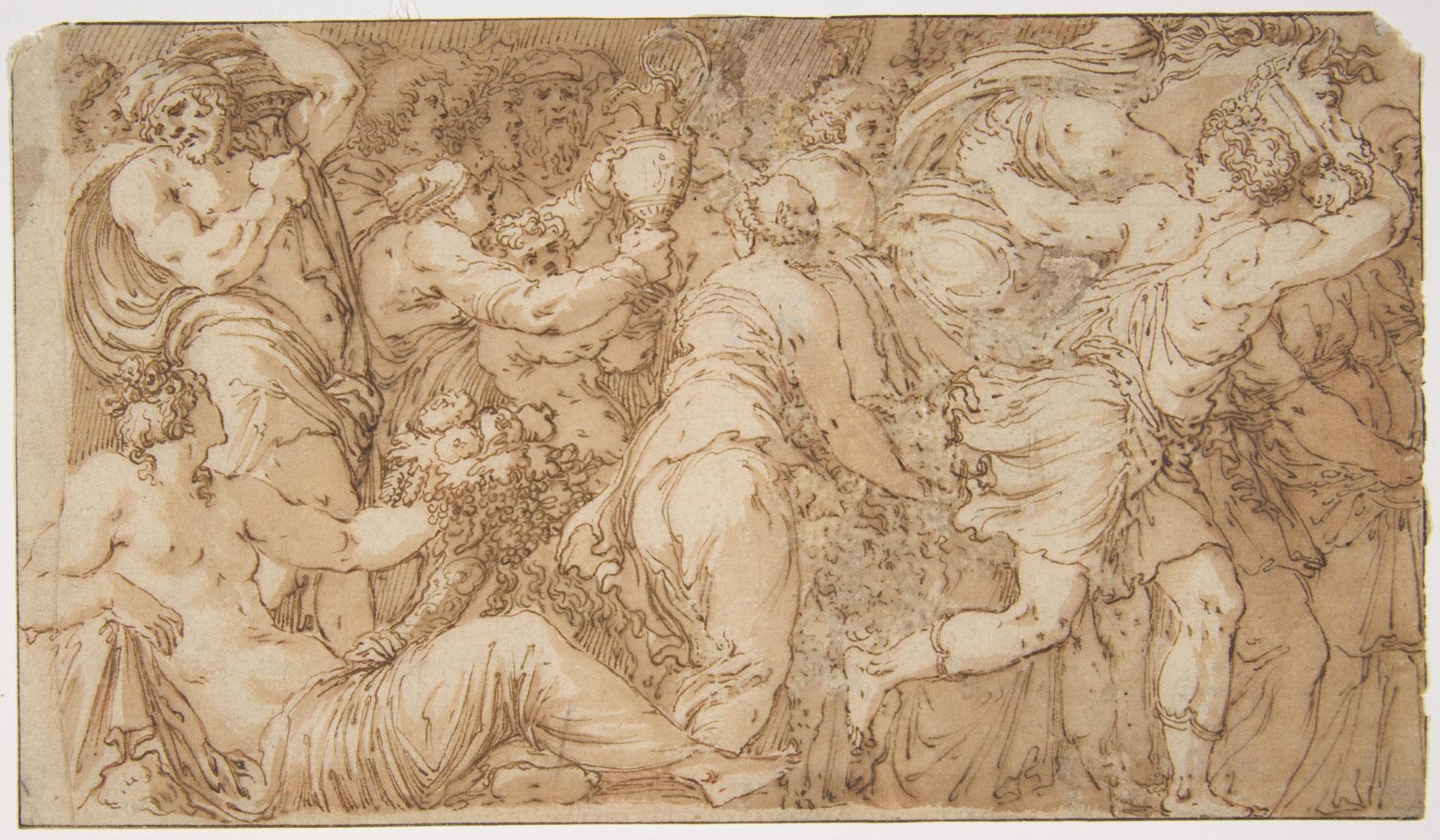
Polidoro da Caravaggio (1499–1543) captures a festive procession in this drawing. Executed in pen and brown ink with brush and brown wash, the sheet measures 11 x 19.3 cm.
Description
Several figures are in motion, forming a train. Some carry wreaths or objects that can be understood as prizes or festive tokens. The clothing follows traditional forms, with folds emphasized by shading. The people move in different directions and interact with one another, giving the image a lively quality. Brown tones dominate the coloration, created by ink and wash.
Context
Polidoro da Caravaggio was an Italian Renaissance painter who made a name for himself primarily through facade decorations in Rome. This drawing may have been made as a study for a larger work or as an independent composition. The artist often used pen and ink to capture movement sequences and figure groups. The idea of the procession can be linked to ancient Roman triumphs, to which Polidoro devoted great attention.
Impact
Loosely placed strokes and the flowing wash give the sheet a lively, sketchy effect. Because the light is evenly distributed and hard shadows are absent, a calm, festive mood arises. The movement of the figures leads the eye along the procession and makes the event appear immediate.
Technique
The drawing was made with pen and brown ink; afterwards the artist worked the sheet with brush and brown wash. This allowed both fine contours and broad areas of shadow to be set down. Pen stroke and wash together are characteristic of Italian drawings of the 16th century.
AI-generated description text
Source: Metropolitan Museum of Art · Public Domain (CC0 1.0)