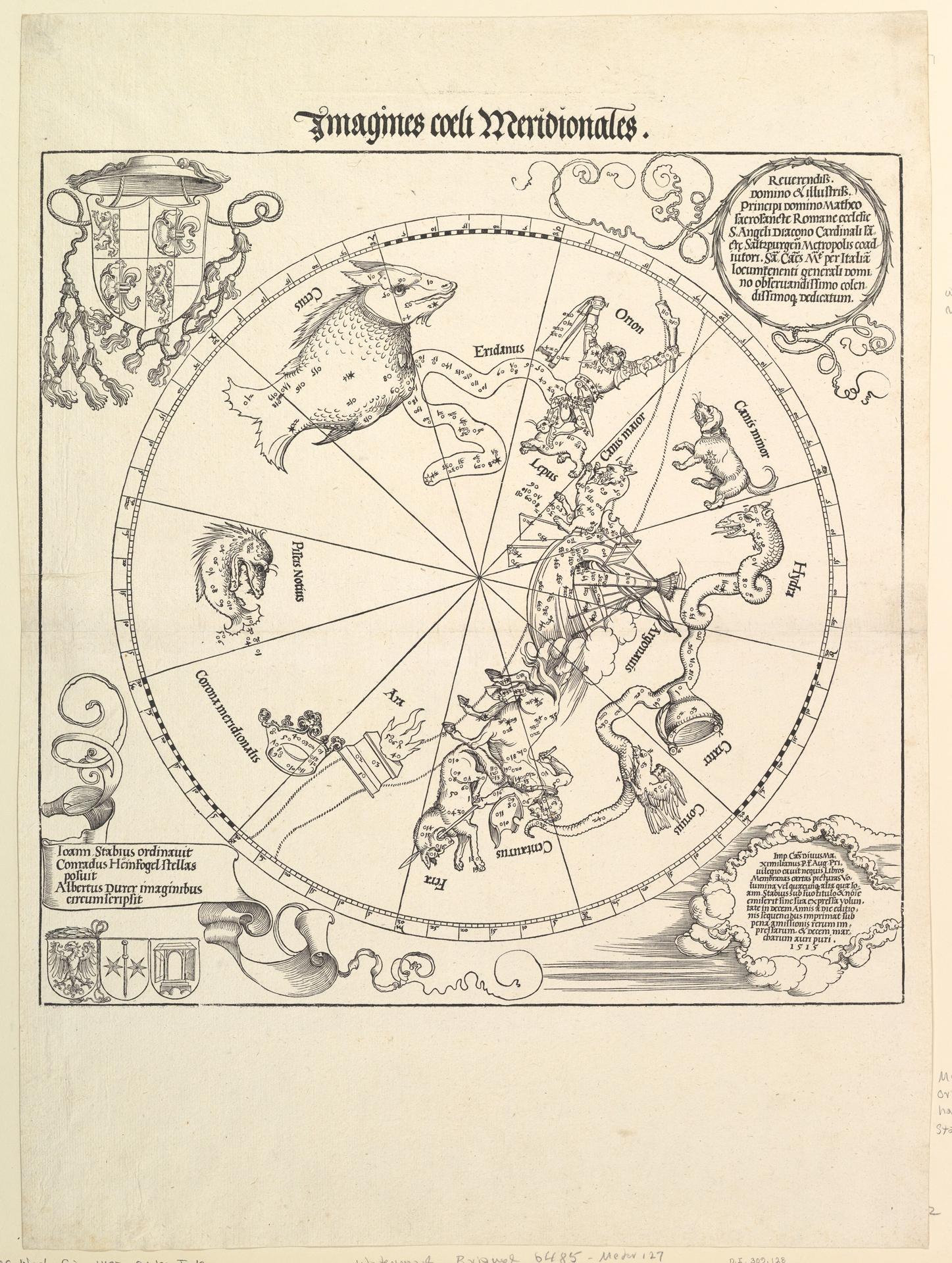
The Celestial Globe-Southern Hemisphere
Original title: The Celestial Globe-Southern Hemisphere
kurzbeschreibung
This woodcut by Albrecht Dürer, dated 1515, depicts the southern celestial hemisphere. It is one of the first printed star charts to accurately represent the southern sky, combining scientific observation with artistic imagination. The print is part of a pair with the northern hemisphere, both commissioned for astronomical use.
Description
The composition centers on a large circular chart filled with stylized constellations, each rendered as mythological or animal figures such as a fish, a dog, and a wolf. The figures are arranged within a ring that lists the zodiac signs and their names, while the surrounding area contains the title 'Imagines coeli Meridionales' at the top and various coats of arms and text at the bottom. The image is executed in black and white, with shading achieved through the woodcut's line work, giving the celestial forms a sense of depth and texture.
Context
Dürer created this woodcut in 1515, during the Renaissance, when there was a renewed interest in astronomy and classical learning. It was based on the star catalog of the Alexandrian astronomer Ptolemy, but also incorporated more recent observations by European navigators, making it one of the first accurate depictions of the southern sky. The print was produced in collaboration with the astronomer Johannes Stabius and the mathematician Conrad Heinfogel, reflecting the era's blend of art and science. This work was part of a pair with the northern hemisphere, intended for scholars and collectors.
Impact
The print impresses with its intricate detail and the elegant integration of scientific data into an artistic composition. The stylized figures of the constellations invite the viewer to explore the night sky as both a cosmic map and a work of art. Its stark black-and-white contrast gives it a graphic, almost modern appeal, while the historical context adds a sense of wonder about early efforts to understand the universe.
Technique
The work is a woodcut, a relief printing technique where the image is carved into a wooden block, inked, and pressed onto paper. Dürer's mastery of the medium is evident in the fine lines and cross-hatching used to create shading and detail. The print is monochrome, relying on the interplay of black ink and white paper to define the celestial figures and text.
AI-generated description text
Source: Metropolitan Museum of Art · Public domain (CC0)