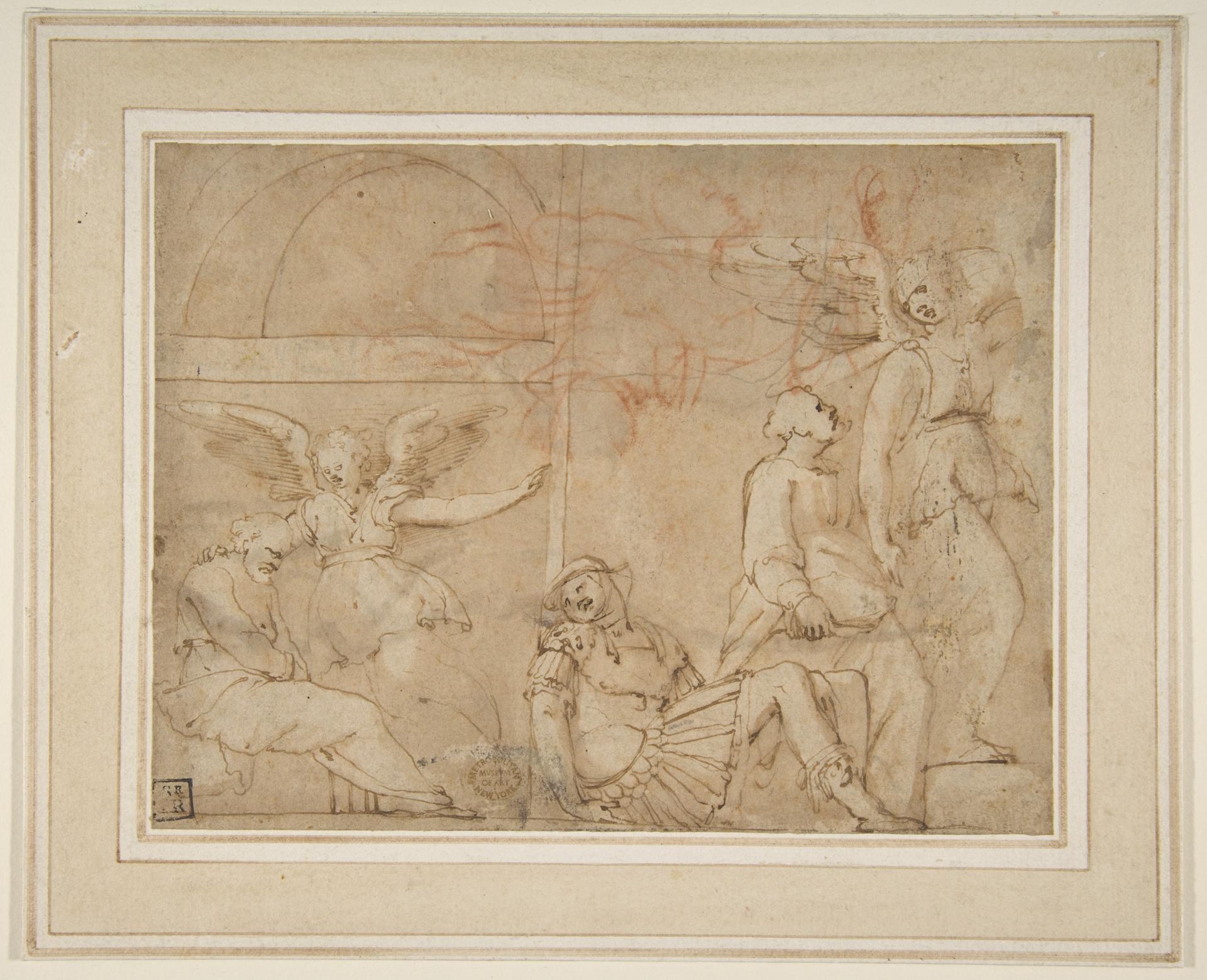
St. Peter Delivered from Prison
Original title: St. Peter Delivered from Prison
kurzbeschreibung
Polidoro da Caravaggio (1499–1543) drew this sheet of the apostle Peter's release from prison. Executed in pen and brown ink, brush and brown wash, and red chalk, it measures 15.3 x 20.1 cm. The work belongs to the Italian Renaissance and demonstrates the artist's expressive hand.
Description
Two figures sit in the foreground, hunched over: one in a robe, the other in only a shirt. Behind them an angel strides to the left with wings spread wide, while another angel hovers in the air, also looking left. The layout is divided horizontally, with the seated figures in front and the angels behind. Brown and gray tones dominate the drawing, intersected by red lines that may serve as a sketch or color indication. The light appears even, without strong shadows or highlights; brushstrokes and hatching stand out clearly.
Context
Polidoro da Caravaggio was an Italian painter and draftsman of the High Renaissance, famous for his facade decorations in Rome. Probably made in the 1520s, when he turned to biblical subjects and antiquity. The release of Peter is a common motif in Christian art, based on the Acts of the Apostles (Acts 12:6-11). Polidoro sometimes worked with Maturino da Firenze; his drawings often served as models for prints and paintings.
Impact
A calm yet palpable visual language conveys the figures' distress and the angel's intervention. Delicate wash and vigorous pen strokes give the sheet a lively, almost sketch-like quality. Horizontal lines and even lighting create a balanced, harmonious arrangement that draws the viewer into the biblical narrative.
Technique
Pen and brown ink form the basis; brush and brown wash create the shading. Red chalk adds further lines, likely as an underdrawing or color note. Such combinations were common in the Renaissance for studies and designs and attest to Polidoro's assured handling of different media.
AI-generated description text
Source: Metropolitan Museum of Art · Public Domain (CC0 1.0)