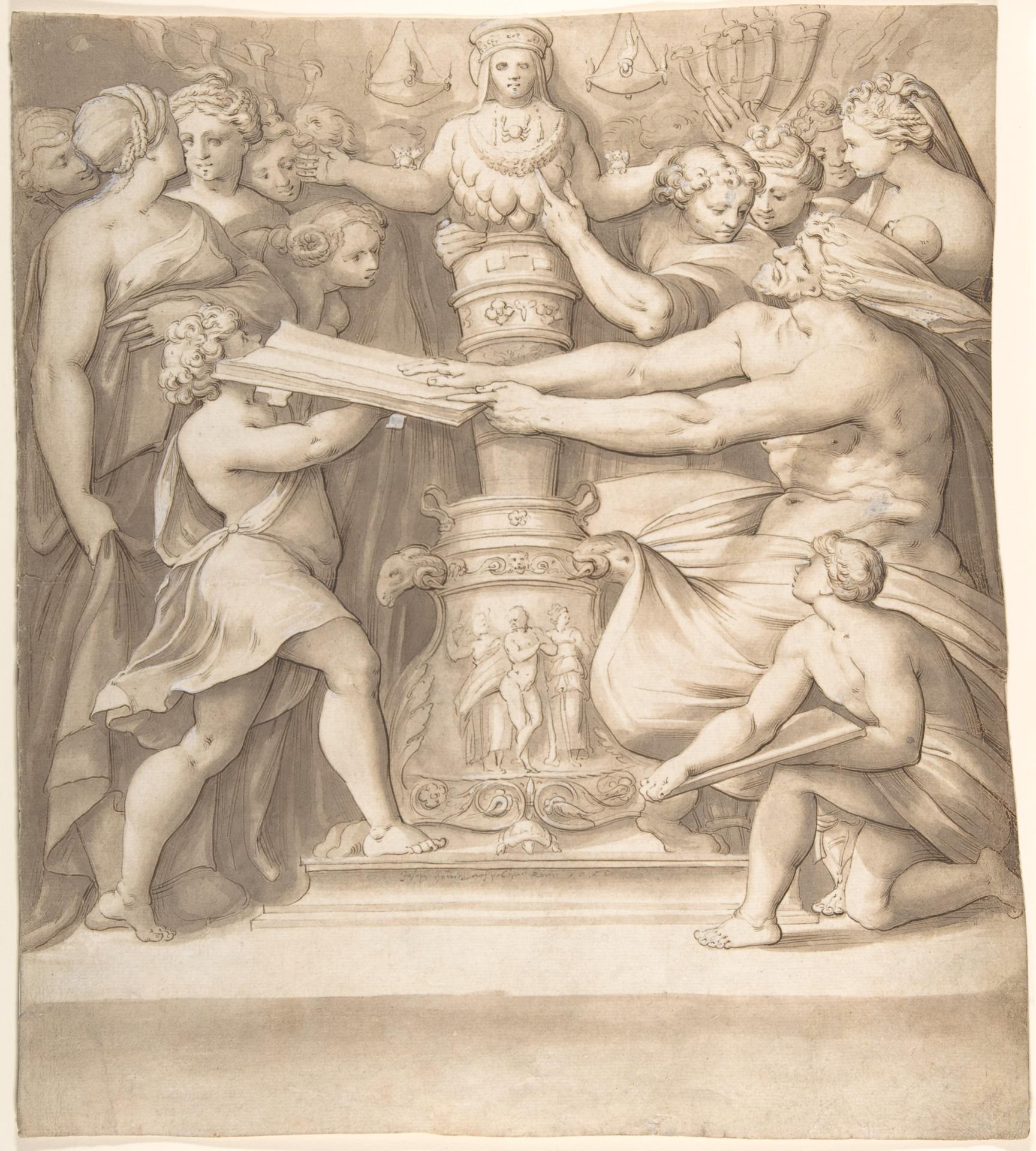
Figures Adoring a Statue of the "Magna Mater"
Original title: Figures Adoring a Statue of the "Magna Mater"
kurzbeschreibung
Drawn in 1585 by Joseph Heintz the Elder, this sheet shows a gathering of figures in antique dress paying homage to a statue of Magna Mater in a ritual act. The drawing is executed in pen and brown ink, with brush and gray-brown wash and white heightening, and measures 36.2 x 31.7 cm.
Description
The statue of Magna Mater is the focus of attention: several figures in ancient clothing stand around it, while a man kneels before it and holds out a book or a sheet. Another person in the foreground also carries a sheet or scroll. The layout feels balanced, with the statue as the fixed point around which the group clusters. Gray and brown tones dominate the coloring, with white heightening standing out as accents. The execution is careful and detailed; brushstrokes and shading remain visible.
Context
Joseph Heintz the Elder (1564–1609) trained in Italy and later worked as a court artist in Prague. This sheet dates from 1585, a phase in which artists increasingly turned to antiquity and mythological subjects. Magna Mater, a goddess from Asia Minor worshipped in Rome, points to humanist interest in Roman culture. Heintz left behind numerous drawings with mythological and religious motifs, often used as models for paintings or prints.
Impact
The balanced arrangement and the calm, dignified posture of the figures give the sheet a solemn, almost devotional mood. The precise linework and subtle wash create a contemplative atmosphere that draws the viewer into the event.
Technique
Pen and brown ink form the basis of the drawing; brush and gray-brown wash serve for shading. White heightening sets accents and emphasizes details. This combination was common in the Renaissance and Mannerism to evoke corporeality and effects of light.
AI-generated description text
Source: Metropolitan Museum of Art · Public Domain (CC0 1.0)