Frieze fragment
Original title: Frieze fragment
kurzbeschreibung
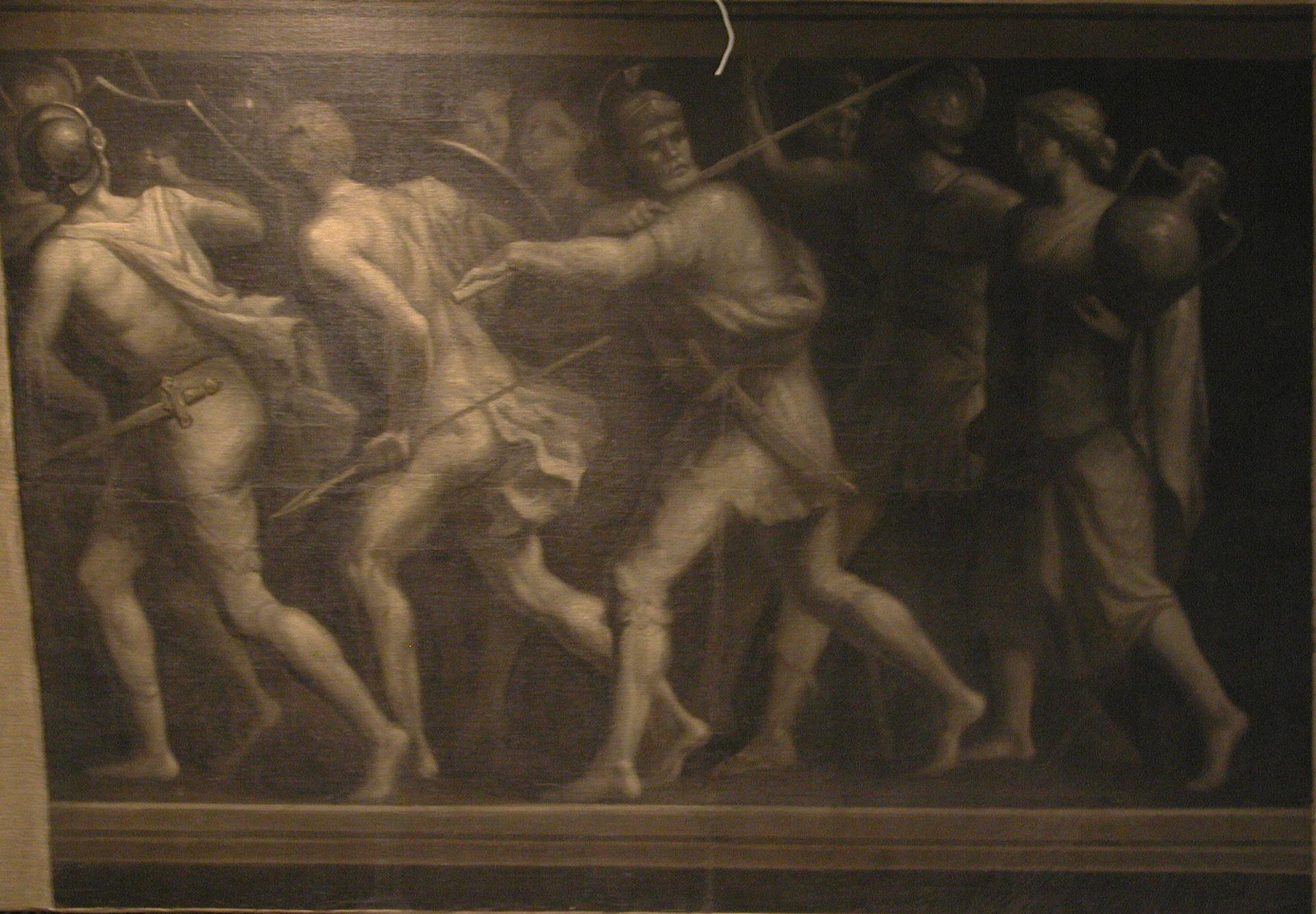
Polidoro da Caravaggio's Friesfragment, painted around 1520–35 in oil on canvas, presents a throng of men in battle gear. A lively skirmish unfolds in a horizontal sequence from left to right.
Description
Men in fighting attire clash: some wear helmets and armor, others make do with staves and shields. Their postures vary widely and convey a sense of rapid movement through space. Gray tones dominate the subdued palette and reinforce the warlike character of the scene. The figures line up in a horizontal row that stretches across the pictorial space from left to right. Light falls evenly and without shadows, as if the action were set indoors or under artificial illumination.
Context
Polidoro da Caravaggio, a High Renaissance painter, became known above all for façade decorations and friezes in Rome. This fragment likely belonged to a larger cycle intended for a Roman palace or villa. Battle scenes were highly popular in the Renaissance and often drew on ancient models. The period of creation around 1520–35 falls in Polidoro's Roman years, when he engaged intensively with the study of antiquity.
Impact
The muted grays and animated figures create a serious, historically resonant mood. Because the light is even and shadowless, the scene feels calm and almost relief-like, like an ancient frieze. The movement of the figures gives the image a tension that nonetheless remains ordered.
Technique
The work is executed in oil on canvas—quite usual for the time, but rather unusual for Polidoro, who worked predominantly in fresco. The handling remains realistic and directs attention to the human figure and its movement. The palette, limited to grays, suggests a monochrome treatment meant to evoke ancient reliefs.
AI-generated description text
Source: Metropolitan Museum of Art · Public Domain (CC0 1.0)