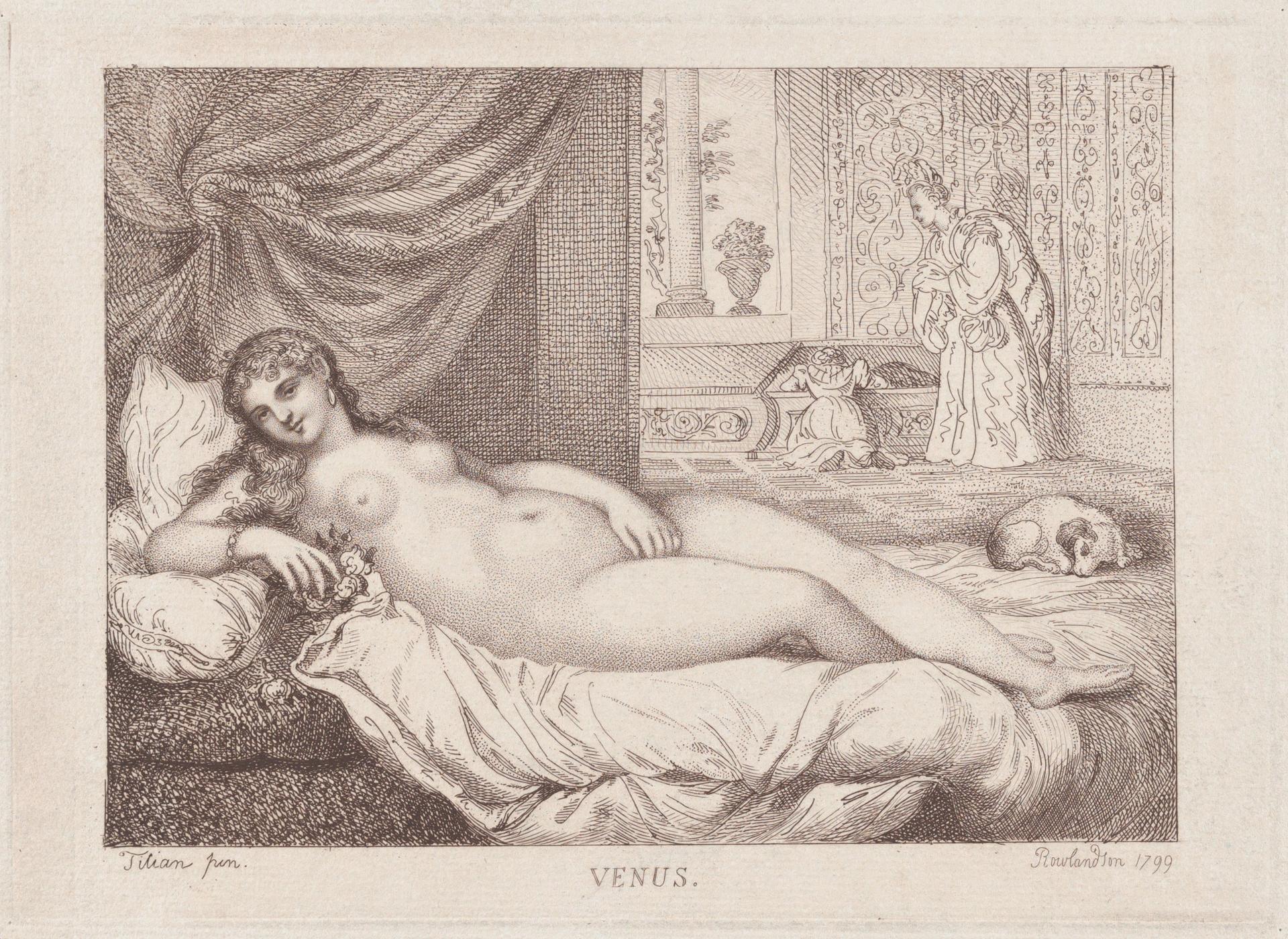
Venus of Urbino
Original title: Venus of Urbino
kurzbeschreibung
Thomas Rowlandson's 1799 etching Venus von Urbino presents a naked woman reclining on a bed, a flower held in her hand. Worked in etching and stipple and printed in brown ink, the sheet has an unusually warm, tonal character for a print of its period.
Description
A nude woman stretches out easily across a bed, a flower between her fingers, while a second figure in a dress looks on from behind her. Curtains, a window, vases and pictures on the wall divide up the room. Fine stippling and line work build texture and shadow throughout, all in shades of brown. Along the lower edge appear the signature Tilman and the date Rowlandson 1799.
Context
Rowlandson made this print in 1799, by which time he was well known for satirical and comic scenes of English social life. Here he takes on Titian's celebrated sixteenth-century Venus of Urbino, a key work of Venetian Renaissance painting. By moving the classical iconography into a contemporary bourgeois interior, he quietly undermines the lofty tradition behind it. Stipple was a common printmaking technique at the time, valued for producing soft tonal values.
Impact
Soft brown tones and delicate stippling give the sheet a gentle, almost painterly feel. The figure's relaxed pose and the intimate interior create a calm mood with an ironic edge, one that invites a smile. An erotic subject meets an everyday setting, which makes the view at once familiar and detached.
Technique
Printed in brown ink, the sheet combines etching with stipple. In this process fine dots and lines are worked into an etched plate to produce tonal values and shading. The plate measures 17.9 × 25 cm, the sheet 25 × 31 cm.
AI-generated description text
Source: Metropolitan Museum of Art · Public Domain (CC0 1.0)