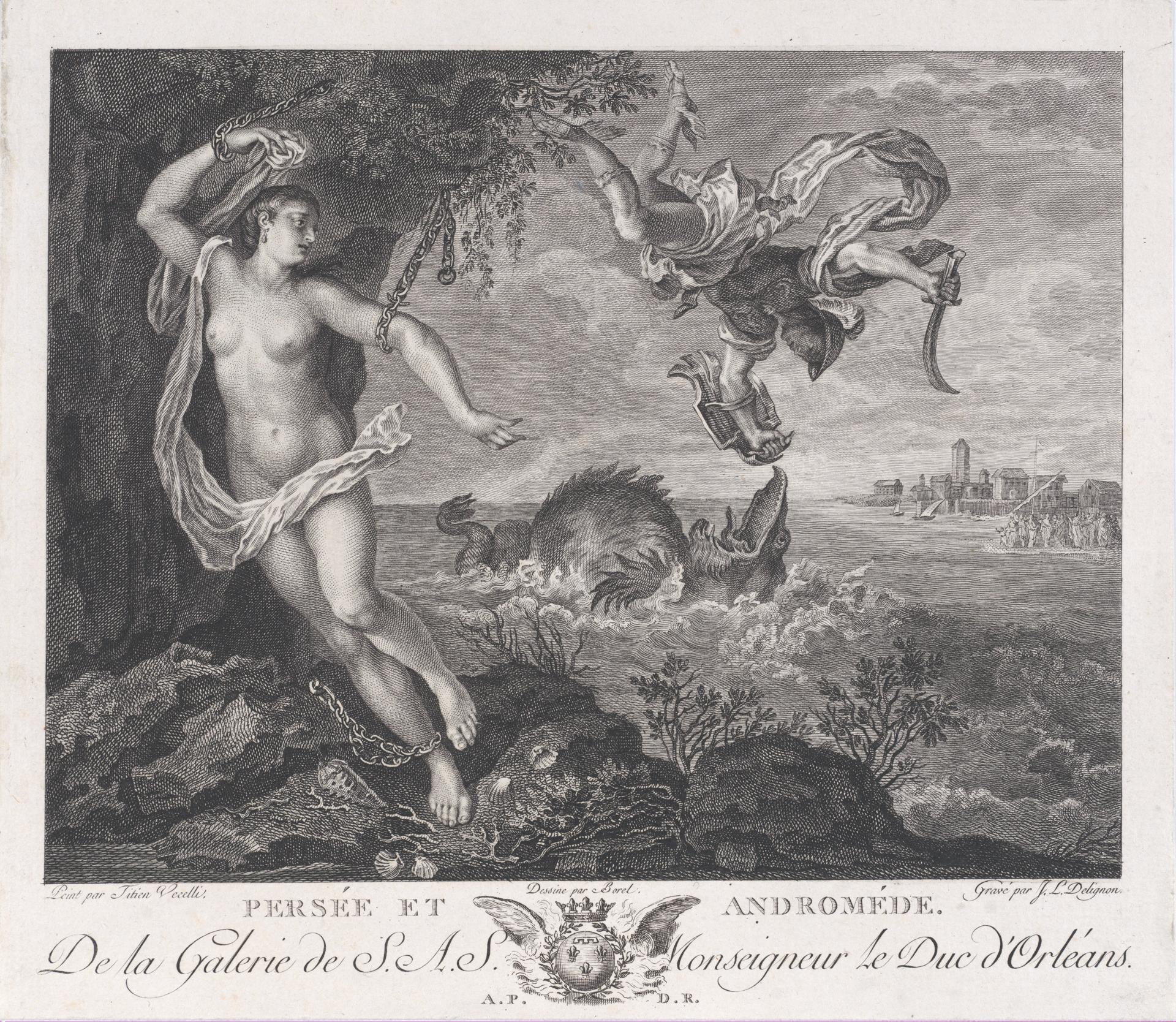
Perseus and Andromeda (1787)
Original title: Perseus and Andromeda
kurzbeschreibung
Jean-Louis Delignon captured in 1787 the moment when Perseus saves the bound Andromeda from a sea monster. This black-and-white print measures 15.7 × 20.4 cm (image area) and belongs to the art of the 18th century.
Description
In the foreground, Andromeda is chained naked to a rock; her arms are stretched upward, a chain holds her, and her legs are also bound. Behind her, Perseus leaps through the air to slay a dragon rising from the sea—the beast with outstretched wings and a coiled tail. Further back on the shore, buildings and people can be seen, while waves wash around the dragon. The layout is clearly structured, the figures sharply outlined, and hatching and lines create the light and shadow values of the etching.
Context
The sheet was made in 1787 in France, when mythological subjects were widespread in art and often highlighted heroic virtues. Delignon, a French copper engraver, was known for his detailed prints. The source was the story from Ovid's Metamorphoses, a key text for 18th-century artists. Prints of this kind often served as reproductions after paintings or as independent collector's items.
Impact
The scene feels dramatic and heroic through Perseus's dynamic pose and the menacing presence of the dragon. The clear structure and delicate lines give the sheet a calm yet tension-filled aesthetic typical of the 18th century.
Technique
The work is an etching, an intaglio process in which the drawing is scratched into a metal plate and etched with acid. The monochrome rendering uses fine lines and hatching to bring out light, shadow, and textures—such as waves or the musculature of the figures. At 15.7 × 20.4 cm, the print is relatively small, suggesting a fine, detailed execution.
AI-generated description text
Source: Metropolitan Museum of Art · Public Domain (CC0 1.0)