The Pesaro Madonna
Original title: The Pesaro Madonna
kurzbeschreibung
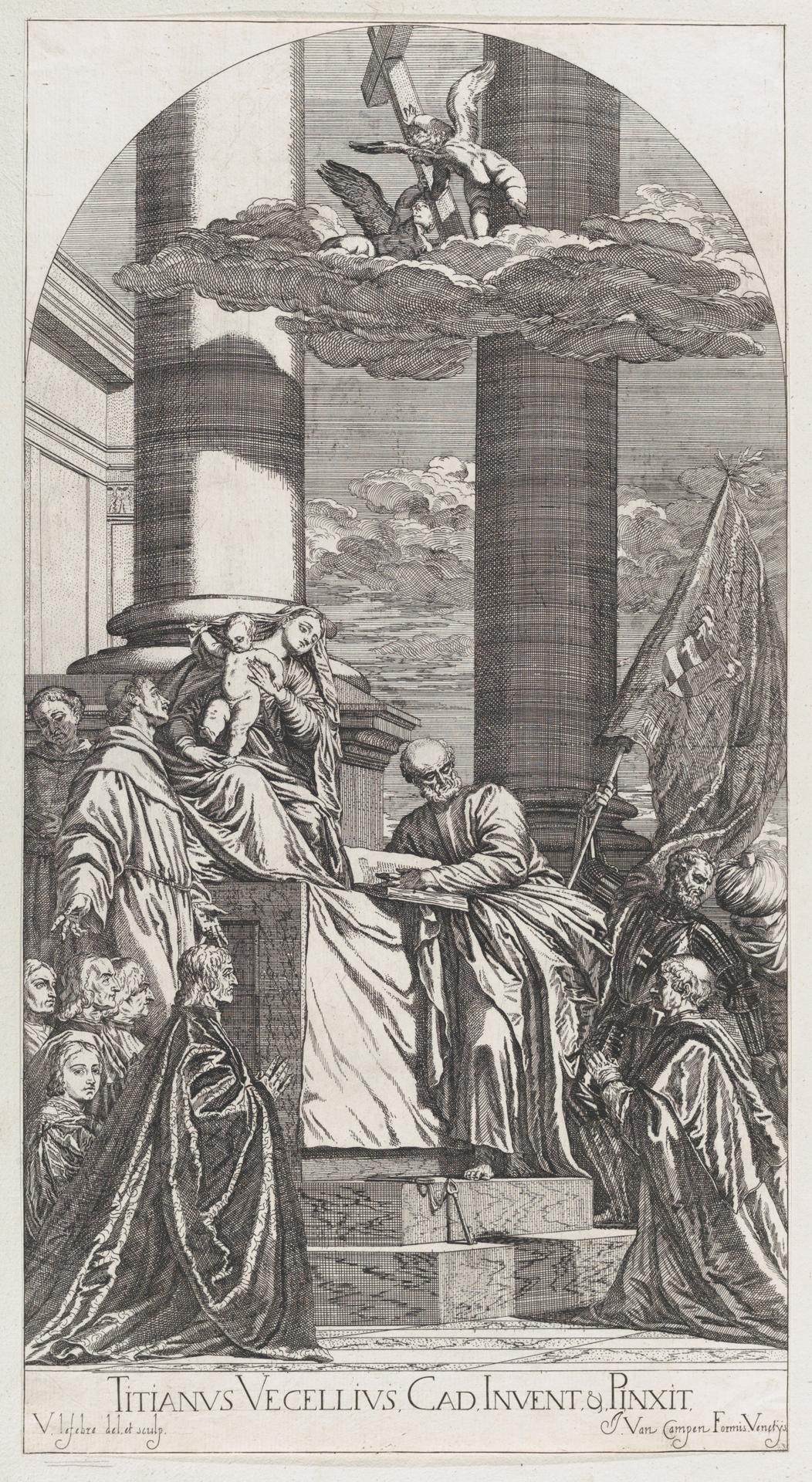
Where many contemporary reproductions after Titian concentrate on the figures alone, Valentin Lefebvre's 1682 etching gives unusual weight to the architectural frame: the Madonna and Child appear with other figures inside a clearly defined, framed pictorial space. The source is Titian's celebrated altarpiece in the Venetian church of Santa Maria Gloriosa dei Frari.
Description
Mary sits enthroned with the child on her lap; above her an angel hovers on clouds. At the base of the throne stand monks and other figures in liturgical vestments, some holding banners. Columns and an arch enclose the subject and stress its architectural structure. Kept in black and white, the effects of light and shadow arise from fine lines and hatching.
Context
The Flemish painter and printmaker Valentin Lefebvre worked in Venice and made etchings after works by Venetian masters. His model was Titian's Pesaro Madonna (1519–1526), a key work of the Venetian High Renaissance. Lefebvre's sheet dates from the late seventeenth century and helped spread knowledge of the famous painting.
Impact
The delicate linework gives the sheet a quiet, solemn mood. The clear arrangement and monumental architecture lend the scene a dignified presence that recalls its original effect as an altarpiece.
Technique
This sheet is an etching, an intaglio process: the drawing is scratched into a wax layer on a copper plate and then bitten with acid. Printing on paper follows, with the lines creating tonal values and shading. The trimmed sheet measures 53 × 28.4 cm.
AI-generated description text
Source: Metropolitan Museum of Art · Public Domain (CC0 1.0)