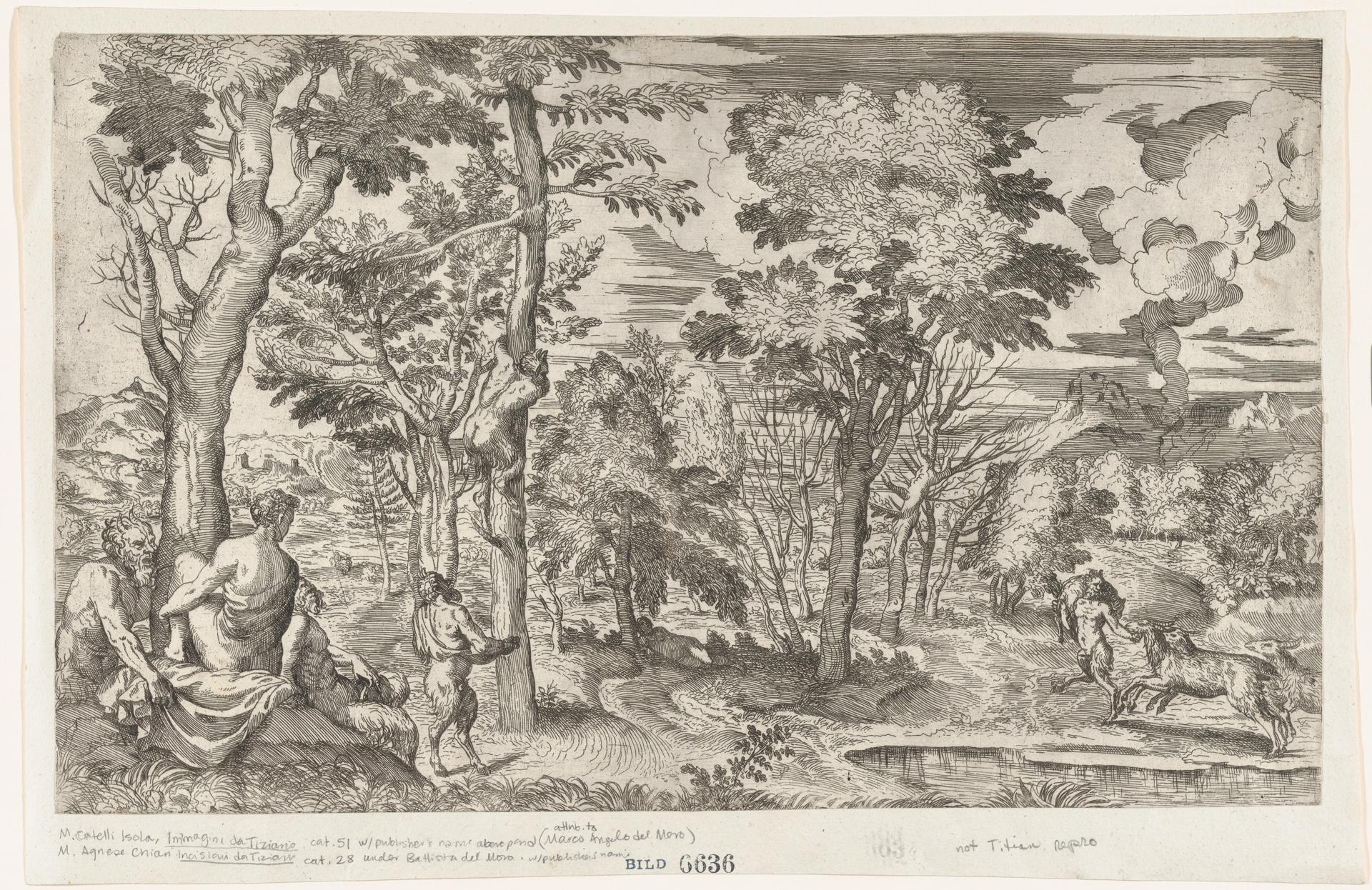
Satyrs in a Landscape (after Titian)
Original title: Satyrs in a Landscape (after Titian)
kurzbeschreibung
Several satyrs, half human and half beast, lounge in an open landscape and go about their business. This etching, made around 1550–60 by an unknown engraver, takes up an invention by the Venetian painter Titian and carries it over into the medium of printmaking.
Description
A broad landscape stretches across the full width of the sheet, while the satyrs in the foreground have settled down or stand together in groups. They wear clothing and turn toward one another. Trees, bushes and a stream divide the background. The mood stays calm; light and dark arise through graded hatching, and the figures stand out against the surrounding land.
Context
Prints after works by recognized masters were widespread around the middle of the sixteenth century. Titian's paintings, too, were copied by other artists so that a larger public could see them. The unnamed etcher relied on a model by Titian that can no longer be identified with certainty today. Such reproductions often served other artists as working material or collectors as objects of acquisition.
Impact
The sheet gives off an Arcadian calm of the kind familiar from Renaissance mythological scenes. The clearly led line and the balanced layout produce a harmony that draws the eye into the landscape.
Technique
The print was made as an etching: in this intaglio process the drawing is scratched into a metal plate and then bitten with acid. Fine lines and hatching produce the gray values and the precise rendering of figures and landscape. The plate measures 25.3 × 41.2 cm.
AI-generated description text
Source: Metropolitan Museum of Art · Public Domain (CC0 1.0)