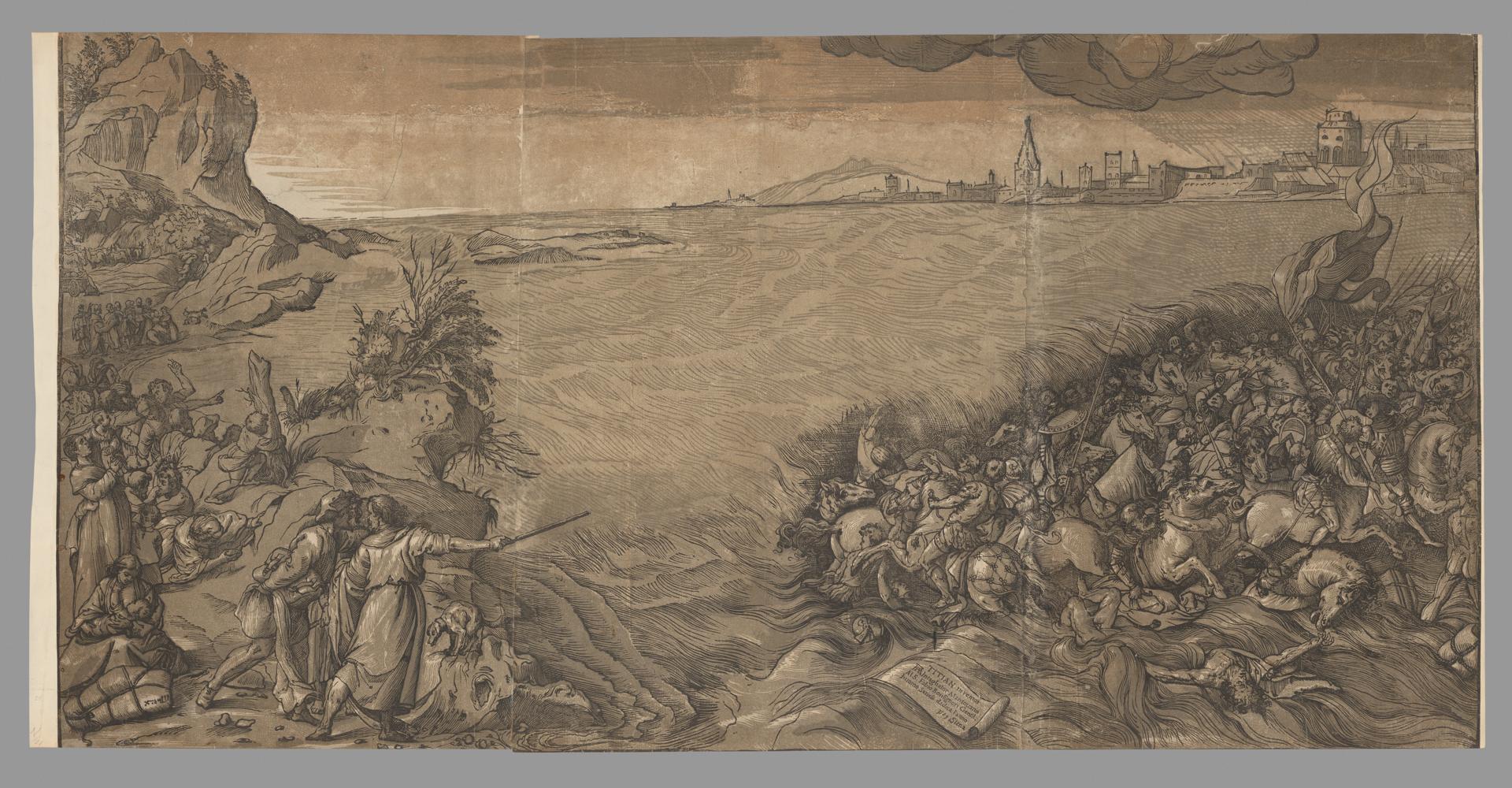
The Crossing of the Red Sea, Moses Stands at the Left Pointing to the Army Being Submerged, after Titian
Original title: The crossing of the red sea, Moses stands at the left pointing to the army being submerged, after Titian
kurzbeschreibung
Andrea Andreani produced this chiaroscuro woodcut in 1589, printed in brown-green tones after a design by Titian. At the left edge Moses points his staff toward the sea while the Egyptian army drowns in the flood.
Description
Moses stands at the left in traditional robes, staff raised toward the churning water. Its waves tower dramatically and swallow soldiers and horses. On the right, people and animals are caught in confused movement beneath the flood. Behind them rocks rise, along with a city with a church or tower. Brown-green tonal steps shape the sheet, with an extra brown strip added across the top.
Context
This print was made in Italy in 1589, in the tradition of the chiaroscuro woodcut popularized by Ugo da Carpi. A drawing or painting by Titian of the biblical story of the Egyptians pursuing the Israelites served as the model. Such prints were prized by collectors and made compositions by famous masters available in larger numbers.
Impact
Tension arises from the interplay between Moses's gesture and the surging waves, which bring strong movement into the image. The restrained brown-green palette gives the scene a serious, almost threatening undertone and lets the miracle of rescue stand out all the more strongly.
Technique
Four woodblocks in brown-green tones were used for printing, each contributing its own level of tone. At the upper edge a strip from another impression with brown hue was added. In this way fine gradations of tone could be achieved, giving the print a painterly effect.
AI-generated description text
Source: Metropolitan Museum of Art · Public Domain (CC0 1.0)